



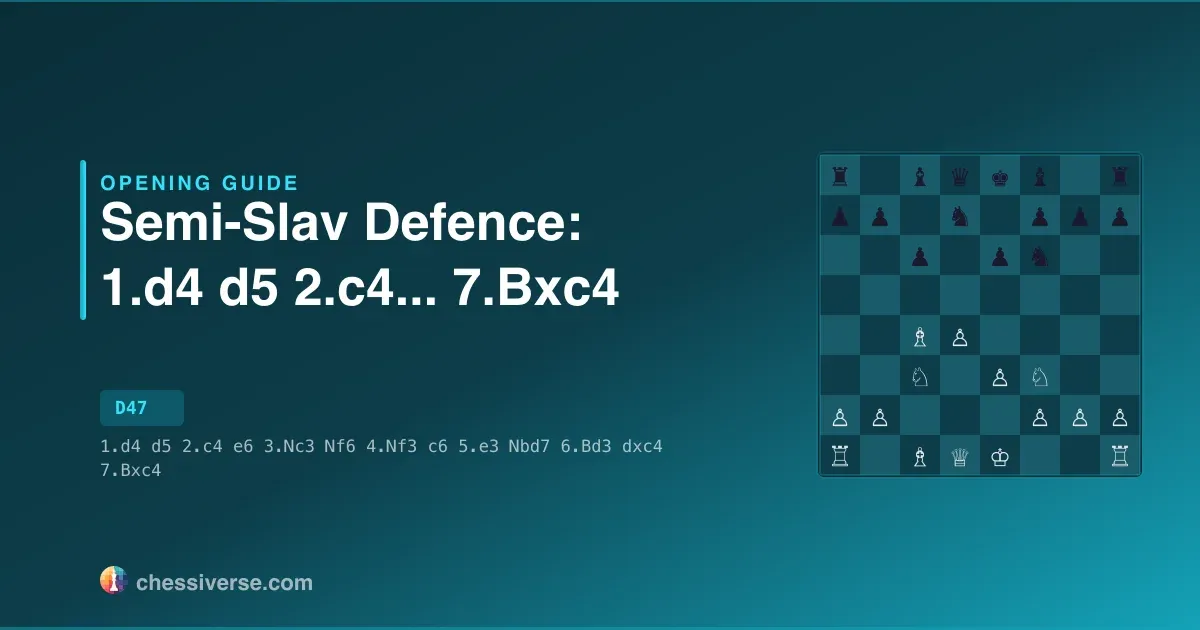
Starting from 1.d4 d5 2.c4 e6 3.Nc3 Nf6 4.Nf3 c6 5.e3 Nbd7 6.Bd3 dxc4 7.Bxc4, players enter the Semi-Slav Defense: Semi-Meran Variation — ECO D47. Lichess records 364,290 games in this line, which gives us a reliable view of how it actually performs in practice.
History and Notable Players
It arises from the Semi-Slav Defense: Main Line (6.Bd3). Among the most prolific White practitioners are Zdenko Kozul (54 games), Aleksej Aleksandrov (45 games), Boris Gelfand (35 games). Black-side regulars include Aleksey Dreev (70 games), Evgeny Sveshnikov (61 games), Igor A Novikov (52 games).
Performance Across Rating Levels
Popularity and results vary sharply by rating level. Among 1200-rated players, it appears in 0.00% of games — 3,474 of them on record — with White winning 46.3% and Black 50.7%. By 1800, popularity is 0.01% and White's score is 46% to Black's 48.6%. At the top end (2500+ Elo), popularity is 0.08% with 9.7% draws — a clear sign of how much theory rules the line at master level. Positions also become less sharp as level rises (sharpness 0.97 → 0.90).
Move Diversity and Theory Depth
What players actually play after the opening moves depends heavily on rating. At 1200 Elo (3,472 games), the top reply is b5, played 70% of the time. Three other moves each take at least 5% of games, and the top three moves account for 83.3% of games. Entropy: 1.71. By 2500 (10,514 games), b5 dominates at 96.7% of replies; no other move reaches 5% and the top three moves account for 99.6% of games. Entropy drops to 0.25. That entropy collapse is the signature of a line where preparation pays off: at the top, players know the best move and play it.
Historical Trends
Long-term, the trajectory of this opening is informative. Adoption peaked in 2015 at 0.02% (3,482 games). By 2025 it sits at 0.01%, 64% below the peak and 63% under its 2013 level, leaving the line in decline.
Main Lines and Variations
The main branches off 1.d4 d5 2.c4 e6 3.Nc3 Nf6 4.Nf3 c6 5.e3 Nbd7 6.Bd3 dxc4 7.Bxc4 include:
Each branch leads to a different middlegame character — the resulting pawn structure decides what kind of game you get.
Common Mistakes
- Drifting away from main theory — At 400 Elo, the three most-played moves cover 71.9% of games, against 96.2% at 2000. The most popular deviation is Nb6 (played 15% of the time at 400, much less so up top). It looks fine but quietly hands the better-prepared side an edge.
- Neglecting development — It can feel productive to make extra pawn moves early, but falling behind in piece development is what loses most amateur games — especially in open positions where active pieces find squares fast.
- Releasing tension too early — The c4/d5 tension is the heart of these openings. Capturing or pushing prematurely usually surrenders the initiative.
Practice on Chessiverse
Ready to try the Semi-Slav Defense: Semi-Meran Variation against a bot? Pick an opponent at your level and play a game.