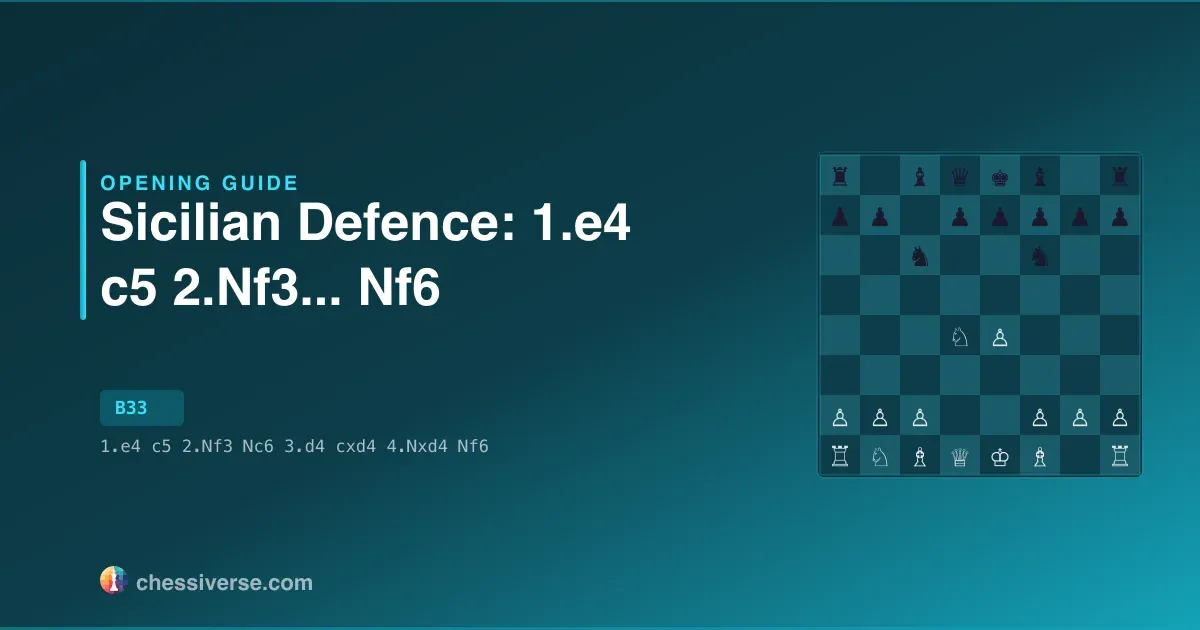
The Sicilian Defense: Open (4...Nf6) arises after 1.e4 c5 2.Nf3 Nc6 3.d4 cxd4 4.Nxd4 Nf6 and falls under ECO code B33. With 4...Nf6, Black launches the classic Sicilian counterattack by putting pressure on the e4 pawn, complementing the traditional themes of queenside play and the ...d5 pawn break. This move effectively forces 5. Nc3, as other responses are considered inferior. Once the knight arrives on c3, it blocks the c-pawn, which means White can no longer set up a Maroczy Bind with c4, a structure that would control d5 and make Black's equalizing ...d5 break extremely difficult or even impossible. With 9.6 million Lichess games across all rating levels, it is a well-established opening choice.
History and Notable Players
It arises from the Sicilian Defense: Open. Among the most prolific practitioners on the White side are Oleg Korneev (89 games), Janis Klovans (74 games), Thomas Luther (67 games). On the Black side, notable exponents include Vladimir Kramnik (117 games), Vasilios Kotronias (116 games), Zdenko Kozul (108 games).
Statistics
Based on 9.6 million Lichess games across all rating levels:
- White wins: 46.3%
- Black wins: 48.4%
- Draws: 5.2%
Interestingly, Black scores well in this opening, suggesting it offers strong counterplay.
Main Lines and Variations
After 1.e4 c5 2.Nf3 Nc6 3.d4 cxd4 4.Nxd4 Nf6, the main continuations include:
- Sicilian Defense: Lasker-Pelikan Variation
- Sicilian Defense: Four Knights Variation
- Sicilian Defense: Classical Variation
Each of these lines leads to distinct types of positions and requires its own understanding of the resulting pawn structures and piece placements.
Common Mistakes to Avoid
- Ignoring the opponent's kingside attack: In many Sicilian lines, White will castle queenside and push pawns toward your king. If you don't create counterplay on the queenside or in the center, White's attack will arrive first.
Practice on Chessiverse
The best way to learn the Sicilian Defense: Open (4...Nf6) is through practice. On Chessiverse, you can play chess against computer opponents that specialize in this opening. Our AI bots range from beginner to grandmaster level, each with unique playing styles — from aggressive attackers to solid defenders. Choose a bot that matches your rating and work your way up as you master the opening's key ideas.
Performance Across Rating Levels
Popularity and results vary sharply by rating level. The 1200 bracket has 324,417 games (0.05% of all games at that level); White wins 46.5%, Black 49.8%, 3.6% are drawn. At 1800 the opening surfaces in 0.33% of games; White wins 45.8%, Black 49.2%, draws 4.9%. At the top end (2500+ Elo), popularity is 0.67% with 9.6% draws — a clear sign of how much theory rules the line at master level.
Time Control Patterns
Time control matters here: blitz players reach for this opening more than others. In bullet, it appears in 0.16% of games (4,318,613); White wins 47.1%. Blitz shows 0.22% adoption across 8,060,218 games, White scoring 46.5%. In rapid, the share rises to 0.14% — 1,534,343 games, White 45.4%.
Move Diversity and Theory Depth
What players actually play after the opening moves depends heavily on rating. At 1200 Elo (324,417 games), the top reply is Nc3, played 54.8% of the time. One other move takes at least 5% of games, and the top three moves account for 93.8% of games. Entropy: 1.57. By 2500 (91,860 games), Nc3 dominates at 98% of replies; no other move reaches 5% and the top three moves account for 99.9% of games. Entropy drops to 0.17. That entropy collapse is the signature of a line where preparation pays off: at the top, players know the best move and play it.
Historical Trends
Year-over-year data tells you whether this opening is a contemporary fixture or a fading one. Adoption peaked in 2020 at 0.29% (1,649,437 games). By 2025 it sits at 0.16%, 44% below the peak and 20% under its 2013 level, leaving the line in decline.