

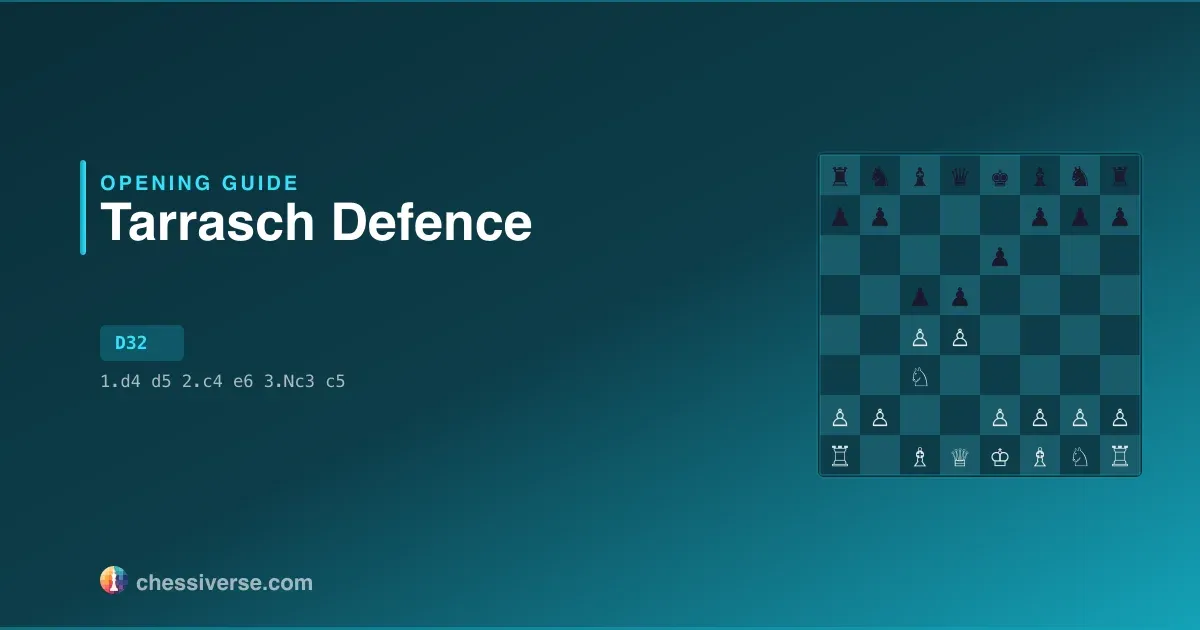
Starting from 1.d4 d5 2.c4 e6 3.Nc3 c5, players enter the Tarrasch Defense — ECO D32. Black strikes the centre immediately and accepts an isolated queen pawn as the price of admission. The Tarrasch is the QGD's aggressive cousin — active pieces, half-open files, and a structural debate that defines the whole middlegame.
Strategic Overview
The Tarrasch is built around a single strategic bargain: Black accepts an isolated queen pawn (IQP) in exchange for active piece play, the bishop pair potential, and a freer position than typical QGD lines. After 4.cxd5 exd5, Black usually ends up with the pawn on d5 with no neighbouring c- or e-pawns to support it — the classic isolated queen pawn. The IQP is both a weakness (it can be blockaded and attacked in endgames) and a strength (it controls central squares and gives Black's pieces excellent outposts on e4 and c4). The whole middlegame becomes a structural debate: White wants to trade pieces and head for an endgame where the IQP is just weak, Black wants to keep pieces on and use the active position to create kingside threats. Many strong players avoid the Tarrasch precisely because of the IQP issue and prefer the Semi-Tarrasch (which avoids the structure). 4.cxd5 is the principled main line — it locks in the IQP and gives White something concrete to play against. 4.e3 is White's quieter sideline that quickly leads to symmetrical equality after both sides develop normally. The Tarrasch isn't an opening for everyone, but for players who like active piece play and don't mind defending an IQP, it's a serious weapon.
Key Ideas
When players succeed in this line, they usually do so by leaning on the following themes:
- The isolated queen pawn is the central trade-off — Black accepts that d5 will be an isolated pawn in exchange for piece activity and the bishop pair. Whether the IQP is a strength or weakness depends entirely on how many pieces stay on the board — Black wants to keep them, White wants to trade.
- Active pieces are the compensation — The isolated pawn comes with benefits: open lines for the rooks, an excellent outpost on e4 for a knight, and the freed light-squared bishop. Black plays for kingside attacks and piece pressure while the structural weakness is still latent rather than felt.
- 4.cxd5 is the principled main line — White locks in the IQP structure and gets something concrete to play for. This is the test of the Tarrasch — if Black can hold the IQP positions, the opening is sound; if not, it's a long-term problem.
- 4.e3 leads to symmetrical equality — The sideline 4.e3 avoids the structural fight entirely. After both sides develop their knights the position becomes nearly symmetrical, and the opening fight effectively ends in a draw before any real tension develops.
- The Semi-Tarrasch dodges the IQP problem — Many players who like Tarrasch ideas prefer the Semi-Tarrasch move-order instead, which gets similar piece-activity benefits without the isolated pawn structure. The cost is less active play, but the structural foundation is sounder.
History and Notable Players
It arises from the Queen's Gambit Declined: Queen's Knight Variation. Among the most prolific White practitioners are Frank James Marshall (56 games), Milan Sr Vidmar (24 games), Rainer Knaak (20 games). Black-side regulars include Antonio Frois (36 games), Paul Michel (30 games), Slavoljub Marjanovic (28 games).
Tarrasch promoted the defence as a challenge to the Steinitz-era view that an isolated pawn was simply a weakness, arguing that Black's piece mobility was full compensation. Long treated with suspicion, it is considered sound today, and in the 2010s Daniil Dubov's 7...cxd4 8.Nxd4 Bc5 treatment revived it at elite level.
Named after: Siegbert Tarrasch, the German master who championed Black's early ...c5 strike despite widespread scepticism about the resulting isolated pawn.
Notable players: Siegbert Tarrasch, Daniil Dubov
Tarrasch was so convinced by his own defence that in his book Die moderne Schachpartie he gave its moves an exclamation mark while attaching question marks to the alternative Queen's Gambit lines.
Performance Across Rating Levels
Popularity and results vary sharply by rating level. At 1200 Elo, the opening shows up in 0.04% of games (296,715 samples). White scores 50.9%, Black 45.4%, draws 3.7%. At 1800 the opening surfaces in 0.07% of games; White wins 49.5%, Black 45.5%, draws 5%. At 2500, 0.19% of games go into this opening; draws sit at 11.6% — the line is well-mapped at this level. White's edge erodes by 6.7pp from 1200 to 2500 Elo, suggesting Black's counterplay is easier to find with experience.
Time Control Patterns
The Tarrasch Defense skews toward bullet chess. In bullet, it appears in 0.07% of games (1,983,149); White wins 49%. Blitz shows 0.07% adoption across 2,406,843 games, White scoring 49.4%. In rapid, the share rises to 0.05% — 513,621 games, White 50.5%.
Move Diversity and Theory Depth
What players actually play after the opening moves depends heavily on rating. At 1200 Elo (296,043 games), the top reply is Nf3, played 30.1% of the time. Four other moves each take at least 5% of games, and the top three moves account for 75.7% of games. Entropy: 2.48. By 2500 (25,725 games), cxd5 takes over as the top reply at 78.4%; only two other moves still reach 5% and the top three moves account for 98.3% of games. Entropy drops to 1.05. That entropy collapse is the signature of a line where preparation pays off: at the top, players know the best move and play it.
Historical Trends
Tracking the Tarrasch Defense year over year shows a clear story. Adoption peaked in 2018 at 0.08% (140,724 games). By 2025 it sits at 0.06%, 24% below the peak and 12% under its 2013 level, leaving the line in decline.
Main Lines and Variations
The main branches off 1.d4 d5 2.c4 e6 3.Nc3 c5 include:
Each branch leads to a different middlegame character — the resulting pawn structure decides what kind of game you get.
Common Mistakes
- Drifting away from main theory — At 400 Elo, the three most-played moves cover 71.7% of games, against 89% at 2000. The most popular deviation is dxc5 (played 12.6% of the time at 400, less so up top). It looks fine but quietly hands the better-prepared side an edge.
- Neglecting development — It can feel productive to make extra pawn moves early, but falling behind in piece development is what loses most amateur games — especially in open positions where active pieces find squares fast.
- Playing without a plan — Each Tarrasch Defense middlegame demands a specific approach. Decide whether the position calls for attack, manoeuvre, or simplification before reaching for a move.
Practice on Chessiverse
Ready to try the Tarrasch Defense against a bot? Pick an opponent at your level and play a game.