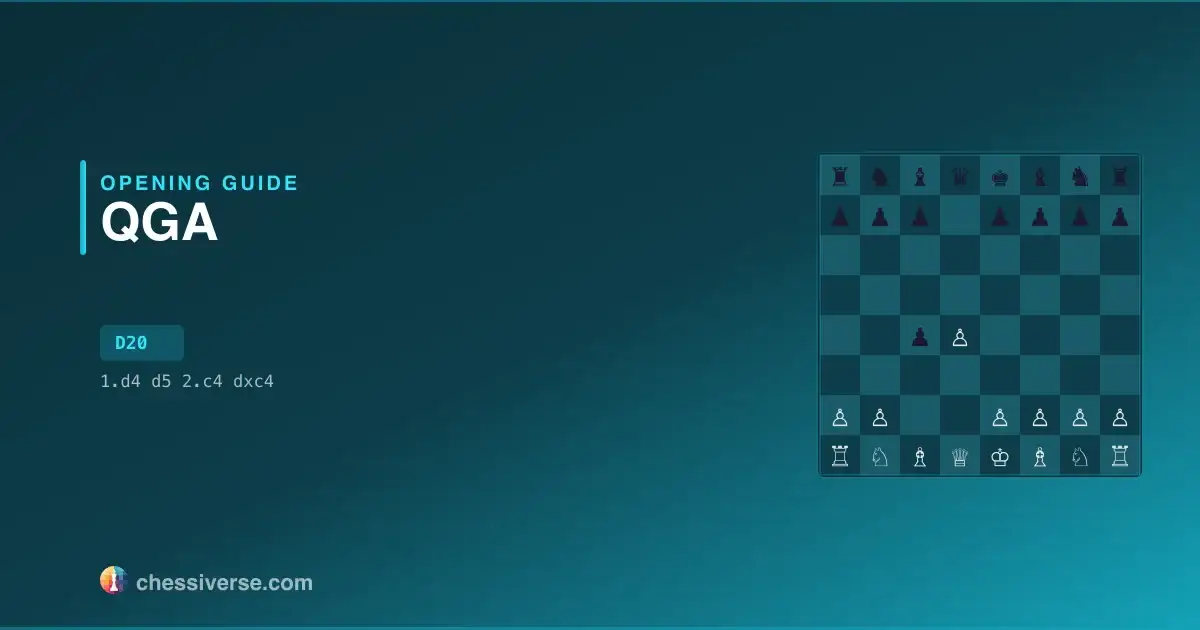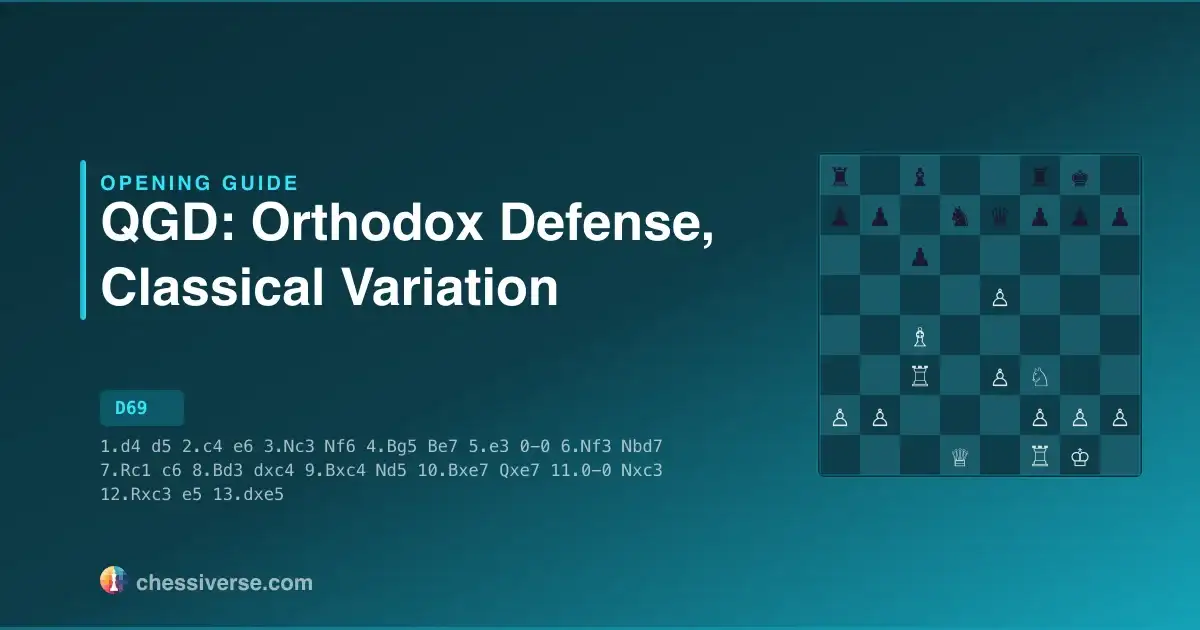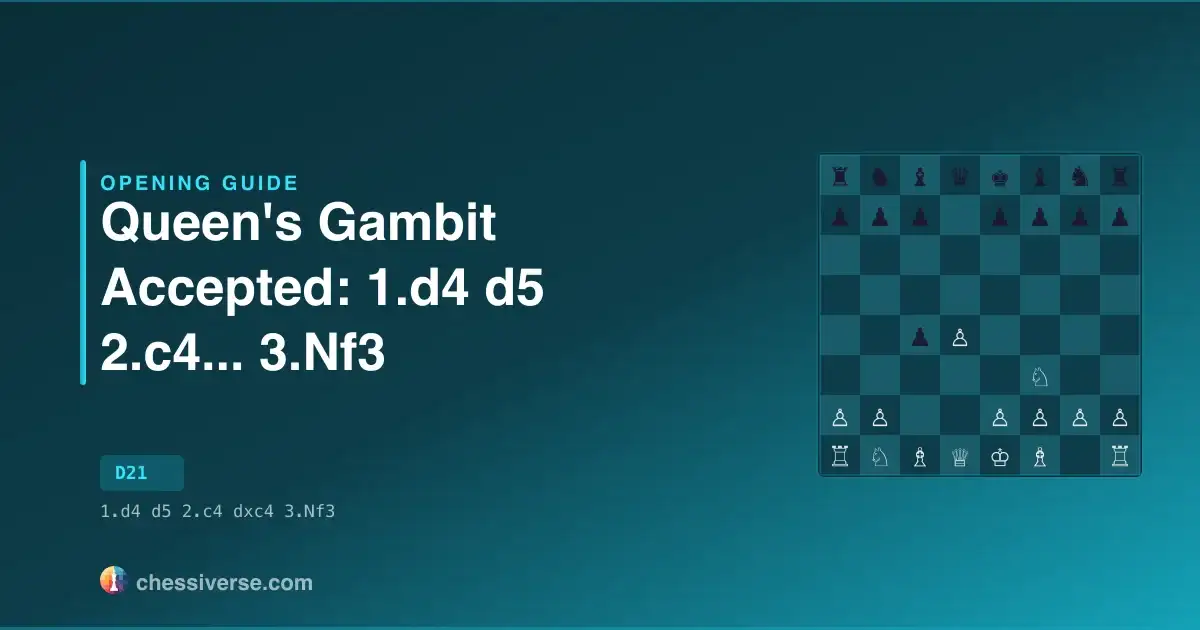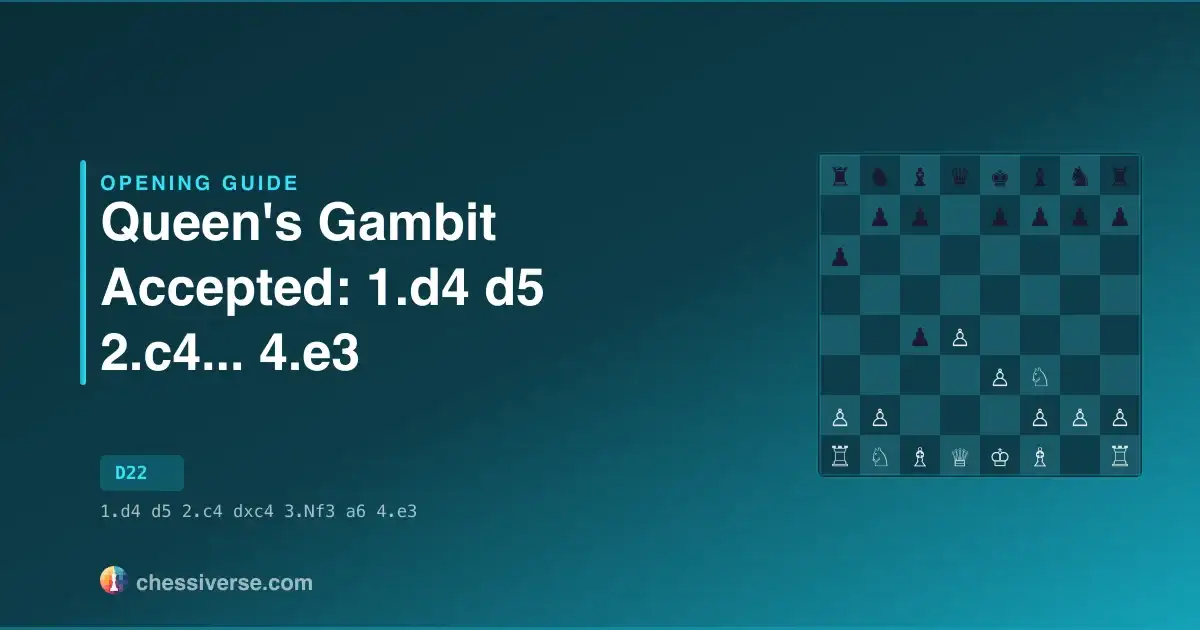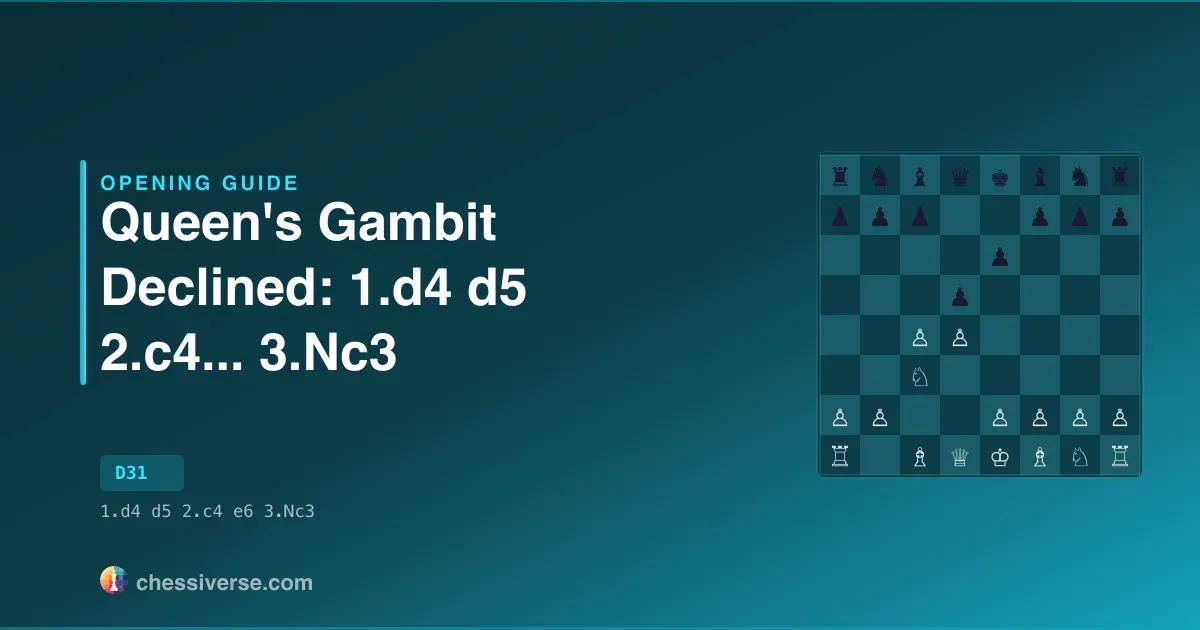
1.d4 d5 2.c4 e6 3.Nc3 opens the Queen's Gambit Declined: Queen's Knight Variation, ECO D31. White develops a knight and applies a third unit of pressure to d5. The move also prepares the e4 break — the central pawn push that haunts every Queen's Gambit line.
Strategic Overview
3.Nc3 is one of the two principal third moves for White in the QGD (the other being 3.Nf3). The knight does several jobs at once: it adds pressure on d5, controls the e4 square, develops a piece, and prepares the long-term goal of pushing e4 to claim the centre. Black has several solid replies. The most common is 3...Nf6, developing toward the standard QGD main lines. 3...c6 enters Semi-Slav territory and creates the classic structural battle, but it has a tactical drawback — the knight on c6 no longer defends g5, which lets White play the aggressive Bg5 pinning the knight, or even the sharp 4.e4!? entering the Marshall Gambit where White sacrifices a pawn for piece activity and king-side threats. 3...c5 is the Tarrasch Defense, an aggressive central counter that accepts an isolated queen pawn in exchange for active piece play and a freer position. Each of these third moves leads to a different style of game, and the choice depends on whether Black wants solid manoeuvring (Nf6), classical Slav structures (c6), or sharp active play (c5).
Key Ideas
When players succeed in this line, they usually do so by leaning on the following themes:
- Nc3 pressures d5 and prepares e4 — The knight adds a third attacker to d5 and controls the e4 square. Both functions matter — Black has to keep defending the central pawn while watching for White's eventual e4 push, which can crack the position open.
- ...c6 unblocks the queenside but invites Bg5 ideas — Playing ...c6 to support d5 is solid but has a hidden cost: the queen no longer protects g5. White can pin the f6-knight with 4.Bg5 or even go for the wild 4.e4!? Marshall Gambit, sacrificing material for active piece play and king attacks.
- 3...c5 is the active Tarrasch — Striking the centre with ...c5 immediately leads to the Tarrasch Defense. Black usually accepts an isolated queen pawn in exchange for piece activity and the bishop pair potential — an aggressive choice that fights for the initiative early.
History and Notable Players
It arises from the Queen's Gambit Declined. On the White side, Frank James Marshall (185 games), Viktor Korchnoi (132 games), Wolfgang Uhlmann (113 games) top the database. Notable Black exponents: Oleg Korneev (167 games), Evgeny Sveshnikov (163 games), Rafael A Vaganian (122 games).
Performance Across Rating Levels
The picture changes a lot as you climb the rating ladder. At 1200 Elo, the opening shows up in 0.44% of games (2,946,726 samples). White scores 52.9%, Black 43.3%, draws 3.8%. By 1800, popularity is 1.28% and White's score is 51.2% to Black's 43.6%. At 2500, 1.63% of games go into this opening; draws sit at 11% — the line is well-mapped at this level. White's edge erodes by 6.6pp from 1200 to 2500 Elo, suggesting Black's counterplay is easier to find with experience.
Time Control Patterns
Time control matters here: blitz players reach for this opening more than others. In bullet, it appears in 0.90% of games (24,033,186); White wins 52.3%. Blitz shows 0.91% adoption across 32,852,155 games, White scoring 51.4%. In rapid, the share rises to 0.64% — 7,066,113 games, White 51.9%.
Move Diversity and Theory Depth
Move choice is far from uniform in the Queen's Gambit Declined: Queen's Knight Variation. At 1200 Elo (2,940,268 games), the top reply is Nf6, played 44.5% of the time. Five other moves each take at least 5% of games, and the top three moves account for 74.7% of games. Entropy: 2.43. By 2500 (221,579 games), Nf6 is still the top reply, at 47.9%; only four other moves still reach 5% and the top three moves account for 74.3% of games. Entropy drops to 2.35. Even elite players don't fully agree on the best continuation here, which keeps the position dynamic.
Historical Trends
Tracking the Queen's Gambit Declined: Queen's Knight Variation year over year shows a clear story. Adoption peaked in 2015 at 1.09% (241,691 games). By 2025 it sits at 0.77%, 29% below the peak and 21% under its 2013 level, leaving the line in decline.
Main Lines and Variations
After 1.d4 d5 2.c4 e6 3.Nc3, the established follow-ups are:
Each branch leads to a different middlegame character — the resulting pawn structure decides what kind of game you get.
Common Mistakes
- Drifting away from main theory — At 400 Elo, the three most-played moves cover 68.5% of games, against 83.6% at 2000. The most popular deviation is dxc4 (played 25.5% of the time at 400, much less so up top). It looks fine but quietly hands the better-prepared side an edge.
- Neglecting development — Extra pawn moves in the opening are tempting, especially when you "know the moves". Developing a piece each turn is the simple correction.
- Overextending the attack — Gambits look like permission to throw everything forward. They aren't — every attacking move should improve a piece. Random checks and threats burn the initiative once they fail to coordinate.
Practice on Chessiverse
Ready to try the Queen's Gambit Declined: Queen's Knight Variation against a bot? Pick an opponent at your level and play a game.