



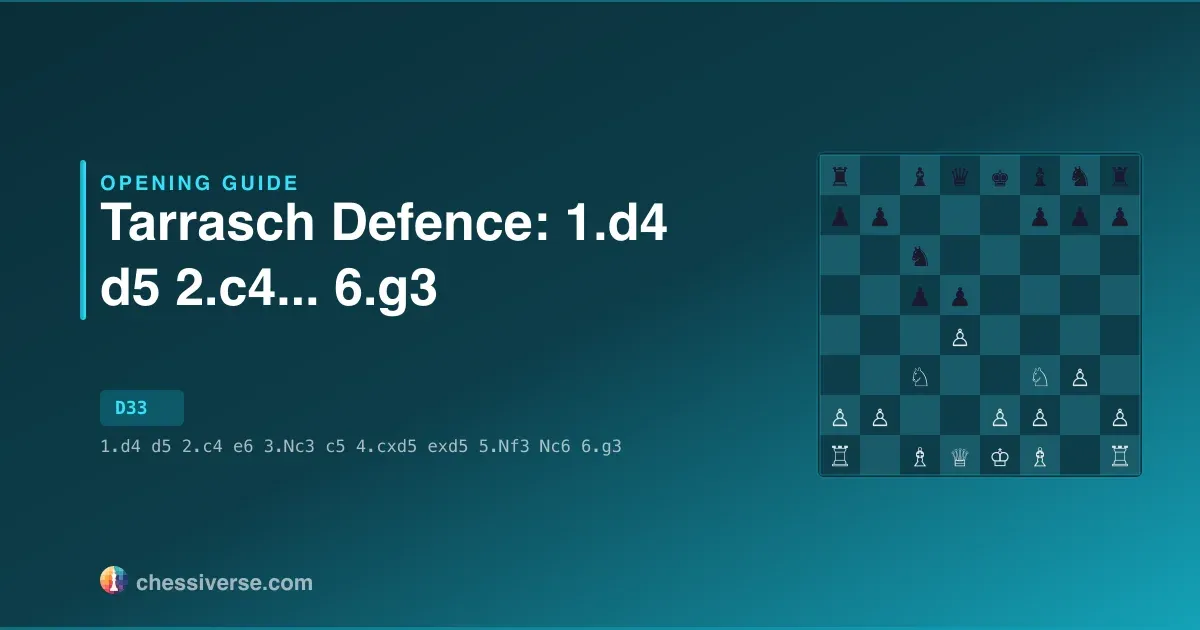
The Tarrasch Defense: Rubinstein System begins with 1.d4 d5 2.c4 e6 3.Nc3 c5 4.cxd5 exd5 5.Nf3 Nc6 6.g3 (ECO D33). With 165,228 games on record, the patterns below come from the largest practical sample available.
History and Notable Players
It arises from the Tarrasch Defense. On the White side, Frank James Marshall (24 games), Akiba Rubinstein (16 games), Wolfgang Uhlmann (15 games) top the database. Notable Black exponents: Milan Orsag (36 games), Paul Michel (28 games), Antonio Frois (27 games).
Performance Across Rating Levels
Popularity and results vary sharply by rating level. At 1200 Elo, the opening shows up in 0.00% of games (1,413 samples). White scores 55.8%, Black 41%, draws 3.2%. At 1800 the opening surfaces in 0.00% of games; White wins 54.5%, Black 39.8%, draws 5.7%. At the top end (2500+ Elo), popularity is 0.08% with 13.7% draws — a clear sign of how much theory rules the line at master level. White's edge erodes by 12.4pp from 1200 to 2500 Elo, suggesting Black's counterplay is easier to find with experience.
Move Diversity and Theory Depth
Looking at move selection shows how forcing — or not — the position really is. At 1200 Elo (1,410 games), the top reply is Nf6, played 44.3% of the time. Five other moves each take at least 5% of games, and the top three moves account for 68.4% of games. Entropy: 2.62. By 2500 (10,263 games), Nf6 dominates at 94.3% of replies; no other move reaches 5% and the top three moves account for 99.2% of games. Entropy drops to 0.41. The narrowing is significant — strong players consolidate around a small set of best moves, while amateurs scatter across many plausible-looking options.
Main Lines and Variations
From the position after 1.d4 d5 2.c4 e6 3.Nc3 c5 4.cxd5 exd5 5.Nf3 Nc6 6.g3, the recognised continuations are:
Each branch leads to a different middlegame character — the resulting pawn structure decides what kind of game you get.
Common Mistakes
- Drifting away from main theory — At 1000 Elo, the three most-played moves cover 67.8% of games, against 91.3% at 2000. The most popular deviation is cxd4 (played 15.6% of the time at 1000, much less so up top). It looks fine but quietly hands the better-prepared side an edge.
- Neglecting development — Extra pawn moves in the opening are tempting, especially when you "know the moves". Developing a piece each turn is the simple correction.
- Playing without a plan — Each Tarrasch Defense: Rubinstein System middlegame demands a specific approach. Decide whether the position calls for attack, manoeuvre, or simplification before reaching for a move.
Practice on Chessiverse
Ready to try the Tarrasch Defense: Rubinstein System against a bot? Pick an opponent at your level and play a game.