



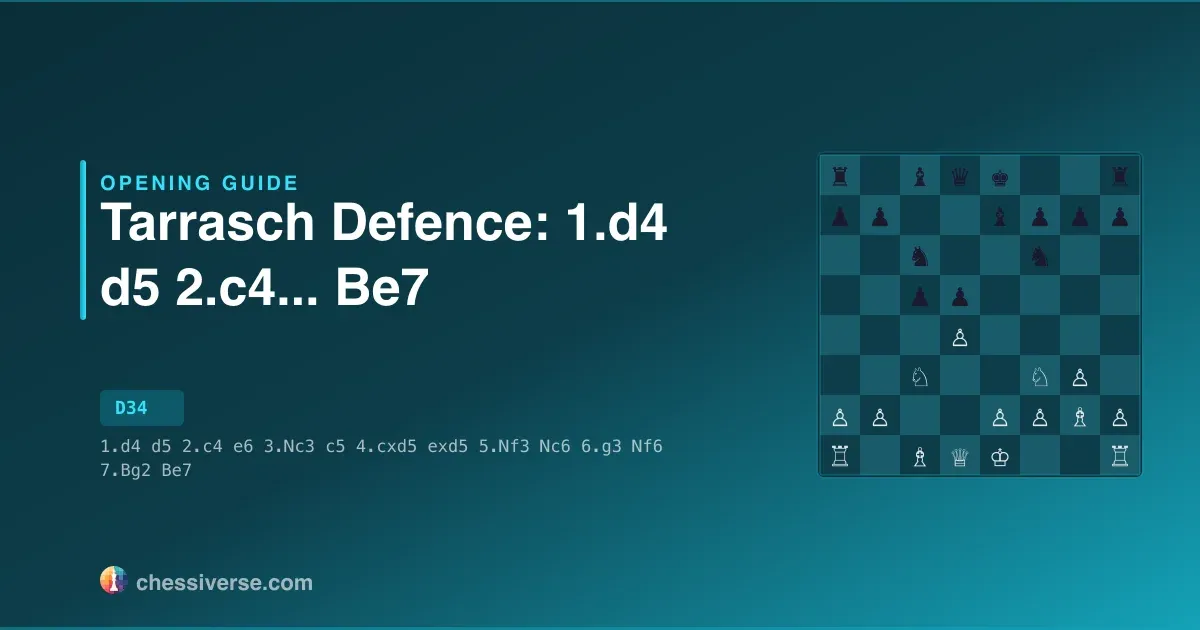
The Tarrasch Defense: Prague Variation, Main Line begins with 1.d4 d5 2.c4 e6 3.Nc3 c5 4.cxd5 exd5 5.Nf3 Nc6 6.g3 Nf6 7.Bg2 Be7 (ECO D34). Across rating levels it shows up in 132,961 recorded games — enough data to map exactly where it succeeds and where it stalls.
History and Notable Players
It arises from the Tarrasch Defense: Rubinstein System. On the White side, Wolfgang Uhlmann (22 games), Mikhail Gurevich (12 games), Ivan Farago (12 games) top the database. Notable Black exponents: Milan Orsag (40 games), Antonio Frois (29 games), Goran M Todorovic (28 games).
Performance Across Rating Levels
How well the Tarrasch Defense: Prague Variation, Main Line works depends on what level you're playing at. At 1200 Elo, the opening shows up in 0.00% of games (675 samples). White scores 50.1%, Black 46.8%, draws 3.1%. At 1800 the opening surfaces in 0.00% of games; White wins 51.7%, Black 42.2%, draws 6.2%. At the top end (2500+ Elo), popularity is 0.05% with 12.6% draws — a clear sign of how much theory rules the line at master level. White's edge erodes by 4.6pp from 1200 to 2500 Elo, suggesting Black's counterplay is easier to find with experience.
Move Diversity and Theory Depth
What players actually play after the opening moves depends heavily on rating. At 1200 Elo (675 games), the top reply is O-O, played 61.1% of the time. Three other moves each take at least 5% of games, and the top three moves account for 81.7% of games. Entropy: 2.02. By 2500 (7,146 games), O-O dominates at 93.1% of replies; only one other move still reaches 5% and the top three moves account for 99.7% of games. Entropy drops to 0.43. The narrowing is significant — strong players consolidate around a small set of best moves, while amateurs scatter across many plausible-looking options.
Common Mistakes
- Drifting away from main theory — At 1000 Elo, the three most-played moves cover 84% of games, against 98.4% at 2000. The most popular deviation is dxc5 (played 13.9% of the time at 1000, much less so up top). It looks fine but quietly hands the better-prepared side an edge.
- Neglecting development — Extra pawn moves in the opening are tempting, especially when you "know the moves". Developing a piece each turn is the simple correction.
- Playing without a plan — Each Tarrasch Defense: Prague Variation, Main Line middlegame demands a specific approach. Decide whether the position calls for attack, manoeuvre, or simplification before reaching for a move.
Practice on Chessiverse
Ready to try the Tarrasch Defense: Prague Variation, Main Line against a bot? Pick an opponent at your level and play a game.