



Chess Jargon for Beginners: 25 Buzzwords Explained (With Boards)
The chess terms every beginner needs fall into five groups: board basics (rank, file, diagonal, center), game states (check, checkmate, stalemate, draw), special moves (castling, en passant, promotion), tactics (fork, pin, skewer, blunder), and strategy words like tempo, gambit and zugzwang.
Why Chess Has Its Own Language
You hear these words in videos, streams and post-game chat long before anyone explains them. Wikipedia's glossary has over 300 entries, which is a reference work rather than a way in. This page has 25, grouped by when you will meet them, each with a plain definition and the phrase people actually say.
The 25 Terms at a Glance
- Board basics: rank, file, diagonal, the center.
- Game states: check, checkmate, stalemate, draw, resign.
- Special moves and rules: castling, en passant, promotion, capture.
- Tactics: fork, pin, skewer, discovered attack, blunder, hanging.
- Strategy and culture: development, tempo, gambit, fianchetto, zugzwang, Elo.
Read the group that matches whatever confused you today. Nothing here depends on anything above it, so the order is a convenience rather than a curriculum.

Board Basics: 4 Words for Finding Your Way Around
These four words are how every other explanation in chess describes where things are. Get them wrong and every sentence in every tutorial becomes slightly harder to follow. They take about a minute to learn and you will use them for the rest of your chess life.
Rank
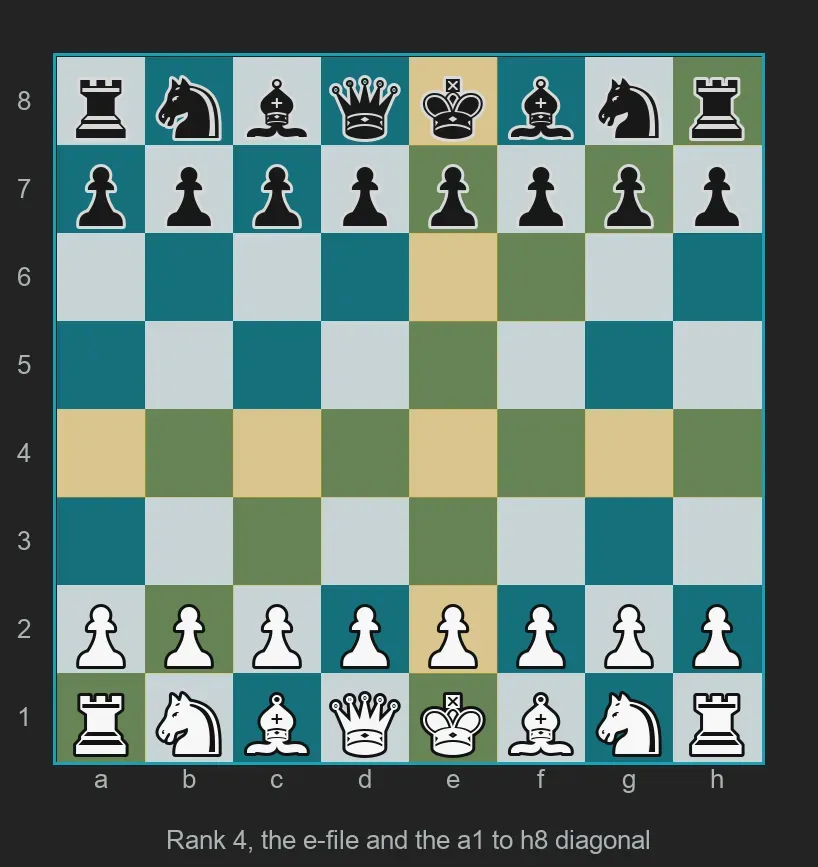
A rank is a horizontal row of eight squares, numbered 1 to 8 from White's side of the board. Rank 1 is where White's pieces start and rank 8 is where Black's do. The most talked-about ranks are the first and the eighth, because that is where the kings live and where back-rank checkmates happen, and the seventh, because a rook that lands there attacks a whole row of pawns at once.
You will hear it like: "get your rook to the seventh rank."
File
A file is a vertical column of eight squares, labeled a to h from left to right as White sees the board. Files matter because rooks and queens travel along them, and because a file with no pawns on it is called open and becomes a highway straight into the enemy position. Half the strategic talk in chess is about which file will open and who gets a rook there first.
You will hear it like: "he doubled his rooks on the d-file."
Diagonal
A diagonal is a slanting line of same-colored squares, and it is how bishops and queens move. The two longest ones run corner to corner, a1 to h8 and h1 to a8, and are called the long diagonals. Because a bishop can never change square color, each one owns exactly half the board forever, which is why players talk about light-squared and dark-squared bishops as if they were different pieces.
You will hear it like: "the bishop is raking the long diagonal."
The Center
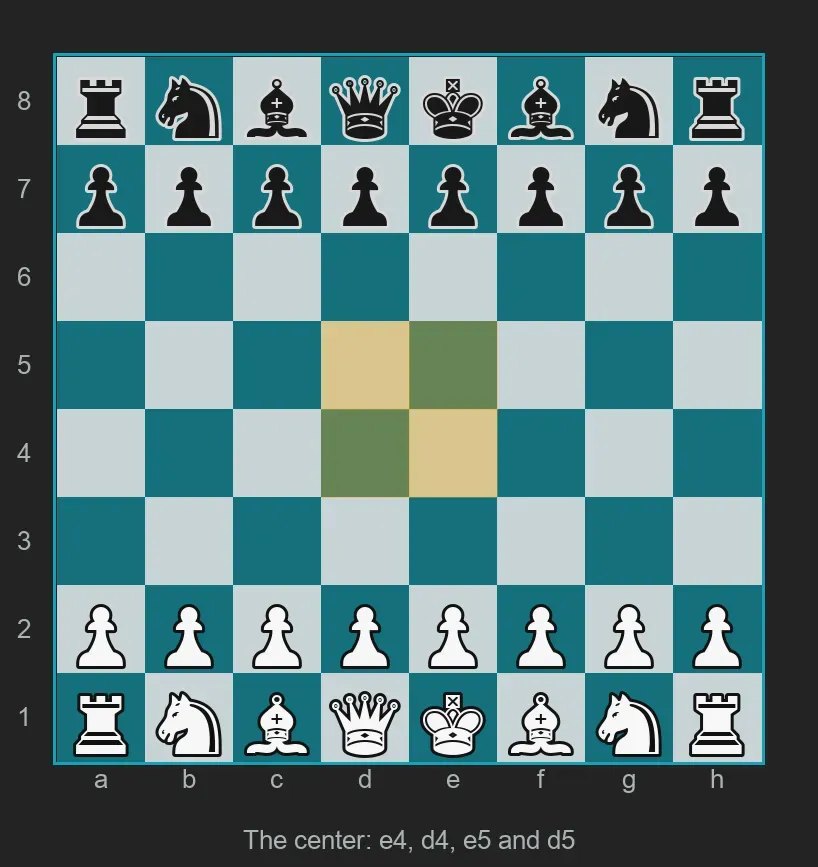
The center means the four squares d4, e4, d5 and e5, and sometimes the ring of squares around them. It matters because pieces control more squares from the middle than from the edge: a knight in the center reaches eight squares, a knight in the corner reaches two. Whoever owns the center also decides where the game happens, because pieces there can switch from one wing to the other in a move. Almost every opening principle you will ever read is a different way of saying fight for these four squares.
You will hear it like: "she has a big center."
Game States: 5 Words That End (or Save) Games
These five decide how games finish, and two of them get confused constantly. The difference between checkmate and stalemate is worth more rating points than any opening you will ever learn, because it is the difference between winning and drawing a position you already control.
Check
Check means the king is under attack right now. You may not ignore it, so you have exactly three legal responses: move the king, capture the attacker, or put something in the way. Check is not a goal in itself, and beginners give a lot of pointless checks. A check that does not improve your position simply hands your opponent a free developing move, so ask what the check achieves before you play it.
You will hear it like: "check, and he had to move the king."
Checkmate
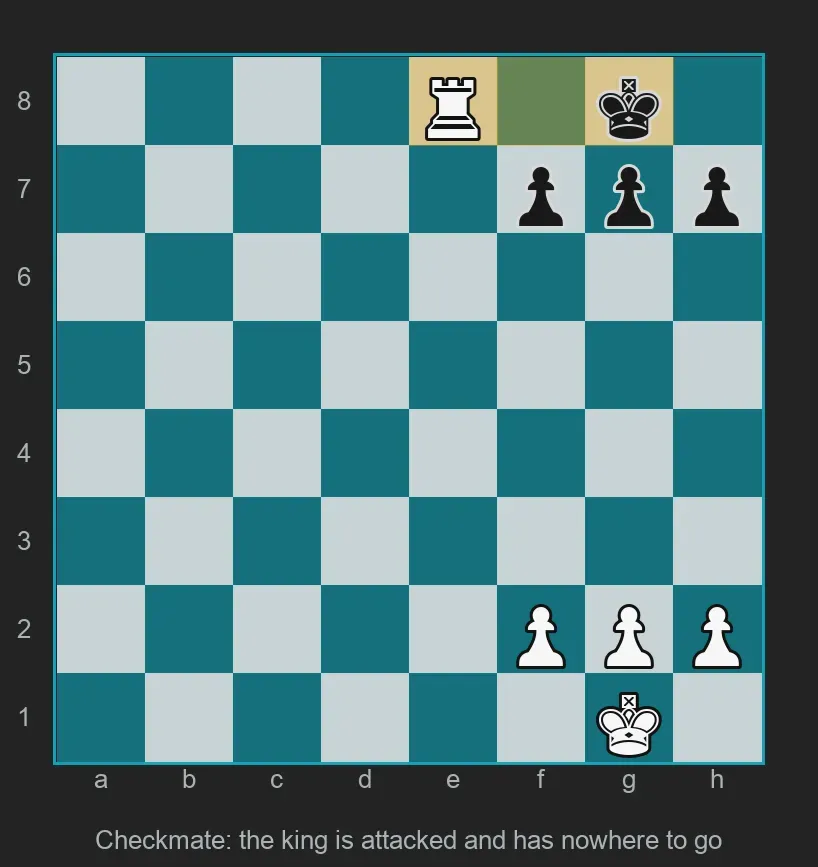
Checkmate is check with no legal escape, and it ends the game immediately. The board below shows the most common pattern of all: a rook arrives on the back rank, the king is attacked, and its own pawns block every square it could run to. Notice that nothing is captured and nothing is counted. The moment the king is attacked and every response is illegal, the game is over regardless of material.
You will hear it like: "that's mate in two."
Stalemate
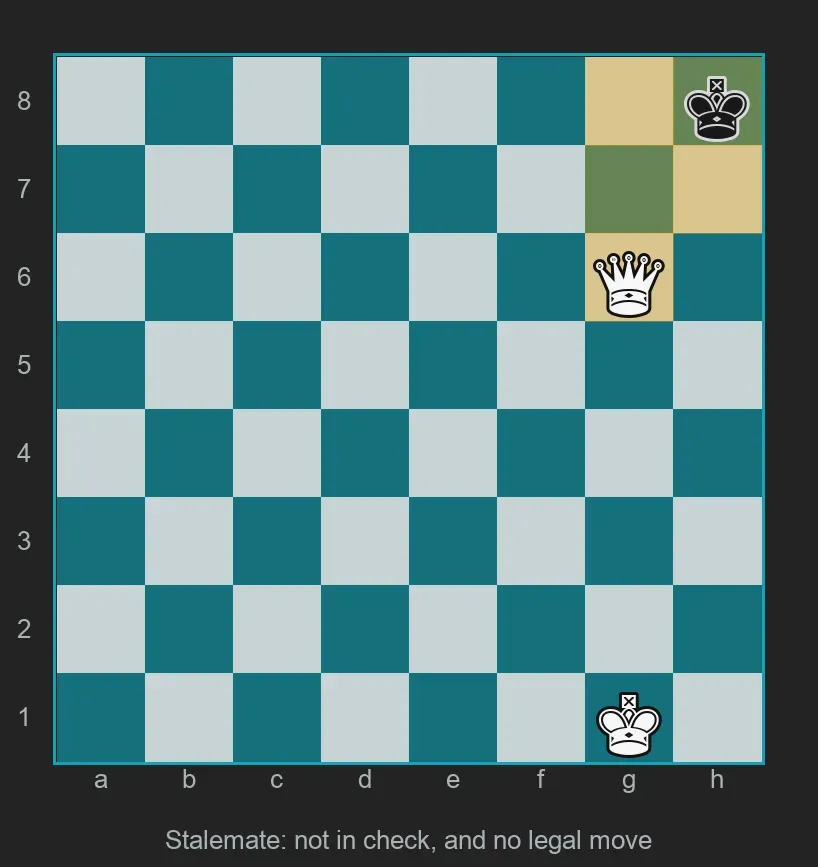
Stalemate is the opposite trap: the player to move is not in check and has no legal move at all. The game is an immediate draw, no matter who is winning on material. In the board below, Black is down a queen and saves the game because the white queen has covered every square the king could use without attacking the king itself. Winning positions are thrown away this way constantly.
You will hear it like: "he had a queen up and stalemated him."
Draw
A draw is a game where neither side wins, and it is worth half a point each. There are five ways to reach one: agreement, stalemate, threefold repetition of the same position, the fifty move rule when no pawn moves and no captures happen for fifty moves, and insufficient material, meaning neither side has enough pieces to force checkmate. Two lone kings is the simplest example of the last one, and king against king and bishop is another.
You will hear it like: "they agreed to a draw on move 30."
Resign
To resign is to concede the game voluntarily, usually by stopping the clock or offering a handshake. Strong players resign when the position is beyond saving, because playing it out wastes both players' time. Beginners should almost never resign: at club level opponents blunder back constantly, and playing lost positions is where endgame technique is actually learned. Resign when you would be embarrassed to win from the other side.
You will hear it like: "he resigned rather than play the endgame."
Special Moves and Rules: 4 Words for the Weird Stuff
Three of these four are moves that break the normal rules, and between them they cause more confusion than the rest of the rulebook combined. If someone tells you their opponent cheated in an online game, one of these three is usually involved, and it usually was not cheating at all.
Castling
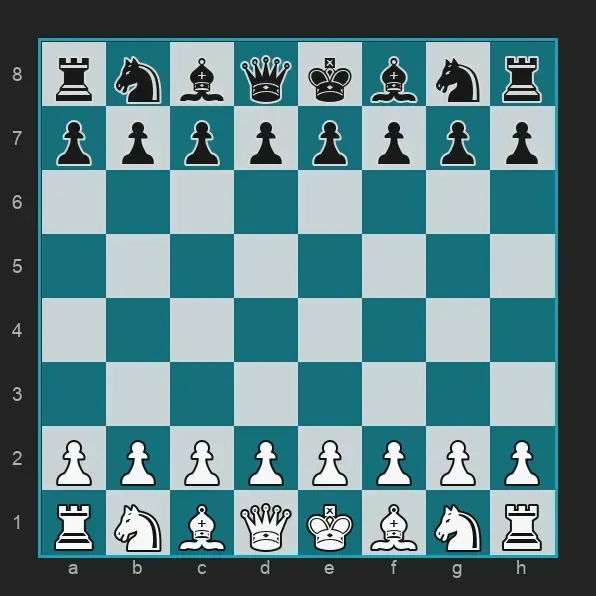
Castling is the only move where two pieces move at once. The king travels two squares toward a rook and that rook jumps over it to the far side, tucking the king behind a wall of pawns and bringing the rook into play in a single turn. It is written O-O kingside and O-O-O queenside. Six separate conditions can make it illegal, and our guide to why you sometimes cannot castle covers each one.
You will hear it like: "castle early and worry later."
En Passant
En passant, French for in passing, is a pawn capture that looks illegal. If your opponent moves a pawn two squares forward and it lands directly beside your pawn, you may capture it as if it had only moved one square, landing on the square it skipped. You must do it immediately, on the very next move, or the right disappears. It is the rule beginners most often mistake for a bug.
You will hear it like: "wait, he took my pawn en passant."
Promotion

When a pawn reaches the far side of the board it must immediately become a queen, rook, bishop or knight of its own color. Almost everyone chooses a queen, and the move is written with an equals sign: e8=Q. You can have several queens at once, which surprises people. Choosing something else is called underpromotion, and it is usually a knight, to deliver a check a queen could not.
You will hear it like: "he pushed the pawn and got a second queen."
Capture
A capture is removing an enemy piece by moving onto its square. Captured pieces leave the board permanently and never return. In notation a capture is marked with an x, so Bxf7 means a bishop captured whatever stood on f7. Pawns are the exception worth remembering: they move straight forward but capture diagonally, which is why a pawn can be blocked head on by a single enemy pawn and simply stop.
You will hear it like: "she just takes on f7 and it's over."

Tactics Talk: 6 Words Every Stream Mentions
Tactics are short forcing sequences that win material or the game, and these six words cover the great majority of what happens in games below master level. Every one of them is a pattern rather than a calculation, which means you learn them by seeing them repeatedly rather than by thinking harder.
Fork
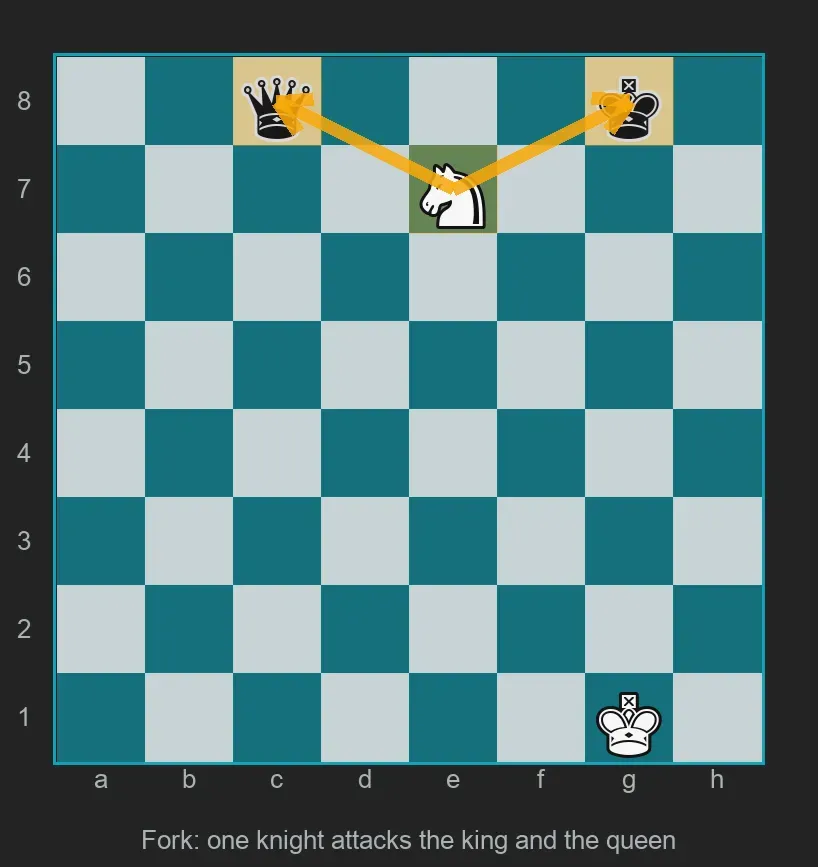
A fork is one piece attacking two or more targets at once, so your opponent can only save one of them. Knights are the classic forkers because their move shape is awkward to see coming, and a knight fork hitting king and queen at the same time is called a royal fork. In the board below, the black king must move out of check, and the queen is simply lost on the following move.
You will hear it like: "the knight forks king and queen."
Pin
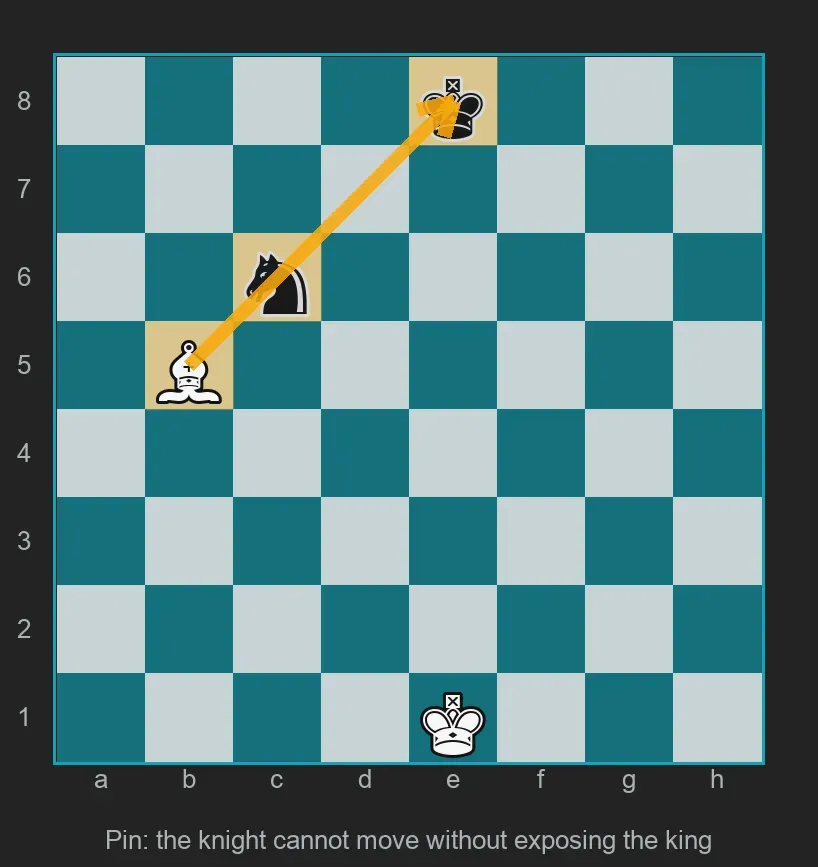
A pin is a piece that cannot move because something more valuable sits behind it on the same line. When the piece behind is the king, the pinned piece cannot move at all, which is called an absolute pin. Below, the knight on c6 is frozen: any move would expose the king on e8 to the bishop on b5. A pinned piece is a defender that is not really defending.
You will hear it like: "the knight is pinned, so just pile up on it."
Skewer
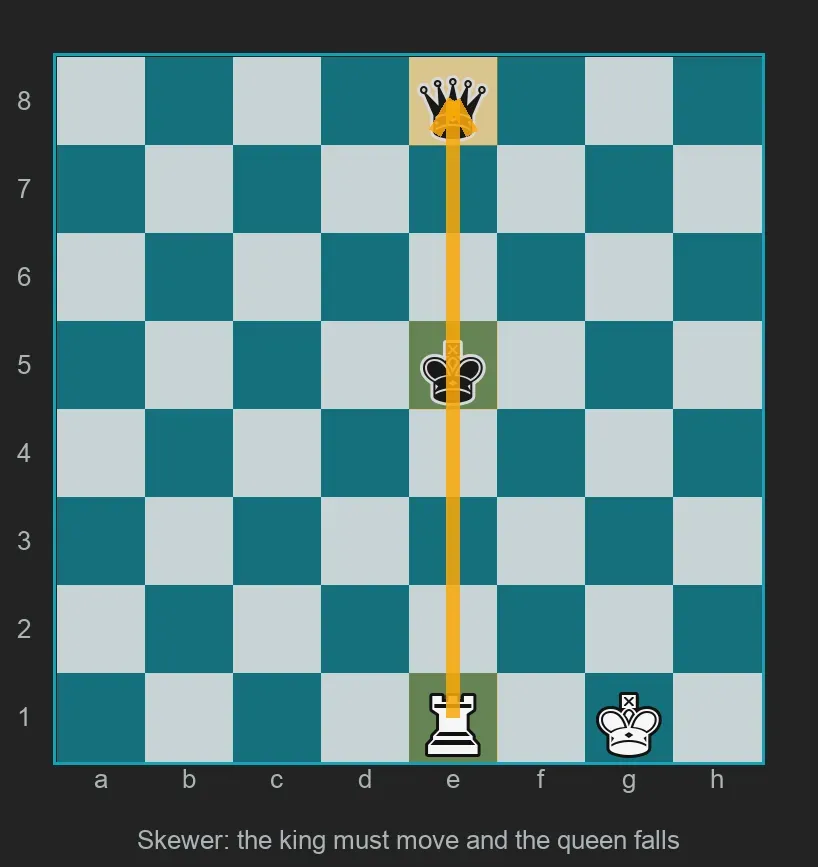
A skewer is a pin with the values reversed: the valuable piece stands in front and is forced to move, and you take whatever was hiding behind it. Below, a rook checks the king along an open file with the queen behind it, so the king steps aside and the rook collects the queen. Pin and skewer are the same geometry seen from two directions, which is why they are taught together.
You will hear it like: "she skewered the king and won the rook."
Discovered Attack
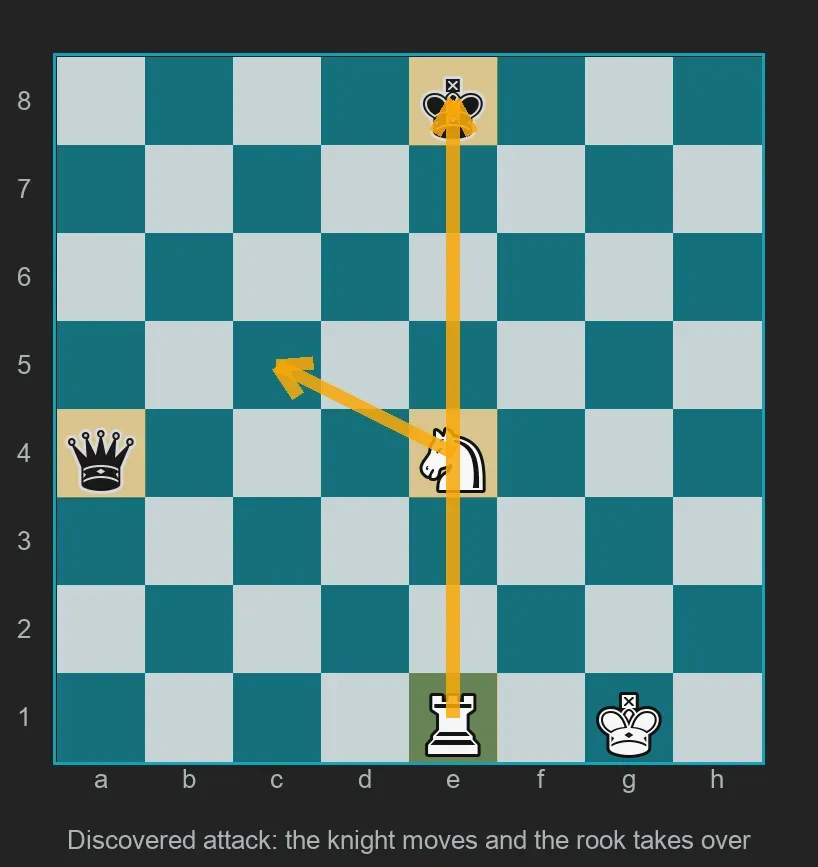
A discovered attack is when you move one piece and a different piece behind it suddenly does the damage. Because the moving piece can attack something on its way out, you make two threats with one move. When the uncovered threat is a check it is called a discovered check, and it is one of the most dangerous things on a board: the checked player must answer the check and cannot deal with the other threat.
You will hear it like: "the knight moves and that's discovered check."
Blunder
A blunder is a move that badly damages your position, usually by dropping material or missing a threat. Engines grade errors in three levels: inaccuracy, mistake and blunder, worst last. It is the most used word in the vocabulary and the least useful on its own. Naming which kind of blunder you made, and why you made it, matters far more, which is what how to analyze your games is about.
You will hear it like: "I blundered my queen in one move."
Hanging
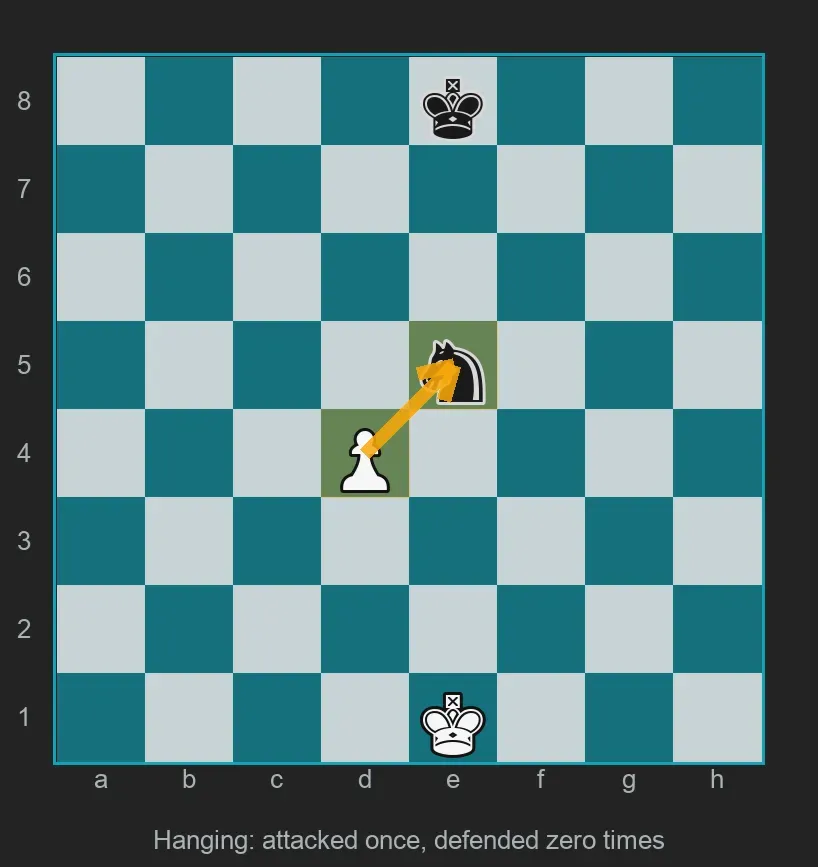
A piece is hanging when it is attacked and defended by nothing, so it can simply be taken for free. In the board below the black knight on e5 is attacked by a pawn and has no defender. Hanging pieces decide a huge share of games below 1 500, and they are a looking problem rather than a thinking problem. Our piece on why you're not improving and the mistakes behind it puts this one first.
You will hear it like: "his bishop has been hanging for three moves."
Practice the Patterns, Do Not Just Read Them
Reading about forks will not make you spot them. Play a human-like bot at your level and try to land one fork, one pin and one skewer in a single game. Beginner bots leave real chances, exactly like your friends do, which is what makes the practice transfer. An engine at full strength never gives you a single one.
Strategy and Culture: 6 Words That Make You Sound Like a Player
These six are the words that separate someone who knows the rules from someone who talks about chess. They describe ideas rather than moves, which is why they take longer to click, and why using one correctly is the fastest way to sound like you know what you are doing.
Development
Development means getting your pieces off their starting squares and onto useful ones. A piece that has never moved is doing nothing, and the opening is essentially a race to get more pieces working than your opponent. Knights and bishops develop first, the king castles, and rooks connect last. If you have played five pawn moves and one piece move, you are behind in development no matter how solid it looks.
You will hear it like: "he's three pieces up in development."
Tempo
A tempo is one move, treated as a unit of currency. You gain a tempo when you make a threat your opponent must answer, so your development advances and theirs does not, and you lose one when you move the same piece twice for no reason. This is why bringing the queen out early usually backfires: every piece your opponent develops attacks her, and each attack costs you a tempo to answer.
You will hear it like: "she developed with tempo by hitting the bishop."
Gambit
A gambit is a deliberate sacrifice, almost always a pawn, offered early for something else: faster development, open lines, or an attack. The word comes from an Italian wrestling term for tripping an opponent. Accepting a gambit is not greedy and declining it is not cowardly, since both are respectable choices. The Scotch Game is a clear example, where White ignores a pawn to aim a bishop at f7 within four moves.
You will hear it like: "he offered a gambit and she declined it."
Fianchetto
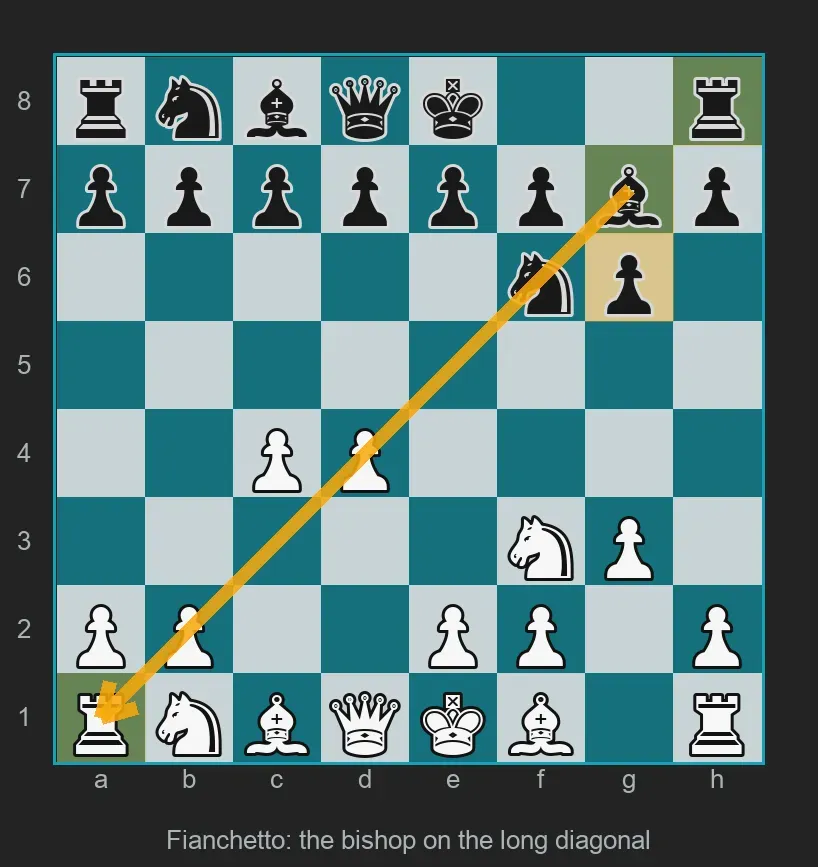
A fianchetto, from the Italian for little flank, is developing a bishop to b2, g2, b7 or g7 after moving the pawn in front of it one square. The bishop then controls the entire long diagonal from a corner, where it is both safe and unusually far-reaching. It is a slower setup than a normal bishop move, and it is a permanent commitment, because the pawn structure around it cannot be undone.
You will hear it like: "he fianchettoed the kingside bishop."
Zugzwang
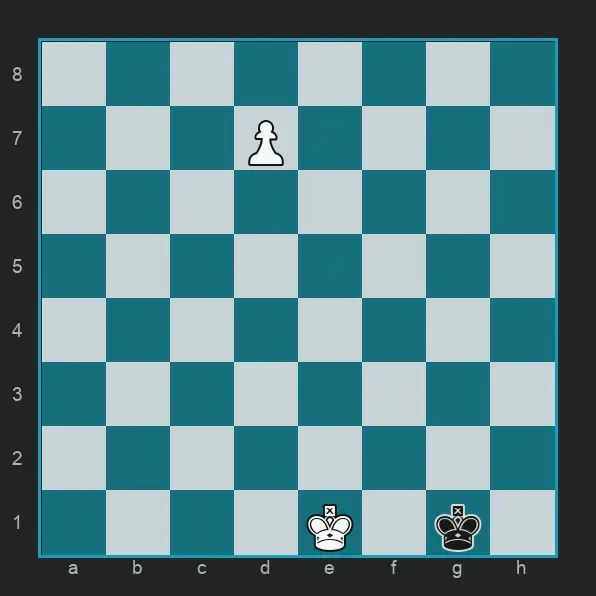
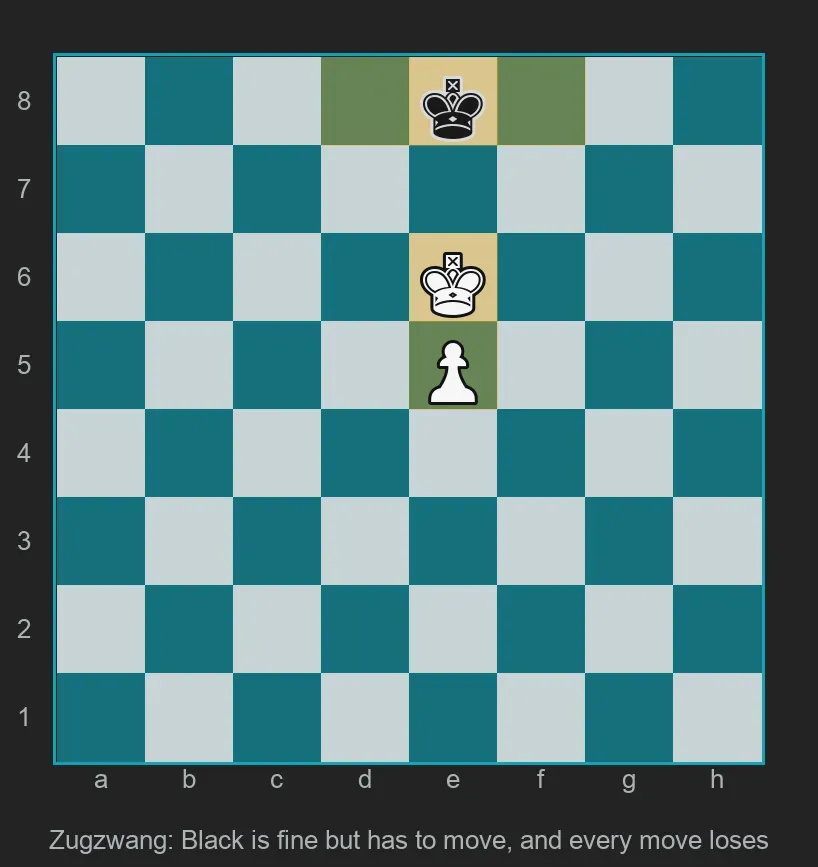
Zugzwang is German for move compulsion, and it means a position where you would be fine if you could pass, and every legal move you have makes things worse. It appears mostly in endgames. Below, Black is not in check and not attacked, and both available king moves let the white king escort the pawn to promotion. Having to move is the only thing losing the game.
You will hear it like: "black is in zugzwang and has to give way."
Elo and Rating
Your rating is a number estimating your playing strength, named after the physicist Arpad Elo who designed the system. You gain points for wins and lose them for losses, and beating someone much stronger is worth far more. Ratings only compare within the same pool, so an online number and a federation number are not the same thing. See how Chessiverse ratings work for how bot ratings map onto yours.
You will hear it like: "he's rated 1 600 but plays like 1 800."
Find the Bot That Matches Your Number
Every one of Chessiverse's 1 000 or more bots carries a rating, so you can pick one that matches yours and watch your own number move as you improve. Play a human-like bot at your level instead of guessing where you stand. It is also the cheapest way to find out whether a word on this page has actually become a pattern you can see.
Chess Slang: The Fun Stuff
Everything above is real vocabulary you can use in writing. Everything below is slang, which is a different register: fine in chat and commentary, out of place in an annotation. We keep the two apart, because glossaries that mix them leave beginners saying odd things in serious contexts.
The Six You Will Actually Hear
- Patzer. A weak or careless player, from a German word for bungling. Usually aimed at oneself.
- Fish. Another word for a weak player, borrowed from card rooms.
- Woodpusher. Someone who moves pieces without a plan, playing wood rather than chess.
- Pigs on the seventh. Two rooks on the seventh rank, because they devour everything on it.
- Booked up. Deeply prepared in the opening, from book meaning known theory.
- Flagging. Winning on time, from the flag on old mechanical clocks.
Words You Do Not Need Yet
Wikipedia's glossary of chess (nofollow) lists over 300 terms, and you can safely ignore most of them for now. Words like zwischenzug, prophylaxis and luft are real and useful, and they describe ideas you will not need until the 25 above are automatic. Learn these first and the rest arrive on their own.
How to Make the Words Stick
Vocabulary sticks when it is attached to an experience rather than a definition, so attach it. Play three games against human-like bots and narrate them out loud with your new words: I am developing, that piece is hanging, this is a gambit, he is in zugzwang. Saying it while it happens is what turns a list into a language.
FAQ
Six questions that come up around chess vocabulary, including the one about what to call a bad player, which is by far the most popular of them. Short answers below, with the longer versions in the sections above, and with the slang kept separate from the formal terms throughout.
What words are used in chess?
The core set is small: check, checkmate, stalemate and draw for how games end, castling, en passant and promotion for the special moves, fork, pin, skewer, blunder and hanging for tactics, and development, tempo, gambit and fianchetto for strategy. Add rank, file, diagonal and center, and you can follow almost any beginner tutorial without stopping.
What is some chess slang?
Patzer, fish and woodpusher all mean a weak or careless player. Pigs on the seventh means two rooks on the seventh rank, booked up means deeply prepared in the opening, and flagging means winning on time rather than on the board. These belong in chat and commentary rather than in written annotations.
What are some names of chess moves?
The named moves are castling, written O-O or O-O-O, en passant, and promotion, including underpromotion when you choose something other than a queen. Beyond that, moves are named after patterns rather than rules: a fianchetto is a bishop development, a gambit is a sacrifice for the initiative, and a fork or pin is a tactic rather than a move.
What are 40 moves in chess?
It is a time control rather than a rule of play. In classical tournament chess, players are often given a fixed amount of time to reach move 40, for example 90 minutes, and then receive extra time for the rest. It is unrelated to the fifty move rule, which is a drawing rule about moves without a capture or pawn move.
What are the most important chess terms for beginners?
Learn the game states first: check, checkmate, stalemate and draw, because they decide who wins. Then the special moves, since castling and en passant are the rules beginners most often get wrong. Then tactics, which is where your games are decided. Strategy words like tempo and zugzwang can wait until the first three groups are automatic.
What do you call a bad chess player?
Patzer is the traditional term, borrowed from German, and fish and woodpusher mean roughly the same thing. All three are informal and mildly insulting, and experienced players use them about themselves far more than about anyone else. In writing, use beginner or improving player instead.
Sources
- Wikipedia: Glossary of chess (nofollow) is the 300-plus term reference this page does not try to replace.
- FIDE Handbook, Laws of Chess (nofollow) is the authority for the rule terms and the drawing conditions.
- All fourteen boards were rendered from FEN and verified with python-chess, including an is_checkmate check on the checkmate board and an is_stalemate check on the stalemate board.
Keep Going
- Why you can't get better at chess: break your plateau: the common mistakes and fixes behind a stuck rating, one at a time.
- Castling in chess: how and when to castle: the six situations behind the most misunderstood rule here.
- Scotch Game opening guide: development, tempo and gambit ideas in a real opening.
- Chess AI vs chess engine: what's the difference?: what bot, engine and rating actually mean.