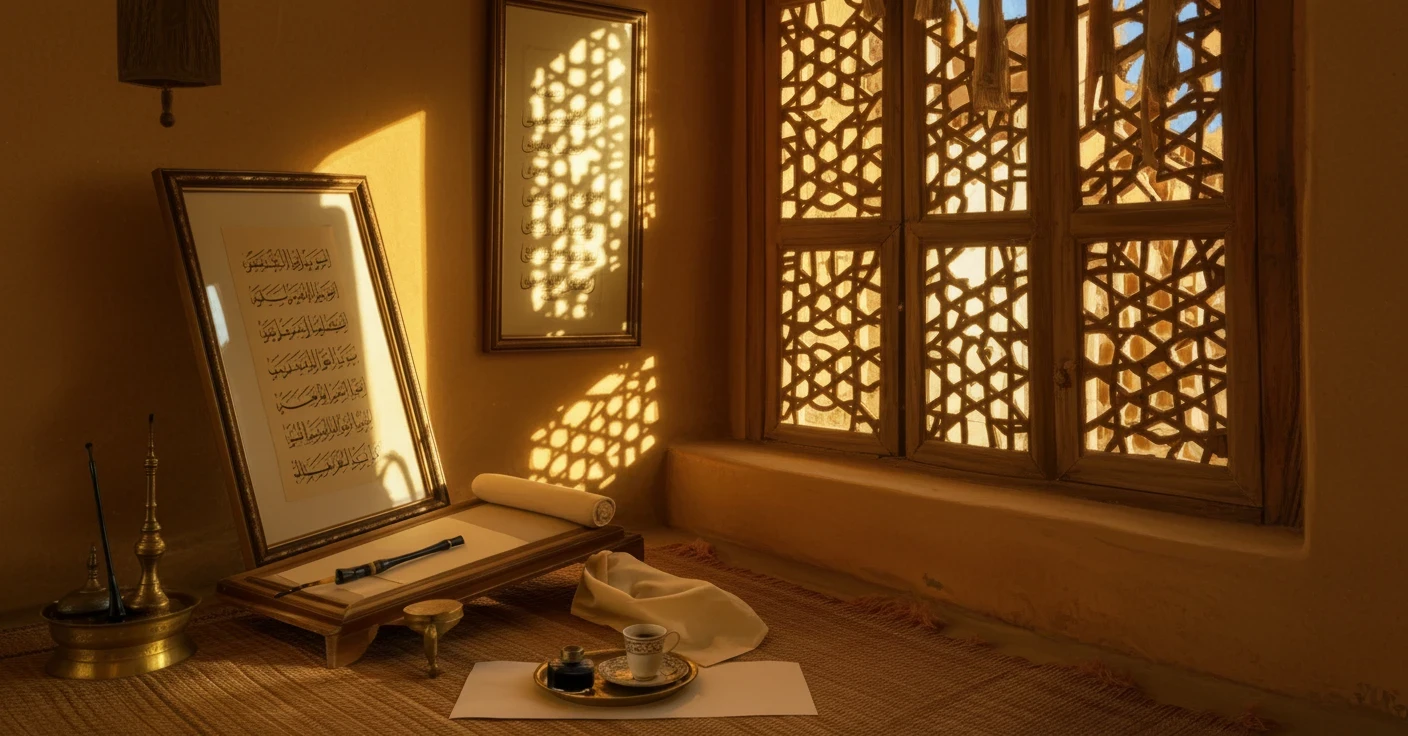
Ahlan, ya habibti, come sit. The page is fresh, the ink is mixed, and my little qalams are waiting their turn along the margin. Play slowly with me, draw one honest stroke at a time, and yallah, let us see where the line goes today.
Reem Al-Harbi is a 41-year-old Arabic calligraphy instructor from Jeddah, Saudi Arabia, who teaches diwani, thuluth, and naskh from a small studio in an old coral-stone rawasheen house. Between lessons she plays casual chess at an estimated 1555 Elo, a comfortable intermediate club level reached through years of relaxed play rather than formal study or competitive training. Reem has not built a deep theoretical repertoire, and her opening choices vary from game to game, but she carries the same steady hand from her writing board to the chessboard: unhurried, observant, careful with each stroke. Her calculation stretches two or three moves ahead, her endgame technique is dependable, and her temperament rarely cracks under pressure. Opponents who sit down across from Reem should expect a slow, patient game with long stretches of tension, soft commentary between moves, and very few wild swings.
How Reem plays
Reem plays in a deeply defensive, patient style, almost never the first to lunge forward. She loves keeping tension on the board and avoids trading pieces down, preferring crowded positions where small mistakes accumulate. Her opening choices float between solid and sharp lines without a fixed allegiance, and she neither leans on mainline theory nor on offbeat tricks. Expect long, quiet middlegames where she waits for her opponent to overcommit.
Who should play Reem
Players rated roughly 1300 to 1750 will get the most out of a game with Reem. Aggressive attackers will learn restraint, because Reem rarely gives them the open lines they crave and instead absorbs pressure until the attack runs out of ink. Players who tend to simplify too quickly will be forced to handle prolonged tension, calculate quietly, and find plans in closed positions rather than relying on quick trades.