

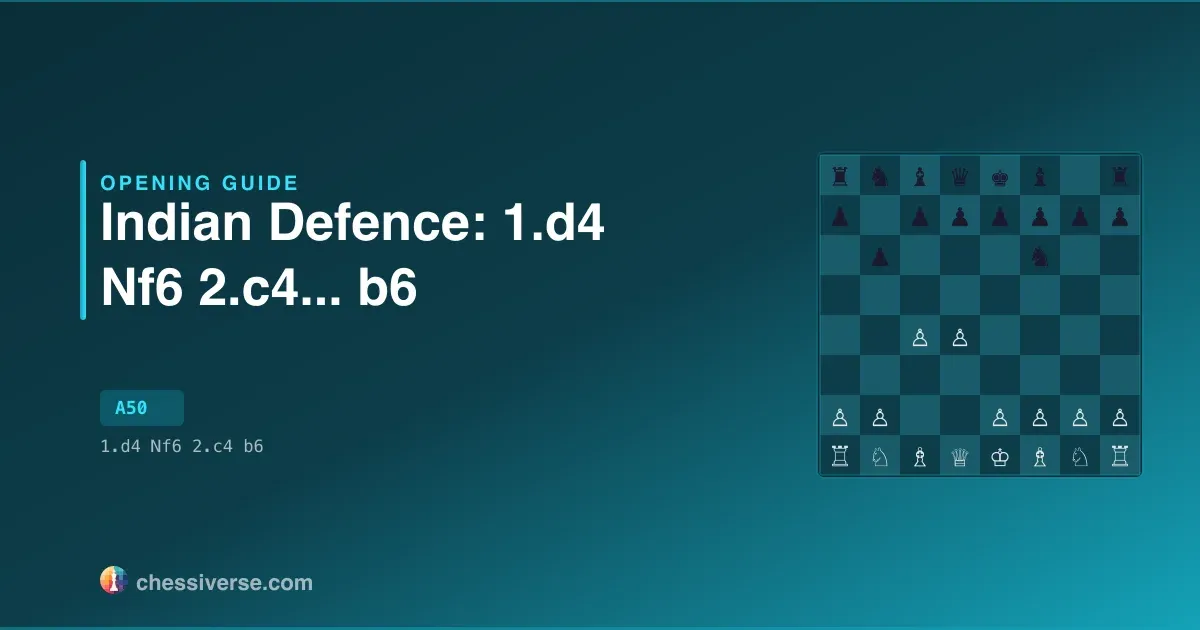
Starting from 1.d4 Nf6 2.c4 b6, players enter the Queen's Indian Accelerated — ECO A50. Lichess records 909,509 games in this line, which gives us a reliable view of how it actually performs in practice.
History and Notable Players
It arises from the Indian Game Mainlines. On the White side, Ivan Farago (1106 games), Svetozar Gligoric (880 games), Loek Van Wely (778 games) top the database. Notable Black exponents: Viktor Korchnoi (593 games), Jan H Timman (482 games), Svetozar Gligoric (479 games).
Performance Across Rating Levels
The picture changes a lot as you climb the rating ladder. At 1200 Elo, the opening shows up in 0.01% of games (60,841 samples). White scores 52.1%, Black 44.7%, draws 3.3%. At 1800 the opening surfaces in 0.03% of games; White wins 49.2%, Black 46.1%, draws 4.7%. Among 2500-rated players the line appears in 0.10% of games and draws spike to 8.9%, indicating tight preparation. White's edge erodes by 8.1pp from 1200 to 2500 Elo, suggesting Black's counterplay is easier to find with experience.
Time Control Patterns
Time control matters here: blitz players reach for this opening more than others. In bullet, it appears in 0.02% of games (405,450); White wins 49.7%. Blitz shows 0.02% adoption across 741,700 games, White scoring 49.4%. In rapid, the share rises to 0.02% — 167,809 games, White 50.8%.
Move Diversity and Theory Depth
Looking at move selection shows how forcing — or not — the position really is. At 1200 Elo (60,841 games), the top reply is Nc3, played 62.6% of the time. Two other moves each take at least 5% of games, and the top three moves account for 86.6% of games. Entropy: 1.90. By 2500 (13,191 games), Nc3 dominates at 61.2% of replies; two other moves reach 5% and the top three moves account for 95.8% of games. Entropy drops to 1.61.
Historical Trends
Long-term, the trajectory of this opening is informative. Adoption peaked in 2020 at 0.022% (128,888 games). By 2025 it sits at 0.018%, 22% below the peak and 11% under its 2013 level, leaving the line in decline.
Common Mistakes
- Drifting away from main theory — At 400 Elo, the three most-played moves cover 75.9% of games, against 94.6% at 2000. The most popular deviation is e3 (played 12.5% of the time at 400, much less so up top). It looks fine but quietly hands the better-prepared side an edge.
- Neglecting development — Extra pawn moves in the opening are tempting, especially when you "know the moves". Developing a piece each turn is the simple correction.
- Letting White own the centre — Hypermodern openings concede central space on purpose, but only if you strike back in time. Delay the counter-blow and you end up squeezed.
Practice on Chessiverse
Ready to try the Queen's Indian Accelerated against a bot? Pick an opponent at your level and play a game.