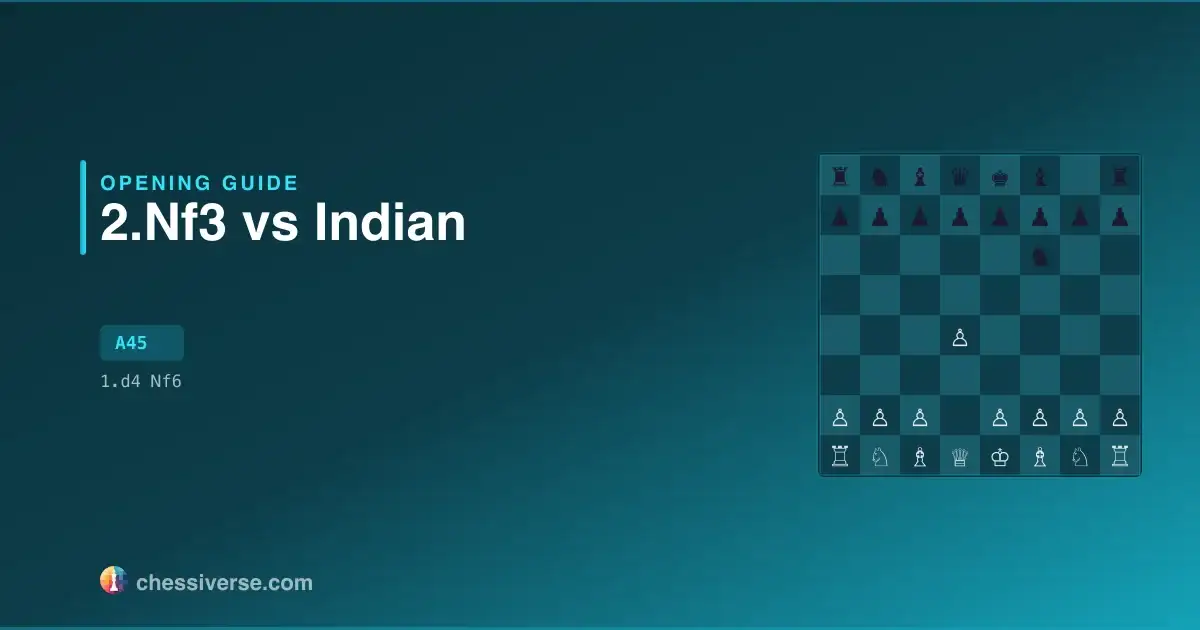




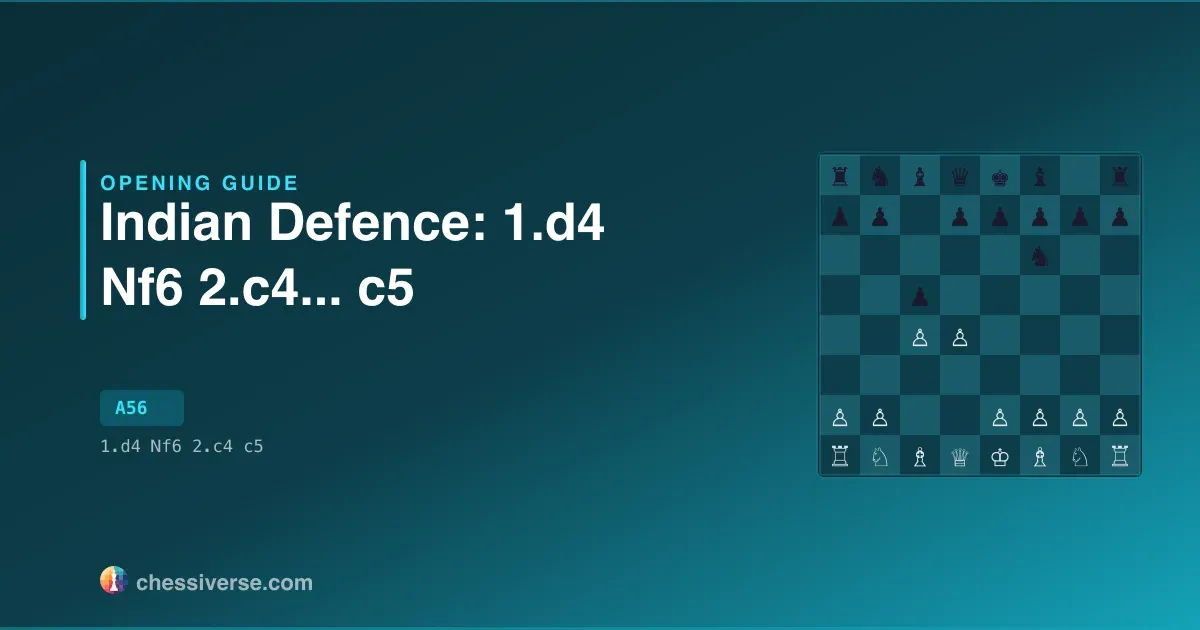
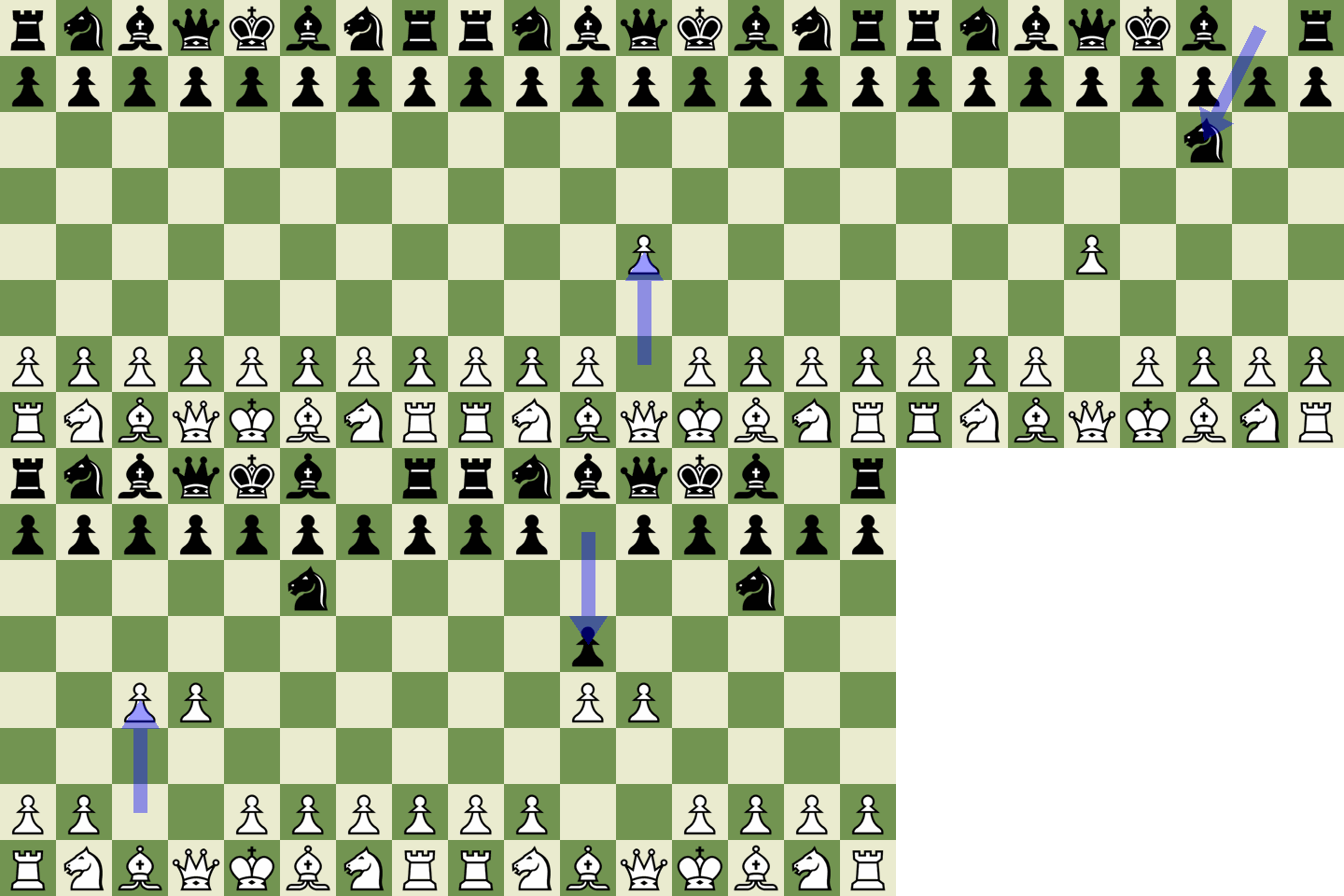
The Benoni Defense arises after 1.d4 Nf6 2.c4 c5 and falls under ECO code A56. Here Black challenges White's central d-pawn from the side. White cannot simply capture with 3. dxc5?, since Black easily recovers the pawn with 3...e6 followed by ...Bxc5, having successfully traded off one of White's key central pawns in the process. The strongest way for White to maintain the pawn is 3. d5, which restricts Black's position and forces Black to find a way to undermine the resulting pawn chain. Passive defenses of d4 such as 3. e3?! or 3. Nf3?! are questionable because they allow Black to exchange the less important c-pawn for White's central d-pawn, diminishing White's grip on the center. With 10.2 million Lichess games across all rating levels, it is a well-established opening choice.
History and Notable Players
It arises from the Indian Defense Systems. Among the most prolific practitioners on the White side are Ivan Farago (125 games), Svetozar Gligoric (98 games), Glenn C Flear (72 games). On the Black side, notable exponents include Dragoljub Velimirovic (121 games), Florin Gheorghiu (119 games), Juan Manuel Bellon Lopez (117 games).
Statistics
Based on 10.2 million Lichess games across all rating levels:
- White wins: 45.3%
- Black wins: 49.2%
- Draws: 5.4%
Interestingly, Black scores well in this opening, suggesting it offers strong counterplay.
Main Lines and Variations
After 1.d4 Nf6 2.c4 c5, the main continuations include:
Each of these lines leads to distinct types of positions and requires its own understanding of the resulting pawn structures and piece placements.
Common Mistakes to Avoid
- Allowing White to build an overwhelming center: Hypermodern openings allow White space in the center, but you need to strike back at the right moment. Delaying the counterattack too long can leave you without active play.
Practice on Chessiverse
The best way to learn the Benoni Defense is through practice. On Chessiverse, you can play chess against computer opponents that specialize in this opening. Our AI bots range from beginner to grandmaster level, each with unique playing styles — from aggressive attackers to solid defenders. Choose a bot that matches your rating and work your way up as you master the opening's key ideas.
Performance Across Rating Levels
The picture changes a lot as you climb the rating ladder. The 1200 bracket has 191,500 games (0.03% of all games at that level); White wins 48.2%, Black 48.6%, 3.3% are drawn. At 1800 the opening surfaces in 0.33% of games; White wins 44%, Black 51.2%, draws 4.8%. Among 2500-rated players the line appears in 1.26% of games and draws spike to 9%, indicating tight preparation.
Time Control Patterns
The Benoni Defense (2.c4 c5) skews toward blitz chess. In bullet, it appears in 0.19% of games (5,152,454); White wins 46.8%. Blitz shows 0.25% adoption across 8,992,023 games, White scoring 45.5%. In rapid, the share rises to 0.11% — 1,215,313 games, White 44%. White's score swings 2.8pp across formats, so time control isn't just a stylistic choice here — it shifts the actual results.
Move Diversity and Theory Depth
Move choice is far from uniform in the Benoni Defense (2.c4 c5). At 1200 Elo (191,500 games), the top reply is d5, played 43.3% of the time. Four other moves each take at least 5% of games, and the top three moves account for 74.6% of games. Entropy: 2.29. By 2500 (172,137 games), d5 dominates at 83.4% of replies; only one other move still reaches 5% and the top three moves account for 96.3% of games. Entropy drops to 0.91. The narrowing is significant — strong players consolidate around a small set of best moves, while amateurs scatter across many plausible-looking options.
Historical Trends
Year-over-year data tells you whether this opening is a contemporary fixture or a fading one. Adoption peaked in 2015 at 0.34% (76,261 games). By 2025 it sits at 0.19%, 46% below the peak but still 16% above its 2013 level, so the line is up over the full period despite easing from the high.