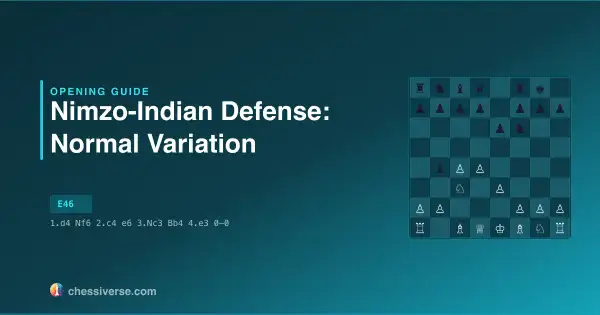
Nimzo-Indian Defense: Normal Variation, Schlechter Defense

Popularity increased 40% since 2013

E521.d4 Nf6 2.c4 e6 3.Nc3 Bb4 4.e3 0-0 5.Nf3 d5 6.Bd3 b6

Feb 20, 20262 min read

TL;DR Karpov's preferred Nimzo setup. ...b6 hits e4 and prepares ...Bb7 to add another long-diagonal piece. Black aims for the IQP middlegame where his light-square coverage and patient defence have historically scored well.

Nimzo-Indian Defense: Normal Variation, Schlechter Defense: A Complete Guide
Nimzo-Indian Defense: Normal Variation, Schlechter Defense - Opening Moves

Summary

The Nimzo-Indian Defense: Normal Variation, Schlechter Defense begins with 1.d4 Nf6 2.c4 e6 3.Nc3 Bb4 4.e3 0-0 5.Nf3 d5 6.Bd3 b6 (ECO E52). With 39,934 games on record, the patterns below come from the largest practical sample available.

History and Notable Players

It arises from the Nimzo-Indian Defense: Normal Variation, Ragozin Variation. Among the most prolific White practitioners are Svetozar Gligoric (20 games), Rainer Knaak (13 games), Jan Hein Donner (11 games). Black-side regulars include Milko G Bobotsov (9 games), Grzegorz Gajewski (9 games), Vladimir Chuchelov (9 games).

Common Mistakes

  • Drifting away from main theory — At 1000 Elo, the three most-played moves cover 82.4% of games, against 96% at 2000. The most popular deviation is a3 (played 9.4% of the time at 1000, much less so up top). It looks fine but quietly hands the better-prepared side an edge.
  • Neglecting development — It can feel productive to make extra pawn moves early, but falling behind in piece development is what loses most amateur games — especially in open positions where active pieces find squares fast.
  • Letting White own the centre — Hypermodern openings concede central space on purpose, but only if you strike back in time. Delay the counter-blow and you end up squeezed.

Practice on Chessiverse

Ready to try the Nimzo-Indian Defense: Normal Variation, Schlechter Defense against a bot? Play chess against the computer at your level.


Play the Nimzo-Indian Defense: Normal Variation, Schlechter Defense

Play As
Start From

After 1.d4 Nf6 2.c4 e6 3.Nc3 Bb4 4.e3 0-0 5.Nf3 d5 6.Bd3 b6 Pick the position up and play on from there.

Opponent

No account needed — your game saves if you sign up after.

Want the full game experience — enter the game arena!

Quick Facts

Games on Lichess
39,934
Most Popular At
2500
Sharpness
Balanced
Scored as part of the Nimzo-Indian family
Main Line
1.d4 Nf6 2.c4 e6 3.Nc3 Bb4 4.e3 0-0 5.Nf3 d5 6.Bd3 b6
FEN
rnbq1rk1/p1p2ppp/1p2pn2/3p4/1bPP4/2NBPN2/PP3PPP/R1BQK2R w KQ - 0 7
Style
Theoretician

White wins 49.1%, draws 5.2%, Black wins 45.6%.

Top Players

Data from Lichess opening explorer (blitz & rapid)

Theoretician
Theoretician openings have deep, well-studied lines where knowledge of specific variations gives a significant advantage. Preparation and memorization of key lines are essential.

Popularity by Rating

Popularity view

It's played most at 2500: about 1 in 10,000 games there, against fewer than 1 in 100,000 games at 1000. At 1400, White wins 52% and Black 45%; at 2500 it's 47% to 42%, with more draws (11%).

Percentage of all games at each rating bracket that feature this opening.

Data from Lichess opening explorer (blitz & rapid games)

Theory Adherence by Rating

Theory adherence view

At 1200, White's most common reply is 7.O-O (69% of games), with three other moves each played in at least 1 in 20 games. By 2500 it comes down to two: 7.O-O (66%) and 7.cxd5 (30%).

How often players choose the single most popular move at this position. Higher = more predictable play.

White to move after the opening line

Popularity Over Time

It's rare: fewer than 1 in 100,000 games in 2025, as in 2013. It peaked in 2017, at 1 in 77,000 games.

Share of all Lichess blitz + rapid games featuring this opening, by year.

Top Moves by Rating

White to move after the opening line

Top moves by rating
RatingMost Popular2nd3rd
4007.O-O69.8%7.a311.3%7.Ng55.7%
10007.O-O66.3%7.a39.4%7.Bd26.7%
12007.O-O68.5%7.a39.5%7.cxd58.3%
14007.O-O70.6%7.a39.4%7.cxd58.7%
16007.O-O73%7.cxd511.5%7.a37.1%
18007.O-O74%7.cxd515.2%7.a35.3%
20007.O-O73.1%7.cxd518.9%7.a34%
22007.O-O71.8%7.cxd522.5%7.a33.9%
25007.O-O65.8%7.cxd529.5%7.a33.1%

Popularity by Time Control

It's played most in blitz: about 1 in 100,000 blitz games, against fewer than 1 in 100,000 rapid games.

  • Bullet<0.01%15K
  • Blitz<0.01%34K
  • Rapid<0.01%6K

3% more decisive in bullet

Raw Data Tables (Lichess Blitz + Rapid)
Nimzo-Indian Defense: Normal Variation, Schlechter Defense: popularity and win rates by player rating
Rating (Elo)Share %GamesWhite win %Black win %Draw %Sharpness
4000.005343.454.71.90.981
10000.0027151.746.12.20.978
12000.0092049.548.02.50.975
14000.002,65651.645.43.00.970
16000.006,45451.744.63.70.963
18000.0010,59549.146.04.90.951
20000.0010,61248.446.15.50.945
22000.007,01547.245.67.10.929
25000.011,35847.242.010.80.892
Nimzo-Indian Defense: Normal Variation, Schlechter Defense: move-choice theory adherence by rating
Rating (Elo)Top moveTop move %Viable movesTheory %Entropy
4007.O-O69.8386.81.596
10007.O-O66.3582.41.849
12007.O-O68.5486.31.741
14007.O-O70.6488.71.574
16007.O-O73.0391.71.424
18007.O-O74.0394.41.315
20007.O-O73.1296.01.254
22007.O-O71.8298.21.154
25007.O-O65.8298.41.189
Nimzo-Indian Defense: Normal Variation, Schlechter Defense: popularity over time
YearShare %GamesWhite win %Black win %Draw %
20130.001471.428.60.0
20140.006962.331.95.8
20150.0021456.139.34.7
20160.0067455.539.05.5
20170.001,50951.743.15.2
20180.002,25849.245.75.1
20190.003,00848.546.25.3
20200.006,36649.345.25.5
20210.006,82348.346.15.7
20220.006,06350.344.25.5
20230.005,74049.346.24.5
20240.005,16448.246.95.0
20250.004,97247.646.95.5
Nimzo-Indian Defense: Normal Variation, Schlechter Defense: popularity by time control
FormatShare %GamesWhite win %Black win %Draw %Sharpness
bullet0.0015,07950.346.53.20.968
blitz0.0034,21649.145.75.20.948
rapid0.005,65049.245.05.80.942
Nimzo-Indian Defense: Normal Variation, Schlechter Defense: top candidate moves by rating bracket
Rating (Elo)1st move1st %2nd move2nd %3rd move3rd %
4007.O-O69.87.a311.37.Ng55.7
10007.O-O66.37.a39.47.Bd26.7
12007.O-O68.57.a39.57.cxd58.3
14007.O-O70.67.a39.47.cxd58.7
16007.O-O73.07.cxd511.57.a37.1
18007.O-O74.07.cxd515.27.a35.3
20007.O-O73.17.cxd518.97.a34.0
22007.O-O71.87.cxd522.57.a33.9
25007.O-O65.87.cxd529.57.a33.1
Nimzo-Indian Defense: Normal Variation, Schlechter Defense: top practitioners by side
SidePlayerGames
WhiteSvetozar Gligoric20
WhiteRainer Knaak13
WhiteJan Hein Donner11
BlackMilko G Bobotsov9
BlackGrzegorz Gajewski9
BlackVladimir Chuchelov9

Frequently Asked Questions

Nimzo-Indian Defense: Normal Variation, Schlechter Defense

What is this opening?

This opening begins with 1.d4 Nf6 2.c4 e6 3.Nc3 Bb4 4.e3 0-0 5.Nf3 d5 6.Bd3 b6 and is classified under ECO code E52.

Is this opening good for beginners?

This opening can be played at any level. Beginners should focus on understanding the key strategic ideas rather than memorizing long theoretical lines. Our AI bots at various rating levels provide a great way to practice the opening concepts.

What are the win rates for this opening?

In a database of 39,934 games, White wins 49.1% of the time, Black wins 45.6%, and 5.2% are drawn. Notable players on the White side include Svetozar Gligoric and Rainer Knaak. On the Black side, Milko G Bobotsov and Grzegorz Gajewski are among the most frequent practitioners.

How can I practice this opening?

On Chessiverse, you can practice this opening by playing against our 1,100+ AI bots. Each bot has a unique playing style and opening repertoire, so you can find the perfect sparring partner for any level.

Sources

Brought to you by

IM John BartholomewCo-Founder & Chess Educator

International Master and chess educator. Co-founded Chessable and joined Chessiverse as co-founder. Best known for his "Climbing the Rating Ladder" YouTube series and structured opening courses.

Practice This Opening on Chessiverse

Play against 1000+ AI bots with unique personalities and opening repertoires. From beginner-friendly to grandmaster-level opponents, find the perfect sparring partner for any opening.

Not sure which opening fits you? Take the free chess personality test — your style determines which openings will work with you.

Back to Articles