



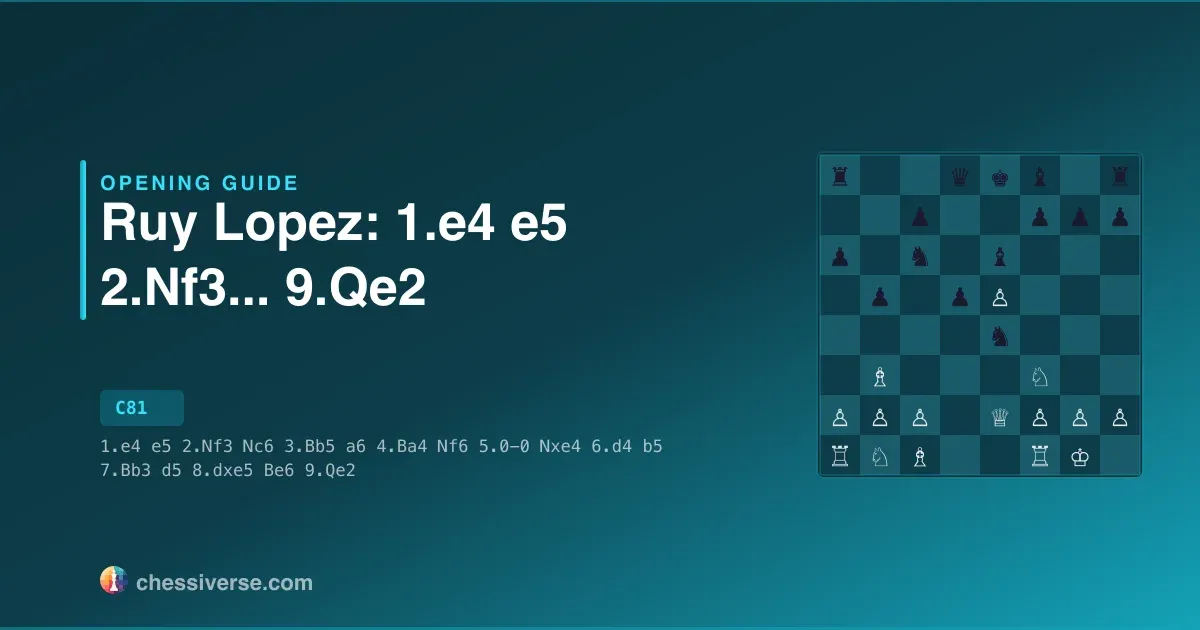
The Ruy Lopez: Open, Howell Attack begins with 1.e4 e5 2.Nf3 Nc6 3.Bb5 a6 4.Ba4 Nf6 5.0-0 Nxe4 6.d4 b5 7.Bb3 d5 8.dxe5 Be6 9.Qe2 (ECO C81). With 11,862 games on record, the patterns below come from the largest practical sample available.
History and Notable Players
It arises from the Ruy Lopez: Open (5...Nxe4). On the White side, Vlastimil Jansa (19 games), Milan Matulovic (16 games), Borislav Ivkov (8 games) top the database. Notable Black exponents: Karoly Honfi (11 games), Viktor Korchnoi (11 games), Wolfgang Unzicker (8 games).
Move Diversity and Theory Depth
Looking at move selection shows how forcing — or not — the position really is. Below 1600 the samples are small (24 games at 1200, 61 at 1400), so the comparison starts at 1600, with 257 games. There, the top reply is Be7, played 39.3% of the time. Three other moves each take at least 5% of games, and the top three moves account for 90.3% of games. Entropy: 2.02. By 2500 (1,342 games), Be7 dominates at 50.1% of replies; only two other moves still reach 5% and the top three moves account for 97.9% of games. Entropy drops to 1.64.
Common Mistakes
- Neglecting development — Extra pawn moves in the opening are tempting, especially when you "know the moves". Developing a piece each turn is the simple correction.
- Playing without a plan — Each Ruy Lopez: Open, Howell Attack middlegame demands a specific approach. Decide whether the position calls for attack, manoeuvre, or simplification before reaching for a move.
Practice on Chessiverse
Ready to try the Ruy Lopez: Open, Howell Attack against a bot? Pick an opponent at your level and play a game.