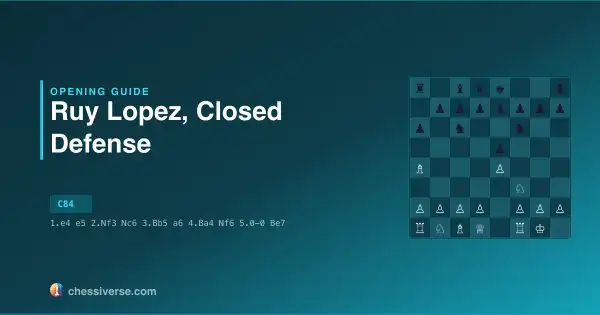
Ruy Lopez, Marshall Attack

Popularity decreased 61% since 2013

C891.e4 e5 2.Nf3 Nc6 3.Bb5 a6 4.Ba4 Nf6 5.0-0 Be7 6.Re1 b5 7.Bb3 0-0 8.c3 d5

Feb 18, 20261 min read

TL;DR Black sacrifices a centre pawn with 8...d5 for sustained kingside pressure, smashing through with ...Nxd5, ...Nf6 and the famous queen lift via ...Qh4. Considered drawn at the top, an absolute gauntlet for any unprepared White player.

Ruy Lopez, Marshall Attack: A Complete Guide
Ruy Lopez, Marshall Attack - Opening Moves

Summary

Starting from 1.e4 e5 2.Nf3 Nc6 3.Bb5 a6 4.Ba4 Nf6 5.0-0 Be7 6.Re1 b5 7.Bb3 0-0 8.c3 d5, players enter the Ruy Lopez, Marshall Attack — ECO C89. Lichess records 706,693 games in this line, which gives us a reliable view of how it actually performs in practice.

History and Notable Players

It arises from the Ruy Lopez: Closed (7.Bb3). Among the most prolific White practitioners are Viswanathan Anand (28 games), Judit Polgar (18 games), Peter Leko (17 games). Black-side regulars include Michael Adams (38 games), Levon Aronian (37 games), Mark L Hebden (30 games).

Common Mistakes

  • Neglecting development — It can feel productive to make extra pawn moves early, but falling behind in piece development is what loses most amateur games — especially in open positions where active pieces find squares fast.
  • Playing without a plan — Each Ruy Lopez, Marshall Attack middlegame demands a specific approach. Decide whether the position calls for attack, manoeuvre, or simplification before reaching for a move.

Practice on Chessiverse

Ready to try the Ruy Lopez, Marshall Attack against a bot? Pick an opponent at your level and play a game.


Play the Ruy Lopez, Marshall Attack

Play As
Start From

After 1.e4 e5 2.Nf3 Nc6 3.Bb5 a6 4.Ba4 Nf6 5.0-0 Be7 6.Re1 b5 7.Bb3 0-0 8.c3 d5 Pick the position up and play on from there.

Opponent

No account needed — your game saves if you sign up after.

Want the full game experience — enter the game arena!

Quick Facts

Games on Lichess
706,693
Most Popular At
2200
Sharpness
Very Sharp
Black's famous pawn sacrifice for a long-term kingside attack — heavy theory, razor-sharp play.
Main Line
1.e4 e5 2.Nf3 Nc6 3.Bb5 a6 4.Ba4 Nf6 5.0-0 Be7 6.Re1 b5 7.Bb3 0-0 8.c3 d5
FEN
r1bq1rk1/2p1bppp/p1n2n2/1p1pp3/4P3/1BP2N2/PP1P1PPP/RNBQR1K1 w - - 0 9
Style
Theoretician

White wins 41.4%, draws 5.3%, Black wins 53.3%.

Top Players

As White

  1. Viswanathan Anand28 games
  2. Judit Polgar18 games
  3. Peter Leko17 games

As Black

  1. Michael Adams38 games
  2. Levon Aronian37 games
  3. Mark L Hebden30 games

Data from Lichess opening explorer (blitz & rapid)

Theoretician
Theoretician openings have deep, well-studied lines where knowledge of specific variations gives a significant advantage. Preparation and memorization of key lines are essential.

Popularity by Rating

Popularity view

It's played most at 2200: about 1 in 1,800 games there, against fewer than 1 in 100,000 games at 400. At 1200, White wins 47% and Black 50%; at 2500 they're level at 44%, with more draws (12%).

Percentage of all games at each rating bracket that feature this opening.

Data from Lichess opening explorer (blitz & rapid games)

Theory Adherence by Rating

Theory adherence view

At 1200, White's most common reply is 9.exd5 (73% of games), with two other moves each played in at least 1 in 20 games. By 2500 it comes down to two: 9.exd5 (85%) and 9.d4 (10%).

How often players choose the single most popular move at this position. Higher = more predictable play.

White to move after the opening line

Popularity Over Time

It's less popular than it used to be: about 1 in 9,300 games in 2025, down from 1 in 3,600 games in 2013. It peaked in 2015, at 1 in 3,500 games.

Share of all Lichess blitz + rapid games featuring this opening, by year.

Top Moves by Rating

White to move after the opening line

Top moves by rating
RatingMost Popular2nd3rd
4009.exd568.8%9.d417.1%9.d38.2%
10009.exd566.4%9.d416.7%9.d38.7%
12009.exd573.3%9.d412.2%9.d38.1%
14009.exd581.2%9.d47.8%9.d36.4%
16009.exd586.4%9.d35.3%9.d45.3%
18009.exd589.2%9.d35%9.d43.9%
20009.exd590.1%9.d34.7%9.d44%
22009.exd589.4%9.d45.1%9.d34.8%
25009.exd585.3%9.d410.2%9.d34%

Popularity by Time Control

It's played most in blitz: about 1 in 6,100 blitz games, against 1 in 14,000 bullet games. White wins more often in bullet (43%) than in rapid (40%).

  • Bullet<0.01%197K
  • Blitz0.02%593K
  • Rapid0.01%114K

3% more decisive in bullet

Raw Data Tables (Lichess Blitz + Rapid)
Ruy Lopez, Marshall Attack: popularity and win rates by player rating
Rating (Elo)Share %GamesWhite win %Black win %Draw %Sharpness
4000.0017043.548.28.20.918
10000.001,23648.149.22.80.972
12000.006,27847.250.02.90.971
14000.0027,78942.653.93.50.965
16000.01102,22640.455.83.70.963
18000.03238,88940.155.04.80.952
20000.05232,86542.052.25.80.942
22000.0591,50943.549.27.20.928
25000.045,73144.044.211.80.882
Ruy Lopez, Marshall Attack: move-choice theory adherence by rating
Rating (Elo)Top moveTop move %Viable movesTheory %Entropy
4009.exd568.8394.11.452
10009.exd566.4391.91.567
12009.exd573.3393.61.359
14009.exd581.2395.41.078
16009.exd586.4397.00.847
18009.exd589.2298.20.692
20009.exd590.1198.90.626
22009.exd589.4299.20.638
25009.exd585.3299.50.761
Ruy Lopez, Marshall Attack: popularity over time
YearShare %GamesWhite win %Black win %Draw %
20130.0379336.359.14.5
20140.032,38735.858.45.8
20150.036,30537.857.54.7
20160.0316,07639.455.94.8
20170.0328,90140.654.54.9
20180.0241,68340.954.34.8
20190.0253,52840.254.94.9
20200.02107,98040.853.75.5
20210.02115,82341.652.95.5
20220.02111,53542.252.55.3
20230.01106,37842.152.55.4
20240.0188,98441.753.05.3
20250.0180,31142.352.35.4
Ruy Lopez, Marshall Attack: popularity by time control
FormatShare %GamesWhite win %Black win %Draw %Sharpness
bullet0.01196,50643.353.33.30.967
blitz0.02593,07241.853.15.10.949
rapid0.01113,62139.754.16.20.938
Ruy Lopez, Marshall Attack: top candidate moves by rating bracket
Rating (Elo)1st move1st %2nd move2nd %3rd move3rd %
4009.exd568.89.d417.19.d38.2
10009.exd566.49.d416.79.d38.7
12009.exd573.39.d412.29.d38.1
14009.exd581.29.d47.89.d36.4
16009.exd586.49.d35.39.d45.3
18009.exd589.29.d35.09.d43.9
20009.exd590.19.d34.79.d44.0
22009.exd589.49.d45.19.d34.8
25009.exd585.39.d410.29.d34.0
Ruy Lopez, Marshall Attack: top practitioners by side
SidePlayerGames
WhiteViswanathan Anand28
WhiteJudit Polgar18
WhitePeter Leko17
BlackMichael Adams38
BlackLevon Aronian37
BlackMark L Hebden30

Frequently Asked Questions

Ruy Lopez, Marshall Attack

What is this opening?

This opening begins with 1.e4 e5 2.Nf3 Nc6 3.Bb5 a6 4.Ba4 Nf6 5.0-0 Be7 6.Re1 b5 7.Bb3 0-0 8.c3 d5 and is classified under ECO code C89.

Is this opening suitable for beginners?

This opening involves significant theoretical preparation and sharp tactical play. While beginners can learn the basic ideas, it is more commonly recommended for intermediate and advanced players who are willing to invest time in studying specific lines. For practice, our lower-rated bots offer a forgiving environment to learn the patterns.

What are the win rates for this opening?

In a database of 706,693 games, White wins 41.4% of the time, Black wins 53.3%, and 5.3% are drawn. Notable players on the White side include Viswanathan Anand and Judit Polgar. On the Black side, Michael Adams and Levon Aronian are among the most frequent practitioners.

How can I practice this opening?

On Chessiverse, you can practice this opening by playing against our 1,100+ AI bots. Each bot has a unique playing style and opening repertoire, so you can find the perfect sparring partner for any level.

Sources

Brought to you by

IM John BartholomewCo-Founder & Chess Educator

International Master and chess educator. Co-founded Chessable and joined Chessiverse as co-founder. Best known for his "Climbing the Rating Ladder" YouTube series and structured opening courses.

Practice This Opening on Chessiverse

Play against 1000+ AI bots with unique personalities and opening repertoires. From beginner-friendly to grandmaster-level opponents, find the perfect sparring partner for any opening.

Not sure which opening fits you? Take the free chess personality test — your style determines which openings will work with you.

Back to Articles