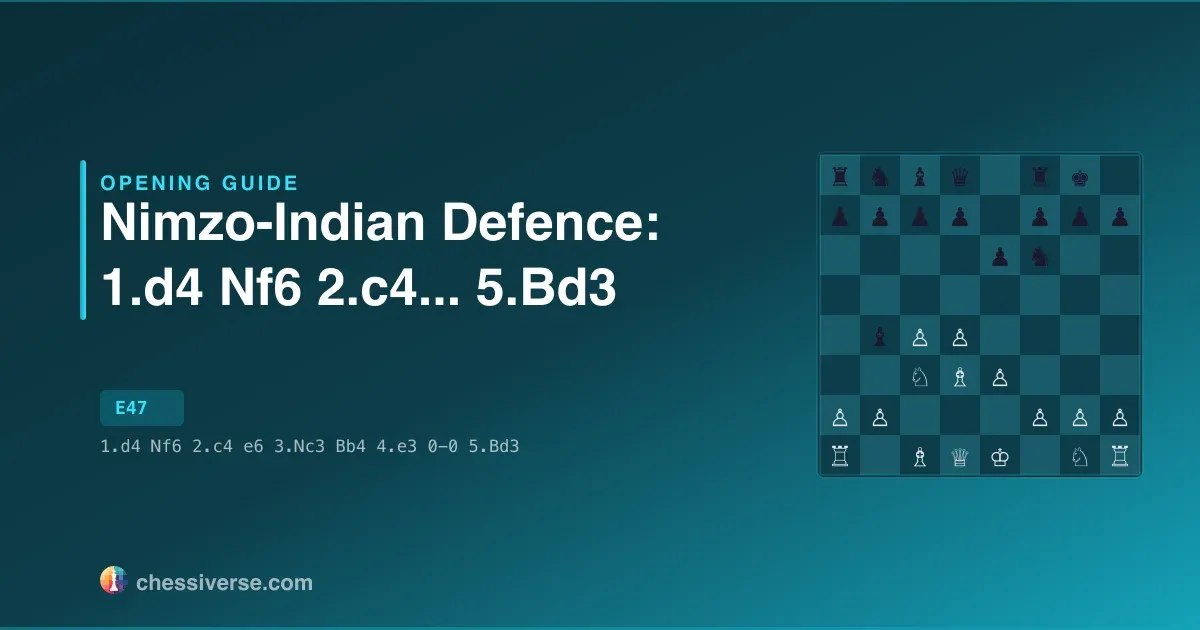
1.d4 Nf6 2.c4 e6 3.Nc3 Bb4 4.e3 0-0 5.Bd3 opens the Nimzo-Indian Defense: Normal Variation (5.Bd3), ECO E47. With 338,925 games on record, the patterns below come from the largest practical sample available.
History and Notable Players
It arises from the Nimzo-Indian Defense: Normal Variation. Among the most prolific White practitioners are Svetozar Gligoric (142 games), Aleksej Aleksandrov (117 games), Fernando Peralta (75 games). Black-side regulars include Wolfgang Unzicker (50 games), Ivan Farago (36 games), Mikhail Tal (33 games).
Performance Across Rating Levels
The picture changes a lot as you climb the rating ladder. The 1200 bracket has 2,710 games (0.00% of all games at that level); White wins 51.2%, Black 46.1%, 2.7% are drawn. At 1800 the opening surfaces in 0.01% of games; White wins 49.6%, Black 45.8%, draws 4.6%. At 2500, 0.21% of games go into this opening; draws sit at 9.5% — the line is well-mapped at this level. Positions also become less sharp as level rises (sharpness 0.97 → 0.91).
Move Diversity and Theory Depth
What players actually play after the opening moves depends heavily on rating. At 1200 Elo (2,707 games), the top reply is d5, played 46.1% of the time. Four other moves each take at least 5% of games, and the top three moves account for 74.1% of games. Entropy: 2.52. By 2500 (28,461 games), d5 dominates at 62.9% of replies; only three other moves still reach 5% and the top three moves account for 90.8% of games. Entropy drops to 1.64. The narrowing is significant — strong players consolidate around a small set of best moves, while amateurs scatter across many plausible-looking options.
Main Lines and Variations
The main branches off 1.d4 Nf6 2.c4 e6 3.Nc3 Bb4 4.e3 0-0 5.Bd3 include:
Each branch leads to a different middlegame character — the resulting pawn structure decides what kind of game you get.
Common Mistakes
- Drifting away from main theory — At 400 Elo, the three most-played moves cover 72.7% of games, against 88.3% at 2000. The most popular deviation is Nc6 (played 19.8% of the time at 400, much less so up top). It looks fine but quietly hands the better-prepared side an edge.
- Neglecting development — It can feel productive to make extra pawn moves early, but falling behind in piece development is what loses most amateur games — especially in open positions where active pieces find squares fast.
- Letting White own the centre — Hypermodern openings concede central space on purpose, but only if you strike back in time. Delay the counter-blow and you end up squeezed.
Practice on Chessiverse
Ready to try the Nimzo-Indian Defense: Normal Variation (5.Bd3) against a bot? Pick an opponent at your level and play a game.