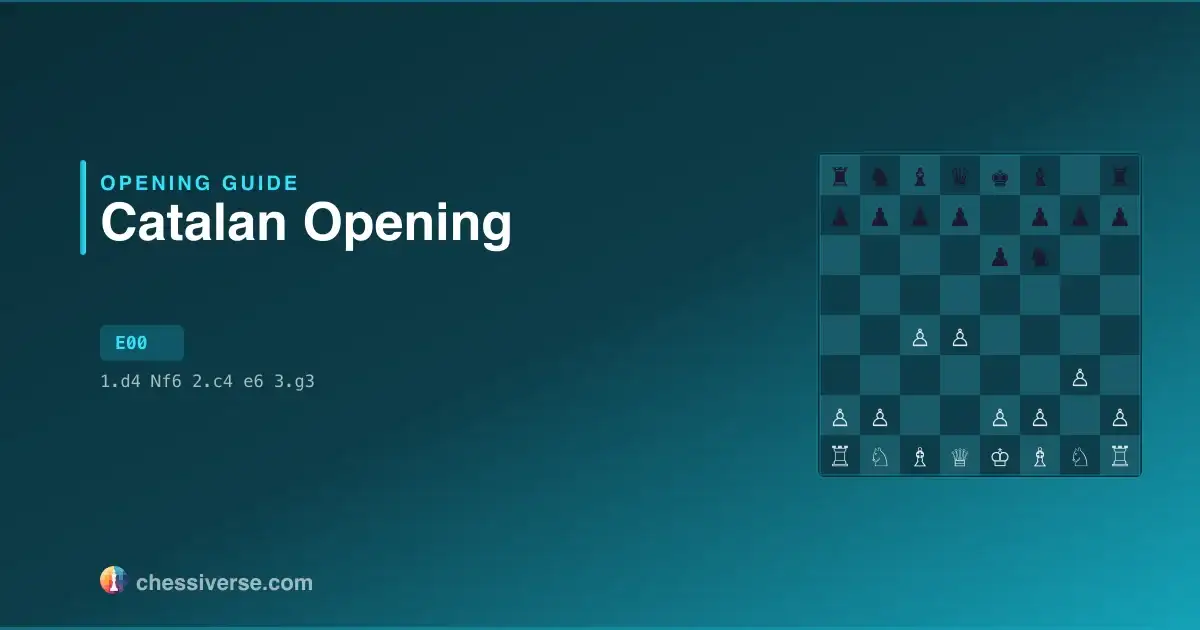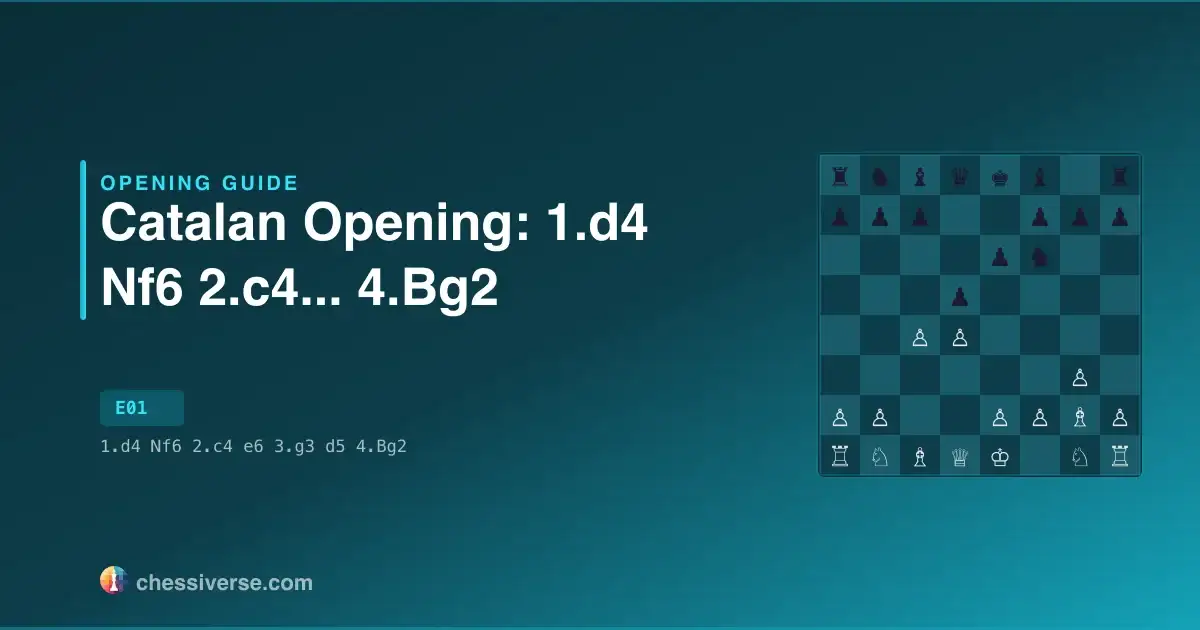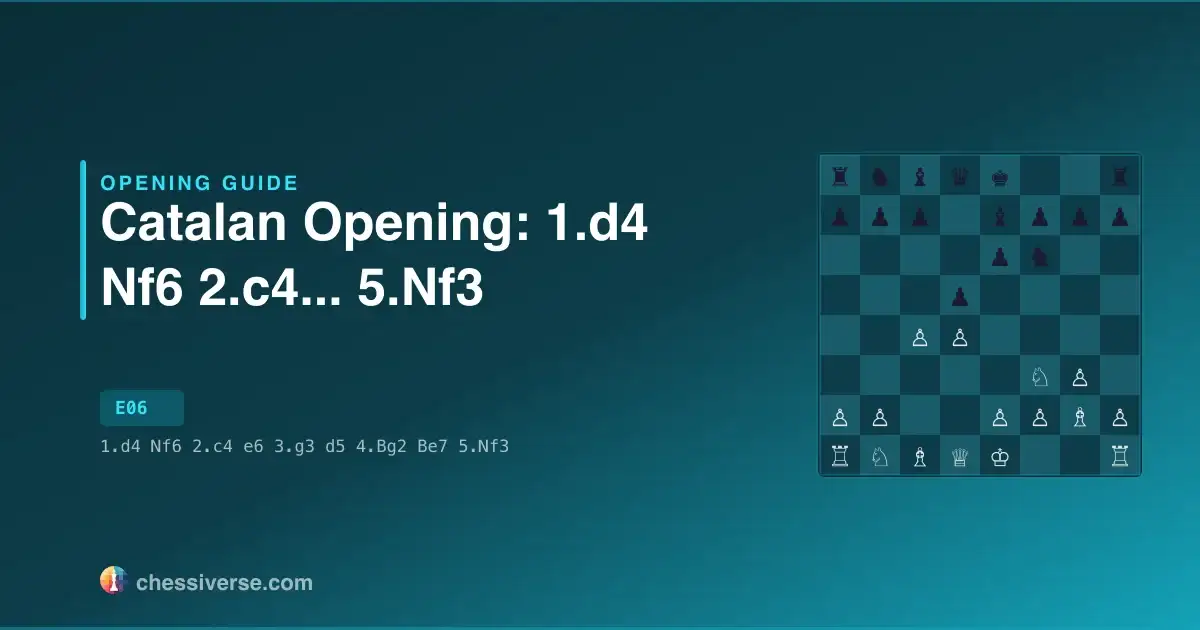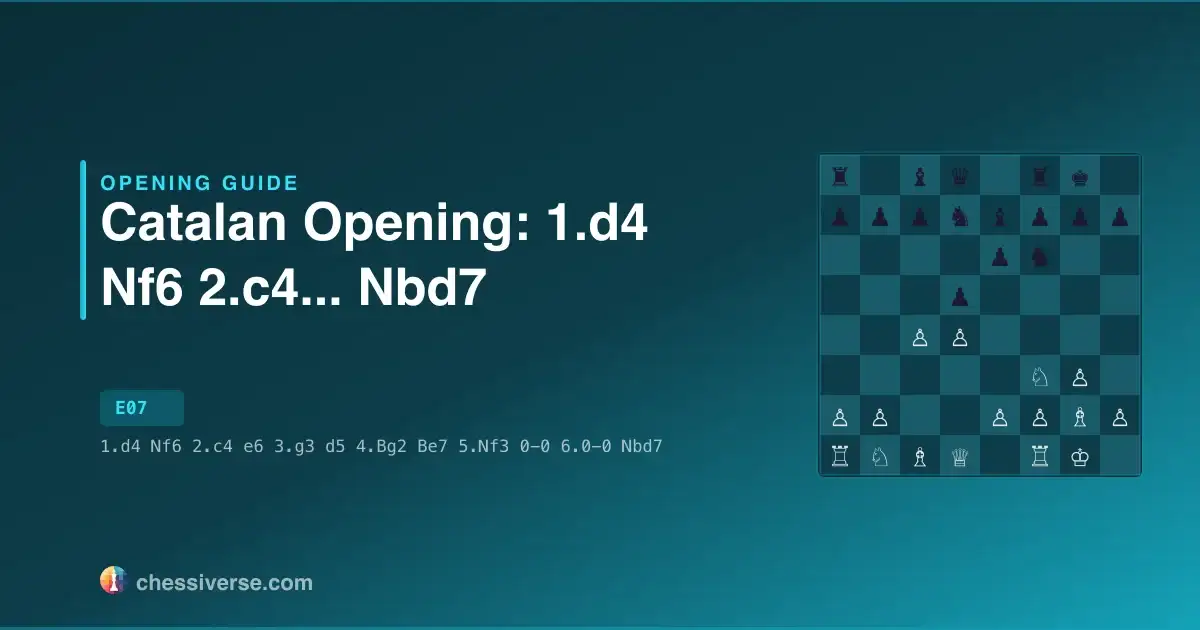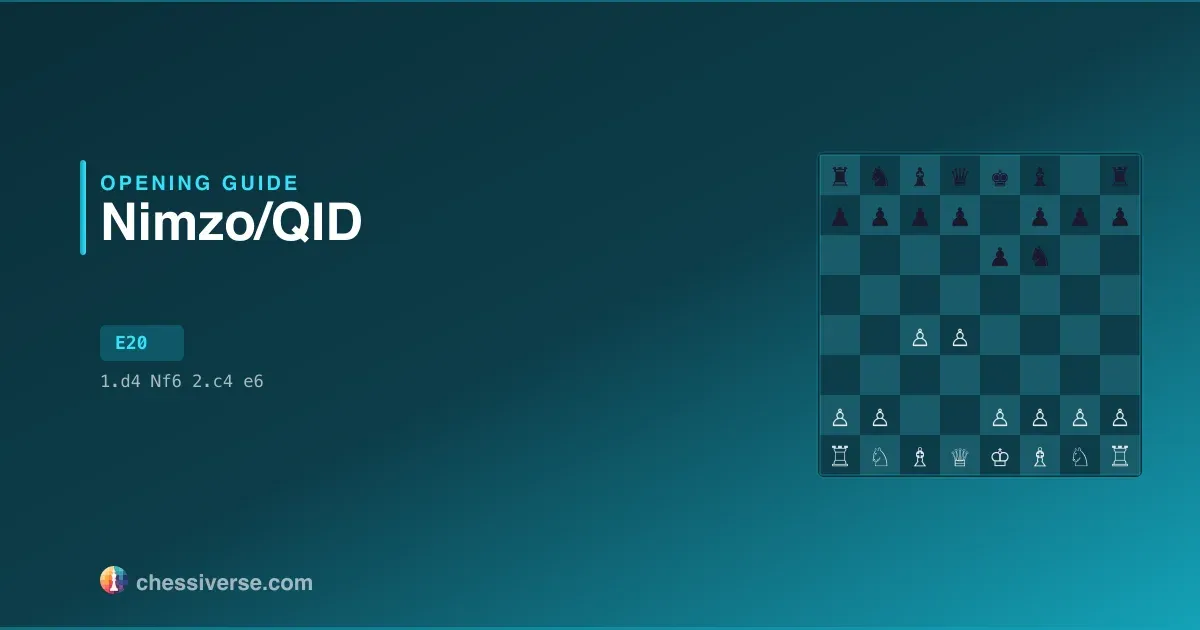
The Nimzo-Indian and Queen's Indian arises after 1.d4 Nf6 2.c4 e6 and falls under ECO code E00. The move 2...e6 is one of Black's most flexible choices against 1.d4, keeping all the major Indian Defense systems available without committing to any specific pawn structure. Everything hinges on White's third move. After 3.Nc3, Black can pin the knight with 3...Bb4, entering the Nimzo-Indian Defense and contesting White's control of e4. The positional significance of this pin is substantial: it neutralizes the knight's influence on e4 and introduces the threat of doubling White's pawns after a bishop-for-knight exchange. If White avoids 3.Nc3 by playing 3.Nf3, Black can head for the Queen's Indian with 3...b6, fianchettoing the bishop to contest the long diagonal and the central light squares, or choose the Bogo-Indian with 3...Bb4+. White also has 3.g3 available, steering toward the Catalan Opening. This strategic crossroads is what makes 2...e6 so appealing — Black defers all structural commitments until White reveals their intentions. With 13.1 million Lichess games across all rating levels, it is a well-established opening choice.
- 2...e6 frees the dark-squared bishop and keeps every door open: Nimzo-Indian after 3.Nc3 Bb4, Queen's Indian after 3.Nf3 b6, or a QGD with ...d5.
- Both main branches fight for the light squares e4 and d5, either with the Bb4 pin in the Nimzo or the ...b6 fianchetto in the Queen's Indian.
- The one drawback is that the e6-pawn temporarily blocks the c8-bishop's diagonal, though that is rarely a real problem in the early game.
History and Notable Players
It arises from the Indian Defense Systems. Among the most prolific practitioners on the White side are Svetozar Gligoric (364 games), Aleksej Aleksandrov (266 games), Jan Hein Donner (218 games). On the Black side, notable exponents include Ivan Farago (178 games), Viktor Korchnoi (174 games), Anatoly Karpov (160 games).
Both openings that grow out of 2...e6 are hypermodern: Black meets White's e2-e4 plans with pieces rather than putting a pawn in the centre. Aron Nimzowitsch introduced the Nimzo-Indian to master-level chess in the early twentieth century, and its sister opening, the Queen's Indian, appears when White sidesteps with 3.Nf3 and Black answers 3...b6.
Named after: The Nimzo half of the name honours Aron Nimzowitsch, whose Nimzo-Indian Defence arises if White continues 3.Nc3 and Black replies 3...Bb4.
Notable players: Aron Nimzowitsch, Garry Kasparov, Magnus Carlsen
White's third move here is really a referendum on the Nimzo-Indian: 3.Nc3 allows Nimzowitsch's famous pin, and many players choose 3.Nf3 or 3.g3 purely to avoid it.
Statistics
Based on 38.2 million Lichess games across all rating levels:
- White wins: 49.2%
- Black wins: 45.5%
- Draws: 5.4%
The statistics show a roughly balanced opening where both sides have equal chances.
Main Lines and Variations
After 1.d4 Nf6 2.c4 e6, the main continuations include:
Each of these lines leads to distinct types of positions and requires its own understanding of the resulting pawn structures and piece placements.
Practice on Chessiverse
The best way to learn the Nimzo-Indian and Queen's Indian is through practice. On Chessiverse, you can play chess against computer opponents that specialize in this opening. Our AI bots range from beginner to grandmaster level, each with unique playing styles — from aggressive attackers to solid defenders. Choose a bot that matches your rating and work your way up as you master the opening's key ideas.
Performance Across Rating Levels
Popularity and results vary sharply by rating level. Among 1200-rated players, it appears in 0.26% of games — 1,772,695 of them on record — with White winning 50.3% and Black 46.2%. At 1800 the opening surfaces in 1.18% of games; White wins 49%, Black 45.9%, draws 5.2%. At the top end (2500+ Elo), popularity is 4.91% with 10.3% draws — a clear sign of how much theory rules the line at master level.
Time Control Patterns
Time control matters here: blitz players reach for this opening more than others. In bullet, it appears in 0.20% of games (5,329,051); White wins 50.1%. Blitz shows 0.31% adoption across 11,040,420 games, White scoring 48.8%. In rapid, the share rises to 0.19% — 2,073,793 games, White 47.2%. White's score swings 2.9pp across formats, so time control isn't just a stylistic choice here — it shifts the actual results.
Move Diversity and Theory Depth
Looking at move selection shows how forcing — or not — the position really is. At 1200 Elo (505,067 games), the top reply is Bd2, played 30.3% of the time. Five other moves each take at least 5% of games, and the top three moves account for 61.5% of games. Entropy: 2.87. By 2500 (243,983 games), e3 takes over as the top reply at 34.7%; only four other moves still reach 5% and the top three moves account for 72.1% of games. Entropy drops to 2.58.