




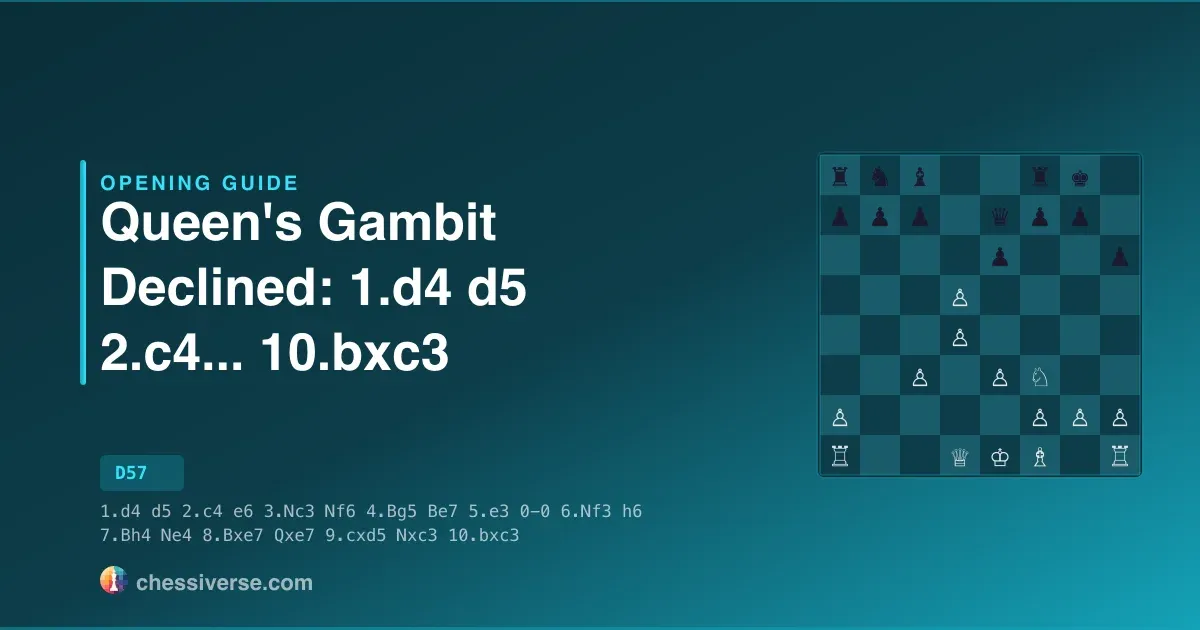
The Queen's Gambit Declined: Lasker Defense, Main Line begins with 1.d4 d5 2.c4 e6 3.Nc3 Nf6 4.Bg5 Be7 5.e3 0-0 6.Nf3 h6 7.Bh4 Ne4 8.Bxe7 Qxe7 9.cxd5 Nxc3 10.bxc3 (ECO D57). Across rating levels it shows up in 31,588 recorded games — enough data to map exactly where it succeeds and where it stalls.
History and Notable Players
It arises from the Queen's Gambit Declined: Neo-Orthodox Variation, Main Line. Among the most prolific White practitioners are Gideon Stahlberg (4 games), Borislav Ivkov (4 games), Wolfgang Uhlmann (4 games). Black-side regulars include Erich Gottlieb Eliskases (6 games), David Marciano (5 games), Oleg Korneev (4 games).
Move Diversity and Theory Depth
Looking at move selection shows how forcing — or not — the position really is. At 1200 Elo (647 games), the top reply is exd5, played 98.6% of the time. No other move reaches 5% of games, and the top three moves account for 99.4% of games. Entropy: 0.14. By 2500 (544 games), exd5 dominates at 100% of replies; no other move reaches 5%. Entropy drops to 0.00.
Common Mistakes
- Neglecting development — It can feel productive to make extra pawn moves early, but falling behind in piece development is what loses most amateur games — especially in open positions where active pieces find squares fast.
- Overextending the attack — Gambits look like permission to throw everything forward. They aren't — every attacking move should improve a piece. Random checks and threats burn the initiative once they fail to coordinate.
Practice on Chessiverse
Ready to try the Queen's Gambit Declined: Lasker Defense, Main Line against a bot? Pick an opponent at your level and play a game.