


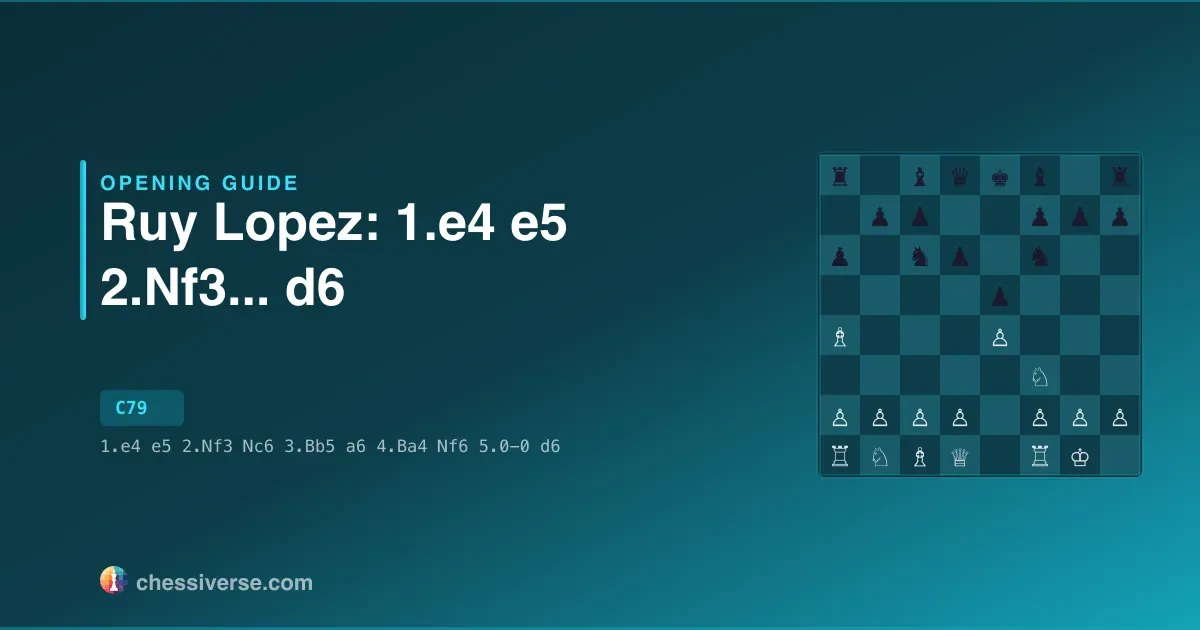
The Ruy Lopez: Morphy Defense, Steinitz Deferred begins with 1.e4 e5 2.Nf3 Nc6 3.Bb5 a6 4.Ba4 Nf6 5.0-0 d6 (ECO C79). Lichess records 694,189 games in this line, which gives us a reliable view of how it actually performs in practice.
History and Notable Players
It arises from the Ruy Lopez: Morphy Defense (5.0-0). On the White side, Frederick Yates (12 games), Emanuel Lasker (12 games), Alexander Alekhine (12 games) top the database. Notable Black exponents: Paul Keres (17 games), Akiba Rubinstein (16 games), Alexander Alekhine (14 games).
Performance Across Rating Levels
How well the Ruy Lopez: Morphy Defense, Steinitz Deferred works depends on what level you're playing at. The 1200 bracket has 45,526 games (0.01% of all games at that level); White wins 52.4%, Black 43.7%, 3.9% are drawn. Move up to 1800 Elo and the share shifts to 0.02%, with White winning 53.5% versus Black's 41.4%. Among 2500-rated players the line appears in 0.04% of games and draws spike to 9.6%, indicating tight preparation. White's edge erodes by 7.3pp from 1200 to 2500 Elo, suggesting Black's counterplay is easier to find with experience.
Time Control Patterns
The Ruy Lopez: Morphy Defense, Steinitz Deferred skews toward rapid chess. In bullet, it appears in 0.01% of games (158,150); White wins 52.8%. Blitz shows 0.01% adoption across 525,950 games, White scoring 52.9%. In rapid, the share rises to 0.02% — 168,239 games, White 52.8%.
Move Diversity and Theory Depth
Looking at move selection shows how forcing — or not — the position really is. At 1200 Elo (45,526 games), the top reply is Re1, played 43.3% of the time. Five other moves each take at least 5% of games, and the top three moves account for 68.4% of games. Entropy: 2.46. By 2500 (5,043 games), Re1 is still the top reply, at 42.5%; only four other moves still reach 5% and the top three moves account for 77.5% of games. Entropy drops to 2.31.
Historical Trends
Year-over-year data tells you whether this opening is a contemporary fixture or a fading one. Adoption peaked in 2017 at 0.02% (26,038 games). By 2025 it sits at 0.01%, 46% below the peak and 38% under its 2013 level, leaving the line in decline.
Common Mistakes
- Drifting away from main theory — At 400 Elo, the three most-played moves cover 70.2% of games, against 76.3% at 2000. The most popular deviation is Nc3 (played 18.6% of the time at 400, much less so up top). It looks fine but quietly hands the better-prepared side an edge.
- Neglecting development — Extra pawn moves in the opening are tempting, especially when you "know the moves". Developing a piece each turn is the simple correction.
- Playing without a plan — Each Ruy Lopez: Morphy Defense, Steinitz Deferred middlegame demands a specific approach. Decide whether the position calls for attack, manoeuvre, or simplification before reaching for a move.
Practice on Chessiverse
Ready to try the Ruy Lopez: Morphy Defense, Steinitz Deferred against a bot? Pick an opponent at your level and play a game.