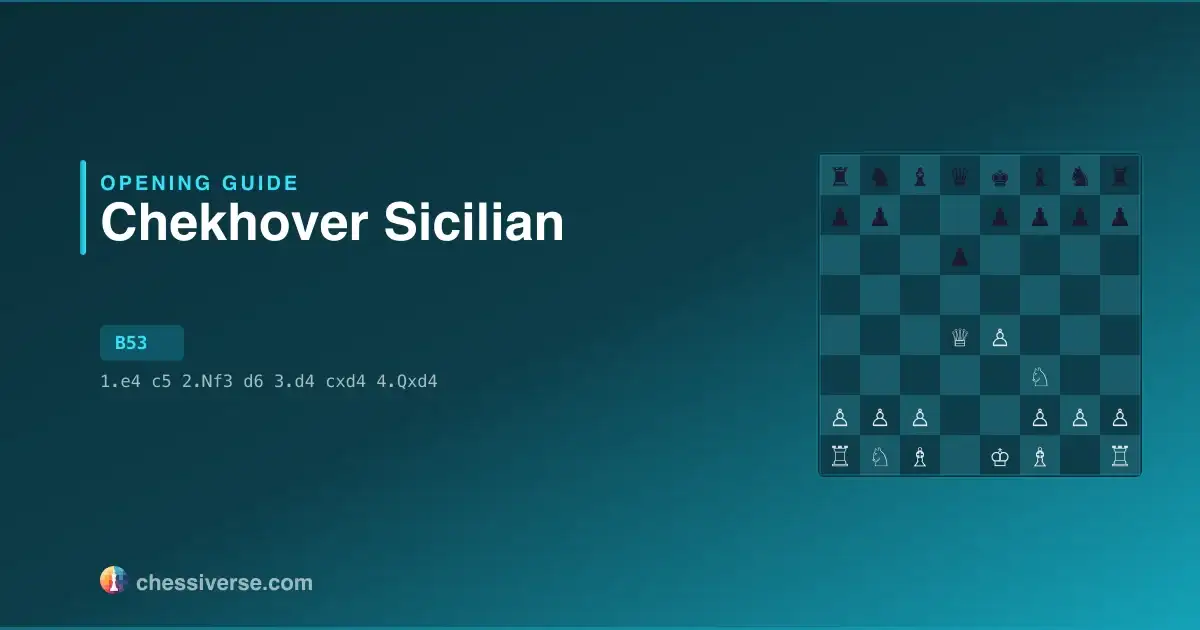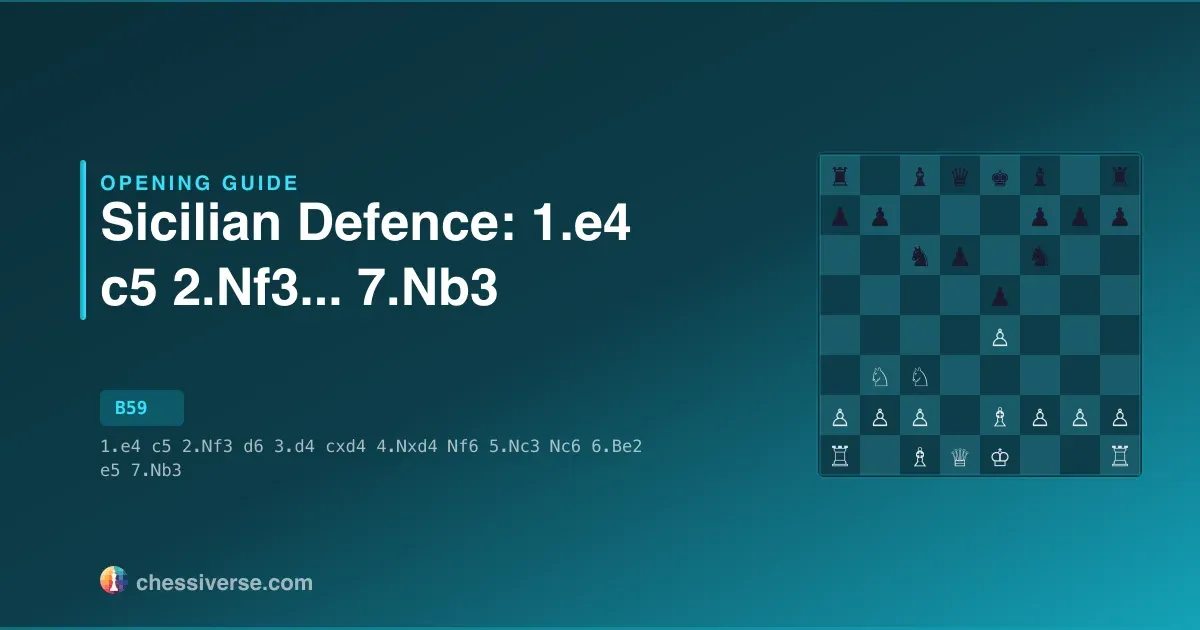
Starting from 1.e4 c5 2.Nf3 d6 3.d4 cxd4 4.Nxd4 Nf6 5.Nc3 Nc6 6.Be2 e5 7.Nb3, players enter the Sicilian Defense: Boleslavsky Variation — ECO B59. Lichess records 143,986 games in this line, which gives us a reliable view of how it actually performs in practice.
History and Notable Players
It arises from the Sicilian Defense: Classical Variation (6.Be2). Among the most prolific White practitioners are Herman Pilnik (17 games), Dragoljub Janosevic (10 games), Wolfgang Unzicker (8 games). Black-side regulars include Ticia Gara (9 games), Ildiko Madl (8 games), Viliam Sulek (8 games).
Performance Across Rating Levels
How well the Sicilian Defense: Boleslavsky Variation works depends on what level you're playing at. The 1200 bracket has 1,592 games (0.00% of all games at that level); White wins 50.9%, Black 46.3%, 2.8% are drawn. Move up to 1800 Elo and the share shifts to 0.00%, with White winning 49% versus Black's 45.8%. Among 2500-rated players the line appears in 0.02% of games and draws spike to 10.3%, indicating tight preparation. White's edge erodes by 11.5pp from 1200 to 2500 Elo, suggesting Black's counterplay is easier to find with experience.
Move Diversity and Theory Depth
Move choice is far from uniform in the Sicilian Defense: Boleslavsky Variation. At 1200 Elo (1,592 games), the top reply is Be7, played 45.2% of the time. Three other moves each take at least 5% of games, and the top three moves account for 81.9% of games. Entropy: 2.25. By 2500 (2,451 games), Be7 dominates at 80.5% of replies; only one other move still reaches 5% and the top three moves account for 96.4% of games. Entropy drops to 1.00. That entropy collapse is the signature of a line where preparation pays off: at the top, players know the best move and play it.
Common Mistakes
- Drifting away from main theory — At 1000 Elo, the three most-played moves cover 77.1% of games, against 93.4% at 2000. The most popular deviation is g6 (played 13.7% of the time at 1000, much less so up top). It looks fine but quietly hands the better-prepared side an edge.
- Neglecting development — It can feel productive to make extra pawn moves early, but falling behind in piece development is what loses most amateur games — especially in open positions where active pieces find squares fast.
- Ignoring the kingside attack — In sharp Sicilian lines, White typically castles long and pushes the h-pawn. Without your own counterplay on the queenside or in the centre, White's attack lands first.
Practice on Chessiverse
Ready to try the Sicilian Defense: Boleslavsky Variation against a bot? Pick an opponent at your level and play a game.