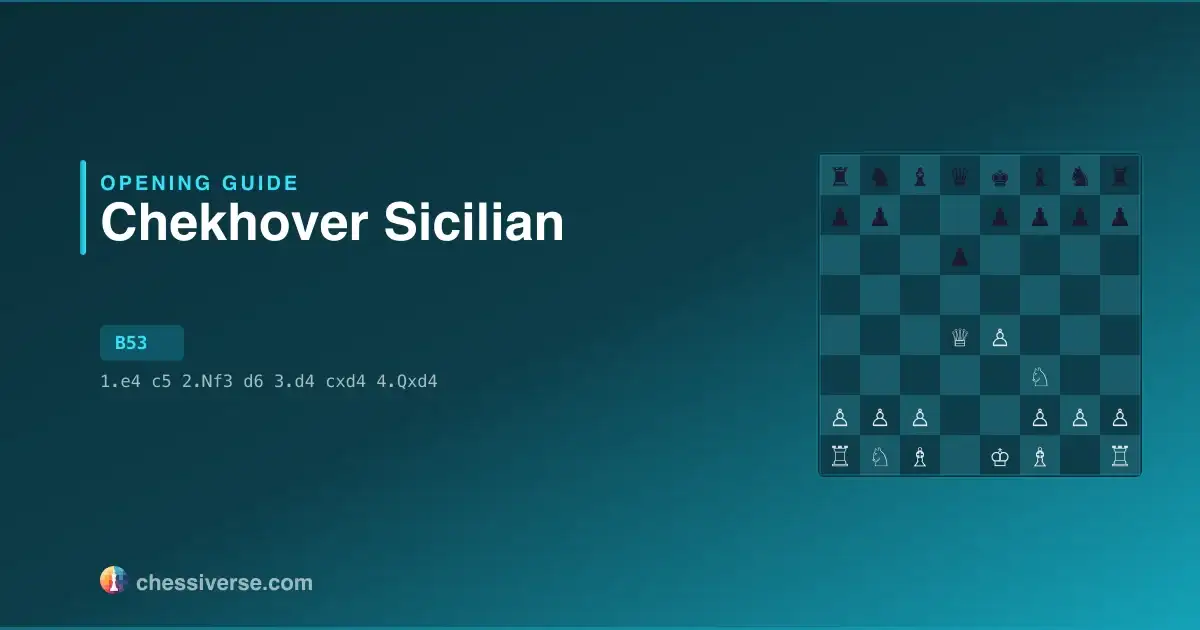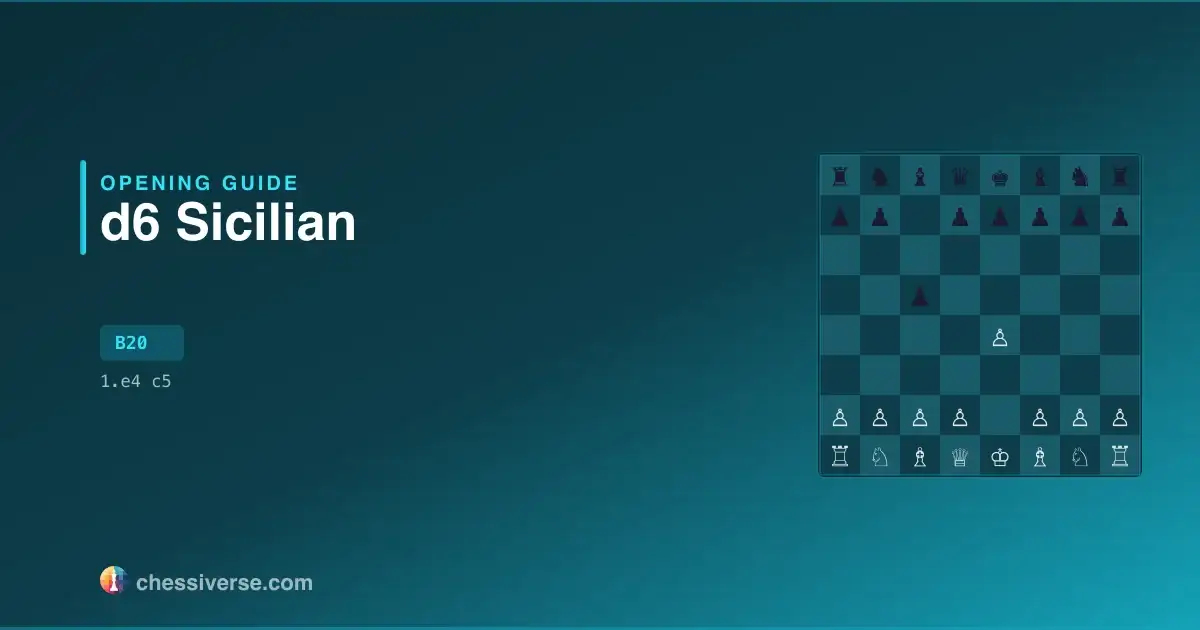




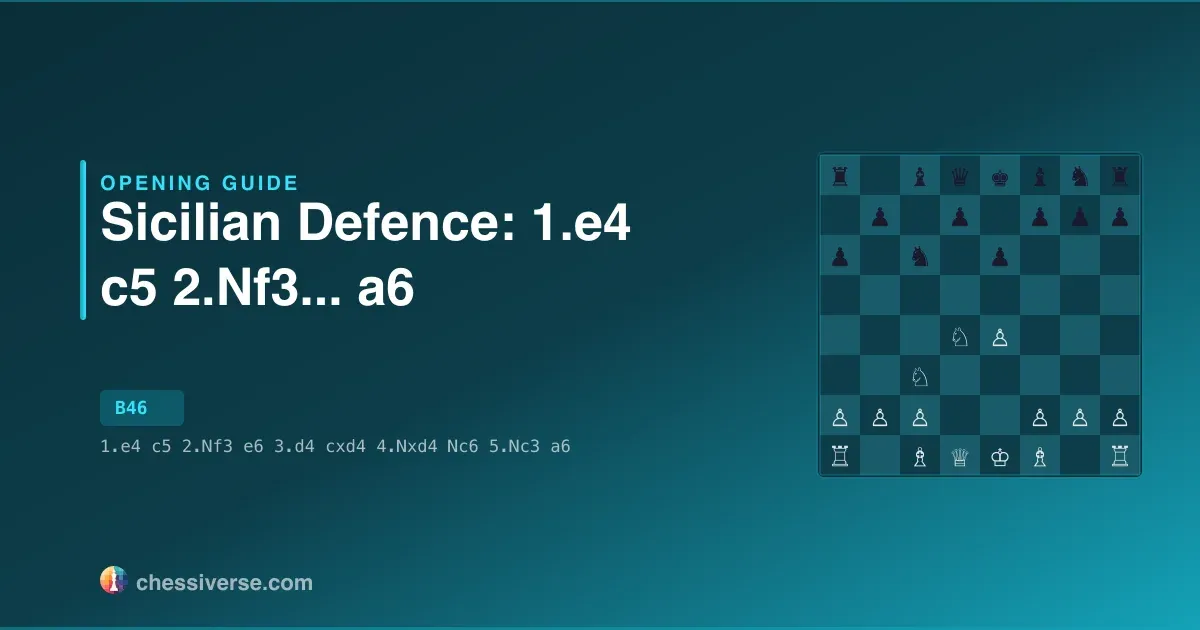
1.e4 c5 2.Nf3 e6 3.d4 cxd4 4.Nxd4 Nc6 5.Nc3 a6 opens the Sicilian Defense: Taimanov Variation (5...a6), ECO B46. With 2,685,568 games on record, the patterns below come from the largest practical sample available.
History and Notable Players
It arises from the Sicilian Defense: Taimanov Variation (5.Nc3). Among the most prolific White practitioners are Dragoljub Velimirovic (24 games), Aleksander Sznapik (23 games), Vlastimil Jansa (22 games). Black-side regulars include Mark E Taimanov (157 games), Vlastimil Jansa (118 games), Sergei Rublevsky (84 games).
Performance Across Rating Levels
How well the Sicilian Defense: Taimanov Variation (5...a6) works depends on what level you're playing at. The 1200 bracket has 77,826 games (0.01% of all games at that level); White wins 46.8%, Black 50%, 3.1% are drawn. At 1800 the opening surfaces in 0.11% of games; White wins 47.8%, Black 47.7%, draws 4.5%. At 2500, 0.07% of games go into this opening; draws sit at 9.3% — the line is well-mapped at this level. Positions also become less sharp as level rises (sharpness 0.97 → 0.91).
Time Control Patterns
Time control matters here: blitz players reach for this opening more than others. In bullet, it appears in 0.05% of games (1,343,618); White wins 47.6%. Blitz shows 0.06% adoption across 2,226,778 games, White scoring 47.8%. In rapid, the share rises to 0.04% — 458,790 games, White 48%.
Move Diversity and Theory Depth
Looking at move selection shows how forcing — or not — the position really is. At 1200 Elo (77,826 games), the top reply is Nxc6, played 35.6% of the time. Four other moves each take at least 5% of games, and the top three moves account for 71.3% of games. Entropy: 2.71. By 2500 (9,807 games), Nxc6 is still the top reply, at 31.6%; only three other moves still reach 5% and the top three moves account for 73.6% of games. Entropy drops to 2.57.
Historical Trends
Long-term, the trajectory of this opening is informative. Adoption peaked in 2015 at 0.09% (19,388 games). By 2025 it sits at 0.05%, 42% below the peak and 25% under its 2013 level, leaving the line in decline.
Common Mistakes
- Neglecting development — It can feel productive to make extra pawn moves early, but falling behind in piece development is what loses most amateur games — especially in open positions where active pieces find squares fast.
- Ignoring the kingside attack — In sharp Sicilian lines, White typically castles long and pushes the h-pawn. Without your own counterplay on the queenside or in the centre, White's attack lands first.
Practice on Chessiverse
Ready to try the Sicilian Defense: Taimanov Variation (5...a6) against a bot? Pick an opponent at your level and play a game.