




Chessiverse mascots facing off over the Italian Game
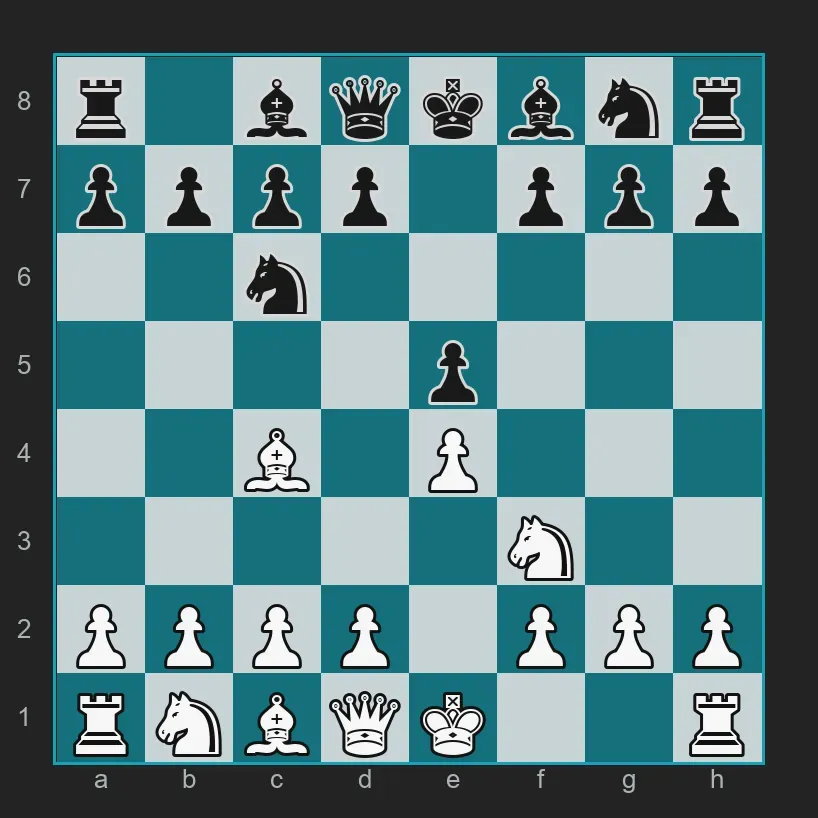
Chess board showing the Italian Game position after 1.e4 e5 2.Nf3 Nc6 3.Bc4
Summary
The Italian Game begins 1.e4 e5 2.Nf3 Nc6 3.Bc4. White develops the bishop to its best square, targets the weak f7 pawn, and prepares to castle. It is one of the oldest recorded openings, easy to learn, and trusted from beginner games to world championships. This guide covers the main line, the three variations, White's plan, and the mistakes to avoid.
Practice the Italian Game against 1000+ human-like bots on Chessiverse - free
Contents
- What is the Italian Game?
- The first five moves
- Why it suits improving players
- The three main variations
- Your five-step game plan
- Typical middlegame plans
- Common mistakes
- Italian Game vs Ruy Lopez
- Practice against a bot
- FAQ
- Sources
What is the Italian Game?
The Italian Game (ECO codes C50 to C59) starts with three natural moves:
- e4 e5
- Nf3 Nc6
- Bc4

Animated sequence of the Italian Game moves 1.e4 e5 2.Nf3 Nc6 3.Bc4
Each move follows a classical principle: the pawn claims the center, the knight develops while attacking e5, and the bishop aims at f7, the one square only Black's king defends. Fast development, king safety, pressure on f7. That is the whole idea.
Why it is called the Italian Game
The opening carries the name of the Italian masters who shaped it in the 16th and 17th centuries, above all Gioachino Greco, whose recorded games spread the ideas across Europe long before modern theory existed (Wikipedia, no-follow). The label stuck because those players documented the bishop-on-c4 attacking plan first.
The main idea in one sentence
White wants to develop every piece toward Black's king, castle short, and build pressure on f7 before Black finishes coordinating. Nothing here is tricky. The Italian rewards understanding of a plan rather than memory of a computer line, which is exactly why it has survived five centuries of analysis.
The first five moves, explained
Most Italian games reach the same tabiya. This table walks through the standard build-up and the point of each move.
| Move | White | Point |
|---|---|---|
| 1 | e4 | Claim the center, open lines for bishop and queen |
| 2 | Nf3 | Develop with a threat against e5 |
| 3 | Bc4 | Aim the bishop at f7 |
| 4 | c3 | Prepare the d4 central break |
| 5 | d3 | Support e4, open the c1 bishop, keep it solid |
After 3...Bc5 4.c3 Nf6 5.d3 you have reached the Giuoco Pianissimo, today's most common Italian structure. Both sides are developed, nothing is committed, and the real game is about to begin.
Why the Italian Game suits improving players
Three reasons make the Italian the best first opening for most players:
- The plans are logical. Develop, castle, fight for the center. You learn ideas, not memorized computer lines.
- It is flexible. Steer toward quiet maneuvering or sharp attacks depending on your mood.
- Theory stays manageable. Compared to the Ruy Lopez or the Sicilian, a handful of key ideas covers most games.
If you are still choosing your repertoire, see our overview of the best chess openings for White.
The three main variations
Black's third move decides which Italian you get. This table gives the map, and each branch is explained below.
| Variation | Black plays | Character | Best for |
|---|---|---|---|
| Giuoco Piano | 3...Bc5 | Slow, strategic | Learning classical plans |
| Evans Gambit | 3...Bc5 4.b4 | Sharp, sacrificial | Attackers |
| Two Knights Defense | 3...Nf6 | Tactical chaos | Fearless calculators |
Giuoco Piano: the quiet main line
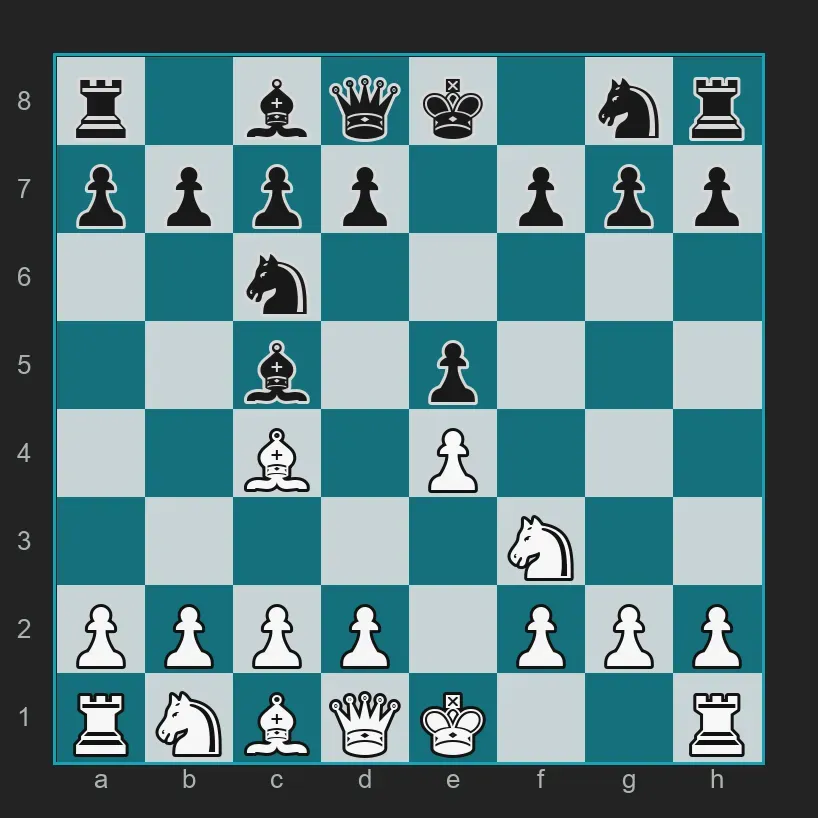
Giuoco Piano position after 1.e4 e5 2.Nf3 Nc6 3.Bc4 Bc5
Giuoco Piano means "quiet game" in Italian. After 3...Bc5 both bishops eye the enemy f-pawns, and play usually continues 4.c3 Nf6 5.d3, the Giuoco Pianissimo. White builds slowly with c3 and d3 before committing to a plan. Move statistics for the 4.c3 setup are in our opening guide to the Italian Game: Classical Variation.
Why modern grandmasters love it
The slow structure keeps every piece on the board and rewards whoever understands the position better. That is why it dominates elite chess today: Magnus Carlsen, Fabiano Caruana, and Wesley So all trust it in top events, as the master database on the Lichess opening explorer (no-follow) confirms. If world champions choose it over sharper systems, the ideas are sound rather than fashionable.
Evans Gambit: the romantic attack
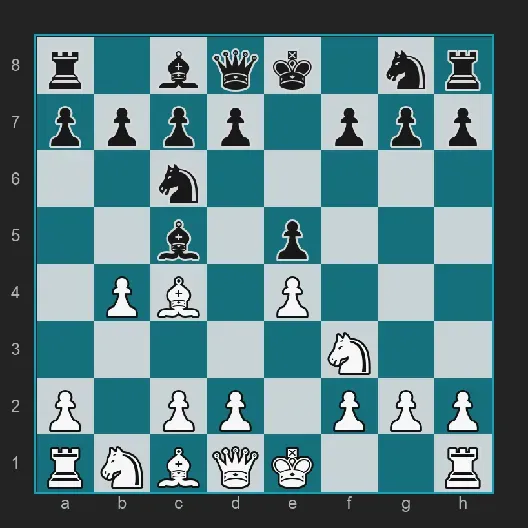
Evans Gambit position after 1.e4 e5 2.Nf3 Nc6 3.Bc4 Bc5 4.b4
The Evans Gambit offers the b-pawn to gain time: after 4...Bxb4 5.c3 the bishop must move again while White builds a broad center with d4. It was the 19th century's favorite weapon and still scores heavily in club chess.
The theory of the Evans Gambit
White trades one pawn for two tempi and open lines toward f7. The main line 5...Ba5 6.d4 exd4 7.O-O gives fast development for the pawn. One imprecise defensive move often ends the game. If Black declines with 4...Bb6, White simply gains queenside space for free and keeps a comfortable position.
Two Knights Defense: inviting the storm
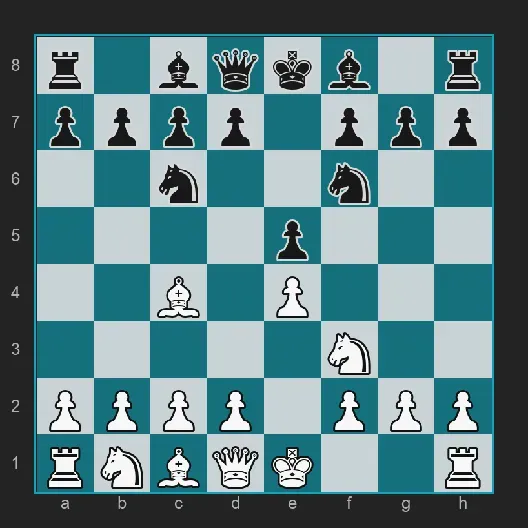
Two Knights Defense position after 1.e4 e5 2.Nf3 Nc6 3.Bc4 Nf6
With 3...Nf6 Black counterattacks e4 instead of developing quietly. The critical answer 4.Ng5 attacks f7 immediately and leads to the famous Fried Liver complex after 4...d5 5.exd5 Nxd5 6.Nxf7.
The Fried Liver Attack
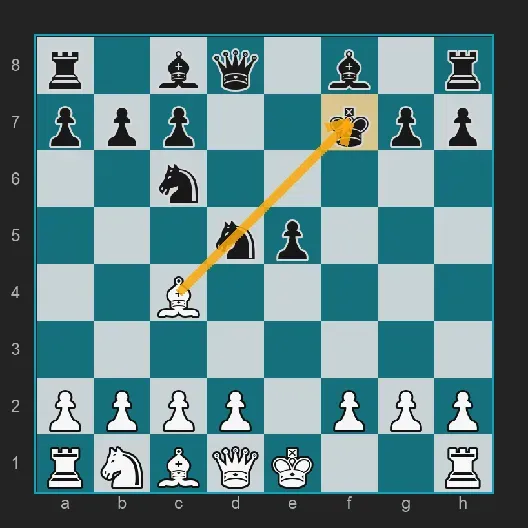
Fried Liver Attack position after 6.Nxf7 Kxf7, White's bishop bearing down on the exposed king
After 6.Nxf7 Kxf7 White sacrifices the knight to drag the black king into the open, then plays 7.Qf3+ and 8.Nc3 hunting the pinned knight on d5. It is one of the sharpest lines a beginner will ever meet. Prefer calm? Answer 3...Nf6 with 4.d3 and transpose to Pianissimo structures instead.
Your five-step game plan
You do not need twenty moves of theory. This plan covers most club games:
- Play 1.e4, 2.Nf3 and 3.Bc4 in that order.
- Castle short early, usually within the first six moves.
- Support the center with c3 and d3 (or d4 when tactics allow).
- Reroute the queenside knight: Nbd2, then Nf1 and Ng3 toward the kingside.
- Start your attack only when every piece has a job.
Typical middlegame plans
Openings are only useful if you know what comes next. These three plans decide most Italian middlegames.
The d3-d4 break
After the quiet c3 and d3 setup, the thematic pawn break is d4 at the right moment. Prepare it with Re1 and h3 first. Played too early, it opens the position for Black's pieces; timed well, it wins the center outright and hands White a lasting space edge.
The kingside knight tour
The queenside knight has a famous journey: Nbd2, Nf1, then Ng3 or Ne3. From g3 it eyes the f5 outpost; from e3 it supports d5. This slow regrouping is the heart of Pianissimo play, and most opponents below 1800 never see the attack coming.
Meeting the ...Na5 bishop hunt
When Black plays ...Na5 to trade your c4 bishop, you choose: retreat with Bb3 and meet ...Nxb3 with axb3, opening the a-file for your rook, or drop back to c2 keeping the bishop for a later kingside attack. Decide before it happens, not after.
Common mistakes to avoid
- Grabbing f7 too early. Bxf7+ on move four trades your best bishop for a pawn and hands Black's king a safe home in most lines.
- Blocking the c-pawn. Nc3 before c3 removes your best central lever in Giuoco Piano structures.
- Ignoring ...Na5. Black often hunts the c4 bishop. Decide in advance: retreat to b3, or allow the trade and take the open file.
- Attacking with undeveloped pieces. A queen raid before castling usually loses time and the initiative.
Italian Game vs Ruy Lopez
Both openings start 1.e4 e5 2.Nf3 Nc6, then split on move three. The choice shapes how much you study.
| Italian Game (3.Bc4) | Ruy Lopez (3.Bb5) | |
|---|---|---|
| Pressure | Direct, on f7 | Long-term, on the center |
| Theory load | Manageable | Heavy |
| Best for | Most improving players | Ambitious theory students |
Neither is objectively stronger. The Ruy Lopez creates more durable pressure but demands far more memorization; the Italian reaches equally healthy positions with a fraction of the theory. For a first 1.e4 opening, we recommend the Italian.
Practice the Italian Game against a bot
Reading builds knowledge; playing builds skill. On Chessiverse you can open with the Italian every single game against a human-like bot at your exact level, with no queues and no cheating. Try steering ten games in a row into the Giuoco Pianissimo and feel the middlegame plans become automatic.
For video study, co-founder IM John Bartholomew's YouTube channel (external link) covers Italian structures in his instructive game series.
Play the Italian Game vs a human-like bot now

A bishop mascot aiming across the board at the classic Italian target
Frequently asked questions
Is the Italian Game good for beginners?
Yes. It follows every classical opening principle, the ideas transfer to other openings, and you can play it for years without hitting a theoretical wall. Many coaches make it the first opening they teach, precisely because it teaches real chess instead of memorized traps.
Why is it called the Italian Game?
It is named after the Italian masters of the 16th and 17th centuries who first analyzed the bishop-to-c4 attack, most famously Gioachino Greco. Their recorded games carried the opening across Europe, and the name has stuck for roughly five hundred years.
What are the first five moves of the Italian Game?
The standard sequence is 1.e4 e5 2.Nf3 Nc6 3.Bc4 Bc5 4.c3 Nf6 5.d3, reaching the Giuoco Pianissimo. Both sides develop naturally and prepare to castle before the middlegame fight begins. Move orders vary, but this is the backbone most games follow.
What does Giuoco Piano mean?
Giuoco Piano is Italian for "quiet game". It describes the slow, strategic character of the 3...Bc5 main line, where both sides build up carefully before any real conflict. The even quieter modern treatment with c3 and d3 is called the Giuoco Pianissimo, or "very quiet game".
Which grandmasters play the Italian Game?
At the top level Magnus Carlsen, Fabiano Caruana, Wesley So, and many others use the Giuoco Pianissimo regularly. Its return to elite chess in the 2010s proved that a low-theory classical opening can still pose real problems at the highest level.
What is the theory of the Evans Gambit?
White plays 4.b4, offering a pawn to deflect Black's bishop and gain the tempi for a big center with c3 and d4. In return White accepts a small material deficit for a fast, attacking initiative aimed at f7. It rewards accurate attacking play and punishes passive defense.
How long does it take to learn the Italian Game?
You can play your first Italian tonight: three moves and a plan is genuinely enough to start. Expect the main Giuoco Piano ideas to feel natural after about twenty games, and the Evans Gambit and Two Knights lines to settle in over a couple of months of casual play.
Start playing free on Chessiverse
Keep learning: best chess openings for White, Vienna Opening guide, or play vs the computer.

Chessiverse mascots studying the opening together
Sources
External links are no-follow.
- Wikipedia: Italian Game (history, ECO classification) - https://en.wikipedia.org/wiki/Italian_Game
- Lichess opening explorer (master-game statistics for the variations) - https://lichess.org/opening
- John Bartholomew, YouTube (video study) - https://www.youtube.com/@johnbartholomew