




The white Chessiverse mascot army lined up behind the board
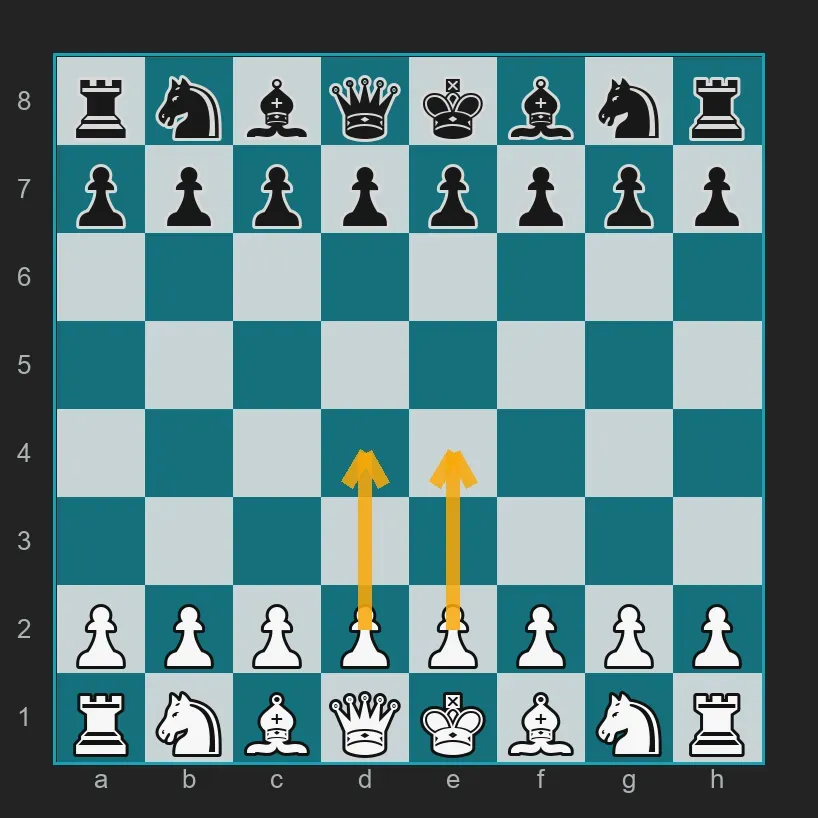
The chess starting position with arrows on the two best first moves, e4 and d4
Summary
The best chess opening for White depends on your level, style, and study time, but the practical default is clear: the Italian Game (1.e4 e5 2.Nf3 Nc6 3.Bc4) offers the best mix of soundness, learning value, and low theory for most players. Engines rate 1.e4 and 1.d4 almost identically, so no first move wins by force. This guide ranks 8 proven openings by rating and style, then shows the key moves and plans for each.
Practice every opening against 1000+ human-like bots on Chessiverse - free
Contents
- The 8 openings at a glance
- The best first move
- Best openings by player type
- The 8 best openings in detail
- 1.e4, 1.d4, 1.c4 or 1.Nf3?
- What the win-rate data says
- Build a complete repertoire
- Common mistakes
- How to learn your opening
- FAQ
- Sources
The 8 best openings at a glance
Every opening below has carried players from beginner to master. This table is the fast way to pick yours by rating band and style; the detailed sections follow.
| Opening | First moves | Style | Theory load | Rating band |
|---|---|---|---|---|
| Italian Game | 1.e4 e5 2.Nf3 Nc6 3.Bc4 | Classical, flexible | Medium | All levels |
| Ruy Lopez | 1.e4 e5 2.Nf3 Nc6 3.Bb5 | Positional pressure | Heavy | 1400+ |
| Queen's Gambit | 1.d4 d5 2.c4 | Strategic | Medium-high | Intermediate+ |
| London System | 1.d4 + Bf4 | Solid, systematic | Minimal | All levels |
| Vienna Game | 1.e4 e5 2.Nc3 | Aggressive | Low-medium | All levels |
| Scotch Game | 1.e4 e5 2.Nf3 Nc6 3.d4 | Open, direct | Low-medium | Beginner+ |
| English Opening | 1.c4 | Positional | Medium | Intermediate+ |
| King's Gambit | 1.e4 e5 2.f4 | Sharp, romantic | Low-medium | Surprise weapon |
What is the best first move in chess?
The two most principled first moves are 1.e4 and 1.d4. Both claim the center and open lines for the pieces. 1.e4 tends toward open, tactical games; 1.d4 toward structured, strategic ones. Master-game databases show nearly identical results for both (Lichess opening explorer, no-follow), so the choice is about taste, not strength.
Best by engine evaluation
At engine level, 1.e4 and 1.d4 are effectively equal, and 1.c4 and 1.Nf3 sit just behind. No first move wins by force from the starting position. That means the search for a single best move is the wrong question; the better question is which opening's plans you will actually learn.
Best for beginners
For a first opening we recommend the Italian Game. Open positions teach tactics naturally, the plans are logical, and the ideas transfer to everything you learn later. If you would rather memorize almost nothing, the London System is the low-theory alternative, though it shows fewer tactical patterns early.
Best White openings by player type
Pick the row that sounds like you, then jump to that opening's section below:
- Best overall and best for beginners: Italian Game. Classical, sound, and endlessly instructive.
- Best low-theory system: London System. One setup against almost everything.
- Best aggressive opening: Vienna Game or King's Gambit. Fast attacks most club players have not studied.
- Best positional opening: Queen's Gambit or English. Slow squeezes and long-term pressure.
- Best for ambitious intermediates (1400+): Ruy Lopez. The most respected 1.e4 weapon, at a real theory cost.
- Best direct 1.e4 alternative: Scotch Game. Opens the center at once with far less theory than the Ruy Lopez.
- Best for rapid and blitz: London System or Vienna. Fast to set up and light on memory when the clock is short.
- Best surprise weapon: King's Gambit. A one-off punch that unsettles opponents who expected a quiet game.
The 8 best openings in detail
Each section gives the main moves, what White wants, how Black usually replies, and who should play it. The diagrams show the position after the defining move.
1. The Italian Game (1.e4 e5 2.Nf3 Nc6 3.Bc4)
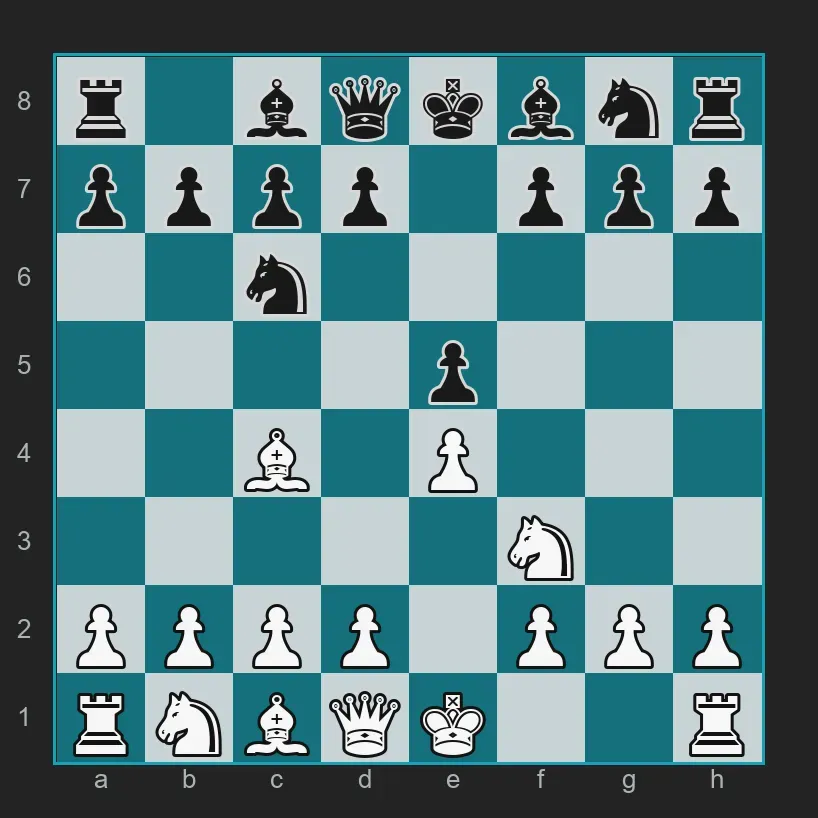
Italian Game position after 1.e4 e5 2.Nf3 Nc6 3.Bc4
White develops naturally, aims the bishop at f7, and castles within a few moves. The plans are logical, the theory is manageable, and the ideas transfer to every opening you will ever learn afterward.
How Black replies and who should play it
Black usually chooses 3...Bc5 (the quiet Giuoco Piano) or 3...Nf6 (the sharper Two Knights). Against both, White builds with c3 and d3 and prepares the d4 break. Best for players who want classical, honest chess with room to grow. See our complete Italian Game guide for every variation. Beginner mistake: grabbing f7 with Bxf7+ too early and trading your best bishop for one pawn.
2. The Ruy Lopez (1.e4 e5 2.Nf3 Nc6 3.Bb5)
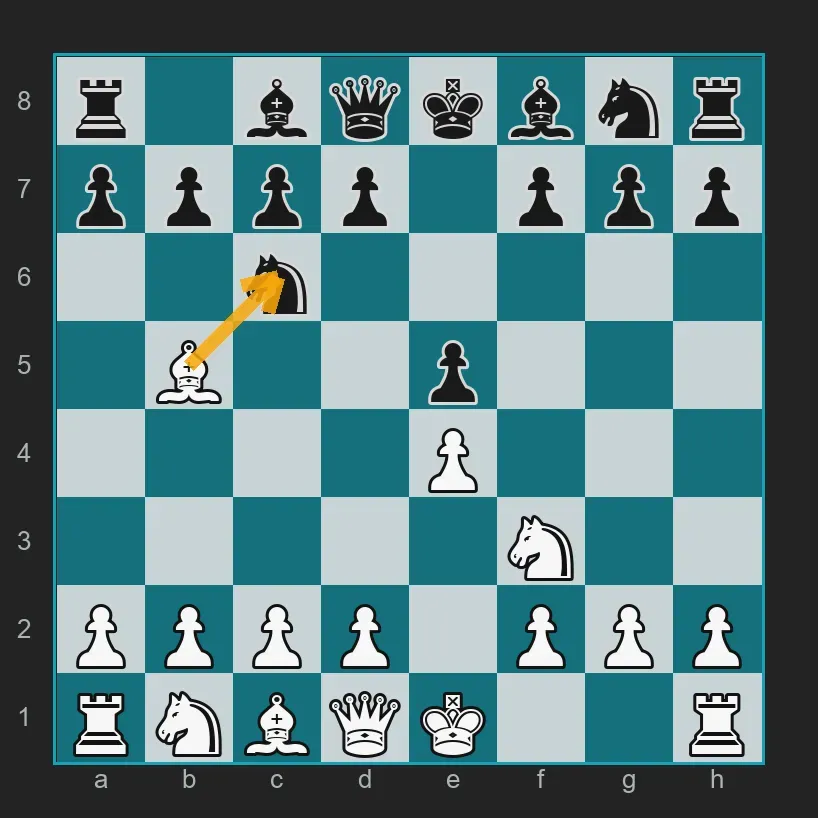
Ruy Lopez position after 1.e4 e5 2.Nf3 Nc6 3.Bb5, the bishop pressuring the knight on c6
The Ruy Lopez, or Spanish, pressures the knight that defends e5. White castles, plays c3 and d4, and builds slow, lasting pressure. It is the Italian's more theoretical sibling and Bobby Fischer's favorite weapon against 1...e5.
How Black replies and who should play it
The main lines run 3...a6 4.Ba4 (the Morphy) or the solid 3...Nf6 Berlin Defense that helped Kramnik dethrone Kasparov. Both demand accurate play from White. Best for ambitious intermediates who enjoy strategy and will invest study time. Beginner mistake: treating the pin as a threat to win the pawn immediately; after 4.Bxc6 dxc6 5.Nxe5 Qd4 Black regains it.
3. The Queen's Gambit (1.d4 d5 2.c4)
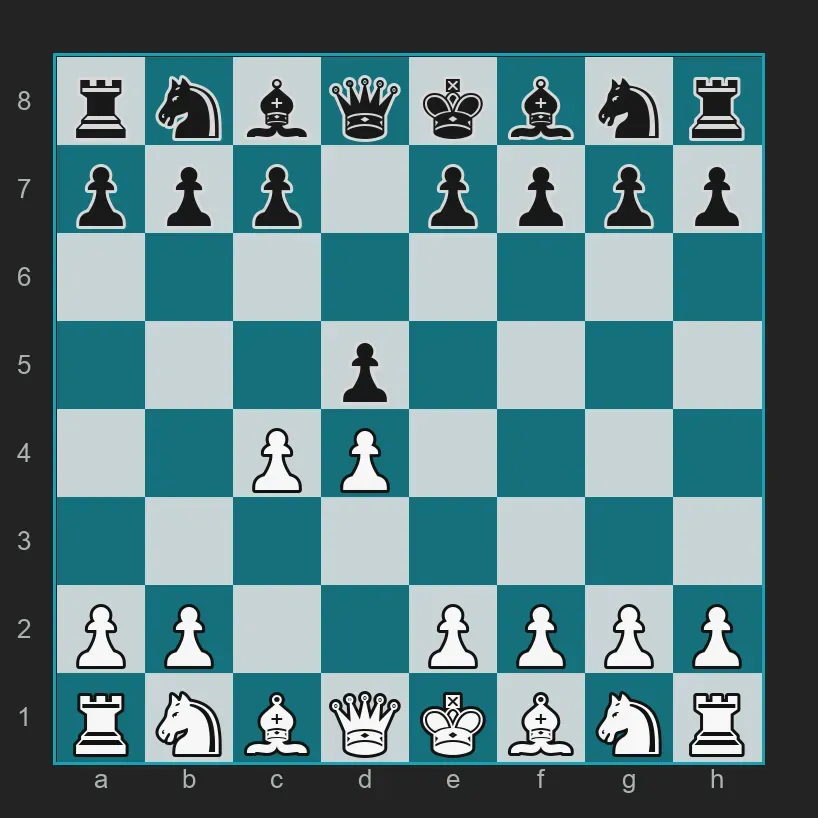
Queen's Gambit position after 1.d4 d5 2.c4
After 1.d4 d5 2.c4, White offers a pawn that is not truly sacrificed: if Black captures, White regains it comfortably and rules the center. The Queen's Gambit has anchored world championship chess for over a century (Wikipedia, no-follow).
How Black replies and who should play it
Black usually declines with 2...e6 (QGD) or 2...c6 (Slav); grabbing with 2...dxc4 rarely holds the pawn. White answers with Nc3, Nf3, and a central or minority-attack plan. Best for improving players ready to study real strategy. Beginner mistake: trying to defend the c4 pawn with b4, which weakens the queenside for nothing.
4. The London System (1.d4 followed by Bf4)
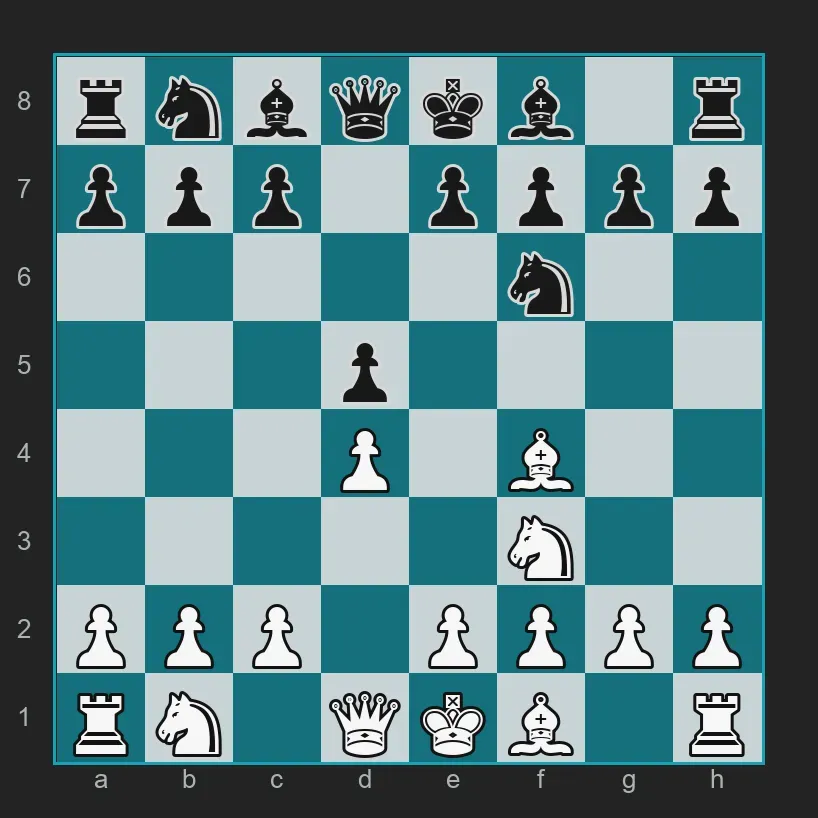
London System position with the bishop developed to f4
The London (1.d4 then Bf4, e3, c3, Nbd2) became the most popular club opening of the modern era for one reason: you play nearly the same setup regardless of Black's reply, which cuts memorization to almost zero.
Animated London System development: d4, Bf4, e3 and the standard structure
How Black replies and who should play it
Black can hit it with an early ...c5 and ...Qb6, or set up King's Indian and Grunfeld structures. White aims for Ne5, h4, and a kingside build-up. Best for busy players who want one reliable setup. Beginner mistake: playing on autopilot and allowing ...Qb6 to win the b2 pawn the bishop left behind.
5. The Vienna Game (1.e4 e5 2.Nc3)
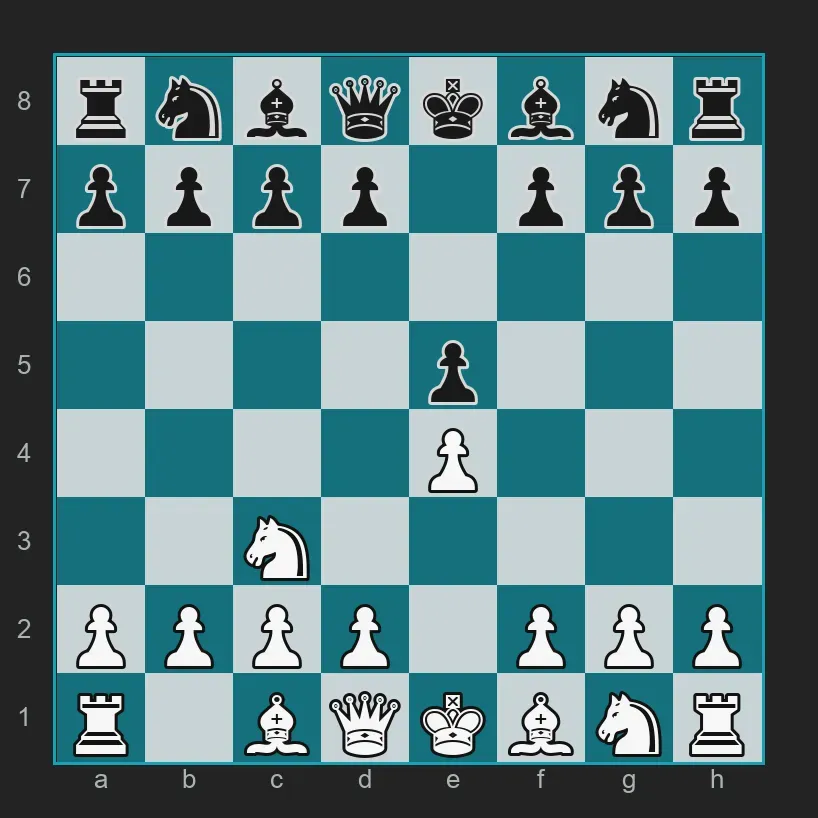
Vienna Game position after 1.e4 e5 2.Nc3
The Vienna looks quiet and turns violent: White often follows with f4, throwing a gambit punch most club opponents have never studied. It scores well precisely because it is less common than the Italian.
Animated Vienna Gambit line: 1.e4 e5 2.Nc3 Nf6 3.f4
How Black replies and who should play it
After 2...Nf6, the Vienna Gambit 3.f4 is the critical try; 3...d5 is Black's best answer. Quieter setups with g3 and Bg2 are also fully sound. Best for attacking players who enjoy catching opponents off guard. See our Vienna Opening guide for the traps. Beginner mistake: playing f4 and then castling into your own opened kingside without calculating.
6. The Scotch Game (1.e4 e5 2.Nf3 Nc6 3.d4)
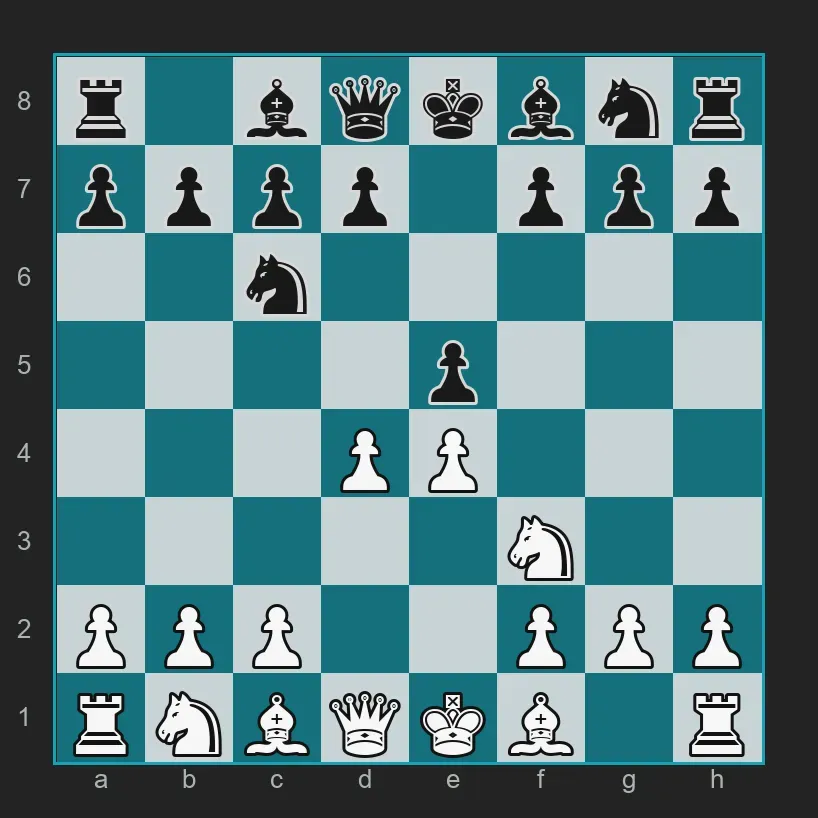
Scotch Game position after 1.e4 e5 2.Nf3 Nc6 3.d4, striking the center immediately
The Scotch opens the center at once with 3.d4. After 3...exd4 4.Nxd4 White gets easy development and a clear plan, with far less theory than the Ruy Lopez. Kasparov revived it at the top level in the 1990s.
How Black replies and who should play it
Black plays 4...Nf6 or the sharp 4...Bc5 hitting the d4 knight. White develops with Nc3 or c3 and Bd3. Best for 1.e4 players who want open positions without heavy memorization. Beginner mistake: recapturing on d4 with the queen too early and letting ...Nc6 chase it around with tempo.
7. The English Opening (1.c4)
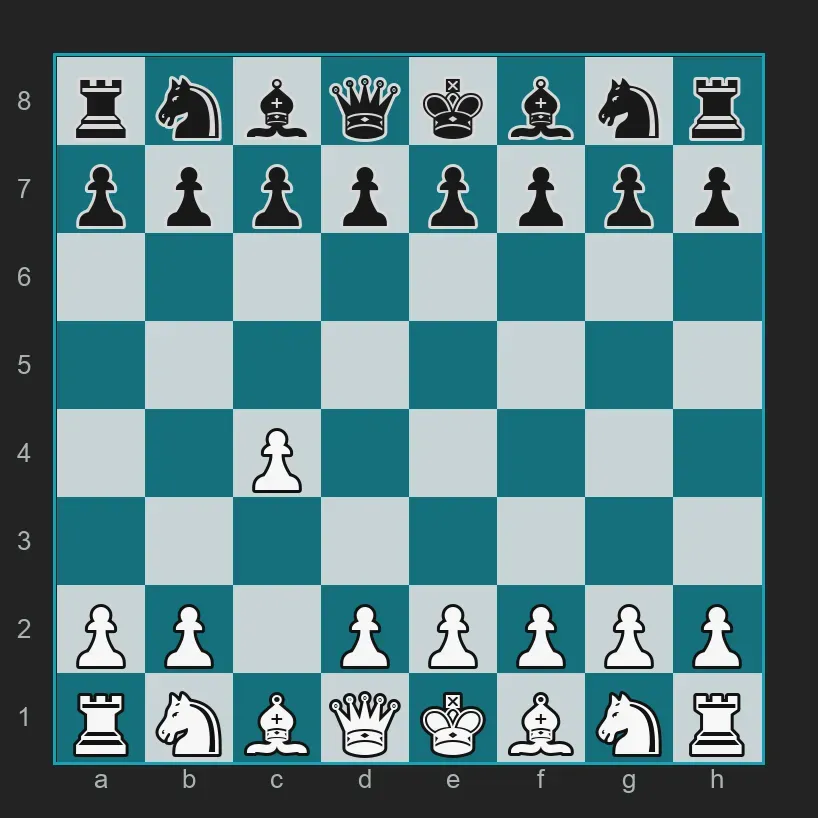
English Opening position after 1.c4, staking a claim on the light squares
The English stakes a claim on d5 from the wing and keeps the game flexible. It often transposes into Queen's Gambit or reversed-Sicilian structures, so the ideas overlap with openings you may already know.
How Black replies and who should play it
Common replies are 1...e5 (a reversed Sicilian), 1...c5 (symmetrical), and 1...Nf6. White fianchettoes with g3 and Bg2 and plays on the long diagonal. Best for positional players who like slow, strategic games. Beginner mistake: drifting without a plan because no pawn is on e4 or d4; the English still needs a central break at the right moment.
8. The King's Gambit (1.e4 e5 2.f4)
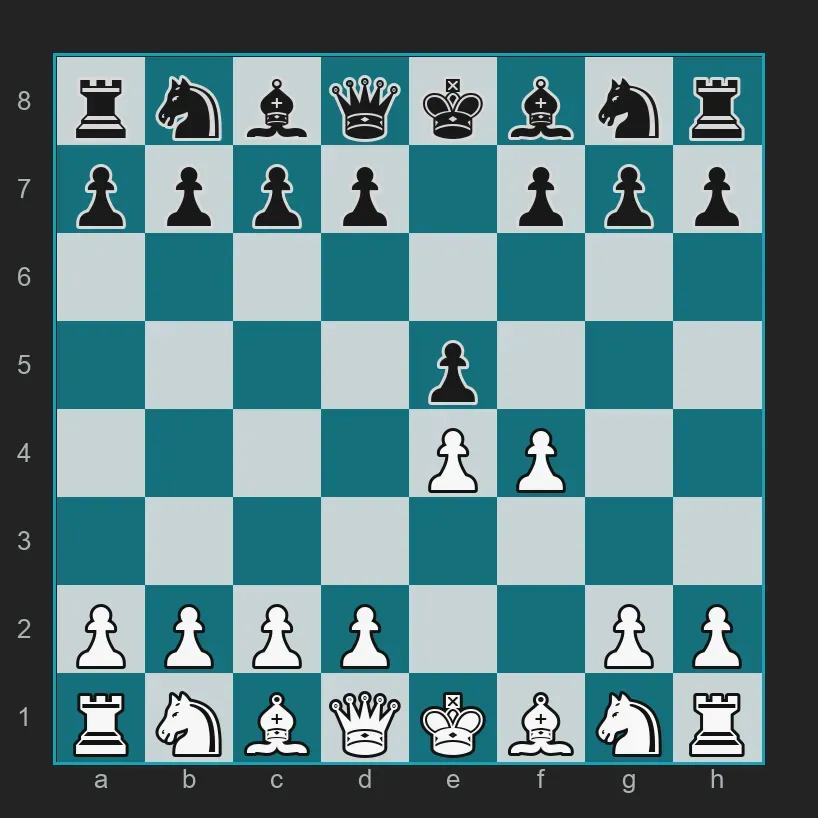
King's Gambit position after 1.e4 e5 2.f4, offering the f-pawn for a fast attack
The King's Gambit is the great romantic opening: White offers the f-pawn to rip open lines toward Black's king. It is riskier than the others here, which is exactly why it works so well as an occasional surprise weapon.
How Black replies and who should play it
Black can accept with 2...exf4 or decline with the Falkbeer Countergambit 2...d5. White follows with Nf3 and Bc4, aiming at f7. Best as a surprise weapon rather than a lifelong main opening. Beginner mistake: chasing the extra pawn instead of developing; the gambit is about the attack, not the material.
Should you start with e4, d4, c4 or Nf3?
Your first move sets the character of every game you play. This table compares the four sound choices.
| First move | Game character | Theory need | Best experience level |
|---|---|---|---|
| 1.e4 | Open, tactical | Medium | Beginners and up |
| 1.d4 | Structured, strategic | Medium | All, London for time-poor |
| 1.c4 | Flexible, positional | Medium | Intermediate and up |
| 1.Nf3 | Flexible, transposes | Low to start | Curious intermediates |
Our recommendation by experience
Beginners should start with 1.e4 for the tactics. Time-poor players do well with a 1.d4 London setup. Curious intermediates can explore 1.c4 or 1.Nf3, which transpose into many structures and reward general understanding over memorized lines.
What the win-rate data says
Large public databases such as the Lichess open database (no-follow) let you compare how these openings actually perform. The exact percentages shift with every refresh, so treat them as directional rather than fixed, but a few patterns are stable across rating bands.
- 1.e4 and 1.d4 finish neck and neck overall, confirming that neither first move is objectively best.
- Sharp gambits like the King's Gambit tend to overperform at lower levels, where defense is hardest, and give back that edge as opposition improves.
- The Ruy Lopez and Queen's Gambit express their advantage more at higher ratings, because their small edges need accurate follow-up to convert.
Engine eval versus practical results
Engines rate the quiet main lines highest, but practical results below master level track something else: how comfortable the resulting middlegame is for the player who knows it. That is why an aggressive, lower-rated-friendly opening can outscore a theoretically superior one in your own games.
Build a complete White repertoire
One opening is a start, not a repertoire. A complete White repertoire needs a plan against each of Black's main replies.
If you open 1.e4
Prepare one answer to each major defense: the Open Sicilian or a system like the Alapin against 1...c5, an Advance or Exchange setup against the French and Caro-Kann, and your chosen 1...e5 opening. You do not need all of them at once; add one at a time.
If you open 1.d4
Decide how you meet 1...d5 (Queen's Gambit or London), the King's Indian and Grunfeld setups, and the Nimzo-Indian. A London player can lean on the same structure against most of these while learning the sharper main lines gradually.
Common mistakes when choosing an opening
- Chasing engine evaluations instead of playable positions you understand.
- Memorizing moves without the plans behind them, so you are lost by move ten.
- Switching openings after every loss, which resets your learning to zero.
- Learning too many at once rather than one until it is second nature.
- Ignoring Black's replies and preparing only your own moves.
- Building a repertoire from traps that stop working once opponents develop normally.
How to learn and practise your opening
Knowledge becomes skill only through repetition. Use this five-step loop to turn any opening above into an instinct:
- Learn the main plans and pawn breaks, not just the first ten moves.
- Play through two or three model games in your opening.
- Play it in every game for at least twenty games against a bot at your level.
- Review each loss and note where you left the plan.
- Expand into a second line only once the first feels automatic.
The 20-game rule
Commit to one opening for at least twenty games before you judge it. Early losses are the tuition fee for learning the plans, not proof the opening is wrong. Most players who "cannot make an opening work" simply changed it after three bad games, resetting their progress every time they lost.
On Chessiverse, human-like bots respond with realistic moves rather than engine perfection, so your practice positions mirror real games: no waiting, no cheating, unlimited retries. Track your overall progress with our guide on how to get better at chess. For video openings study, IM John Bartholomew's YouTube channel (external link) is the co-founder's own classroom.
Train your White opening against a bot now

A white king mascot weighing the opening routes
Frequently asked questions
What is the number one best chess opening for White?
No opening wins by force, but the Italian Game offers the best balance of soundness, clear plans, and manageable theory for most players, which is why it tops our ranking. At higher levels the Ruy Lopez and Queen's Gambit become equally strong once you can handle their theory.
What is the most effective chess opening for White?
Statistically 1.e4 and 1.d4 score almost identically at every level. Effectiveness comes from familiarity: the opening whose plans you know is the most effective one for you. The Italian Game is the best starting point for most players.
What is the most aggressive opening for White?
The King's Gambit (1.e4 e5 2.f4) is the sharpest classical choice, offering a pawn to open lines toward the king. The Vienna Gambit is a slightly safer aggressive option that still catches unprepared opponents. Both reward attackers who calculate.
Is the Ruy Lopez the best opening for White?
It is one of the most respected, and Fischer's favorite, but it is not automatically best for you. The Ruy Lopez creates lasting pressure at the price of heavy theory. Below roughly 1400, the Italian reaches similar positions with far less to memorize.
What opening does Magnus Carlsen play as White?
Carlsen deliberately varies: the Italian, the Ruy Lopez, the Queen's Gambit, the English, and even the London all appear in his games. His approach proves that understanding beats memorization, and that a broad, flexible repertoire suits the very top.
What was Bobby Fischer's favorite opening as White?
Fischer played 1.e4 almost exclusively, famously calling it best by test. His main weapon against 1...e5 was the Ruy Lopez, the Italian's more theoretical sibling, which he handled with legendary precision.
What is the statistically best chess opening for White?
In large databases 1.e4 and 1.d4 lead the pack by a hair and finish nearly level. No single line stands out as statistically best, because results depend far more on the player's knowledge than on the opening's name.
How many openings should you learn as White?
One. A single opening played in every game teaches more than five sampled occasionally. Add a second system only when you can explain your first opening's middlegame plans without thinking, which for most players is a few hundred games away.
Start playing free on Chessiverse
Keep learning: Italian Game complete guide, how to get better at chess, or play vs the computer.

A white pawn mascot stepping into the first move
Sources
External links are no-follow.
- Lichess opening explorer and open database (master and amateur statistics) - https://lichess.org/opening
- Wikipedia: Queen's Gambit (history) - https://en.wikipedia.org/wiki/Queen%27s_Gambit
- John Bartholomew, YouTube (opening fundamentals on video) - https://www.youtube.com/@johnbartholomew