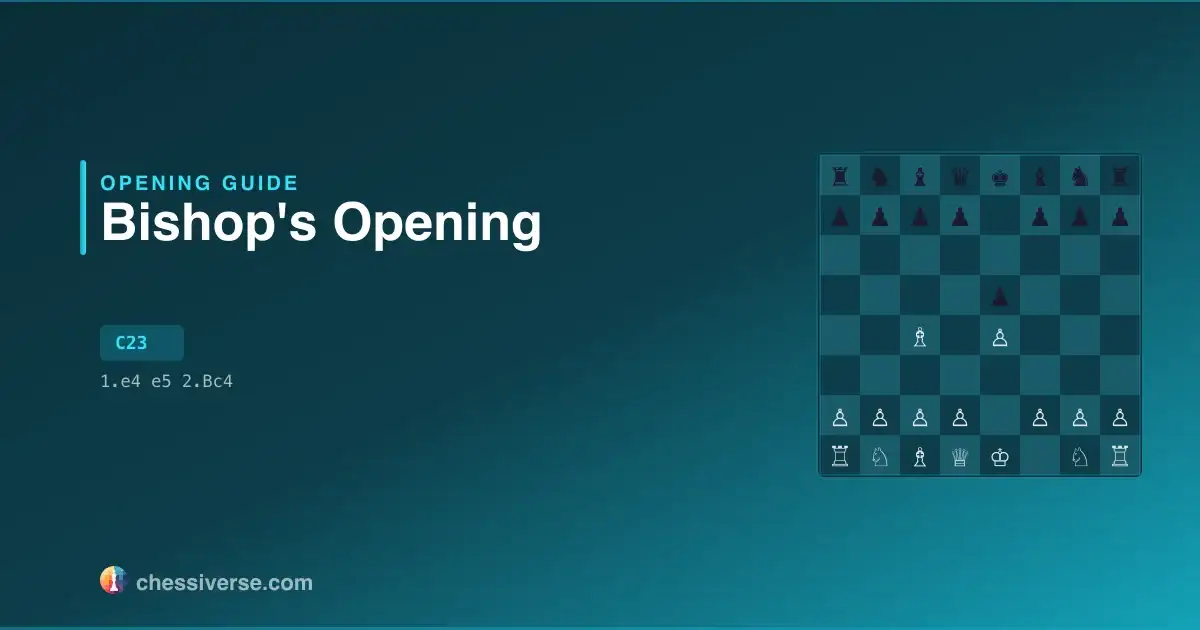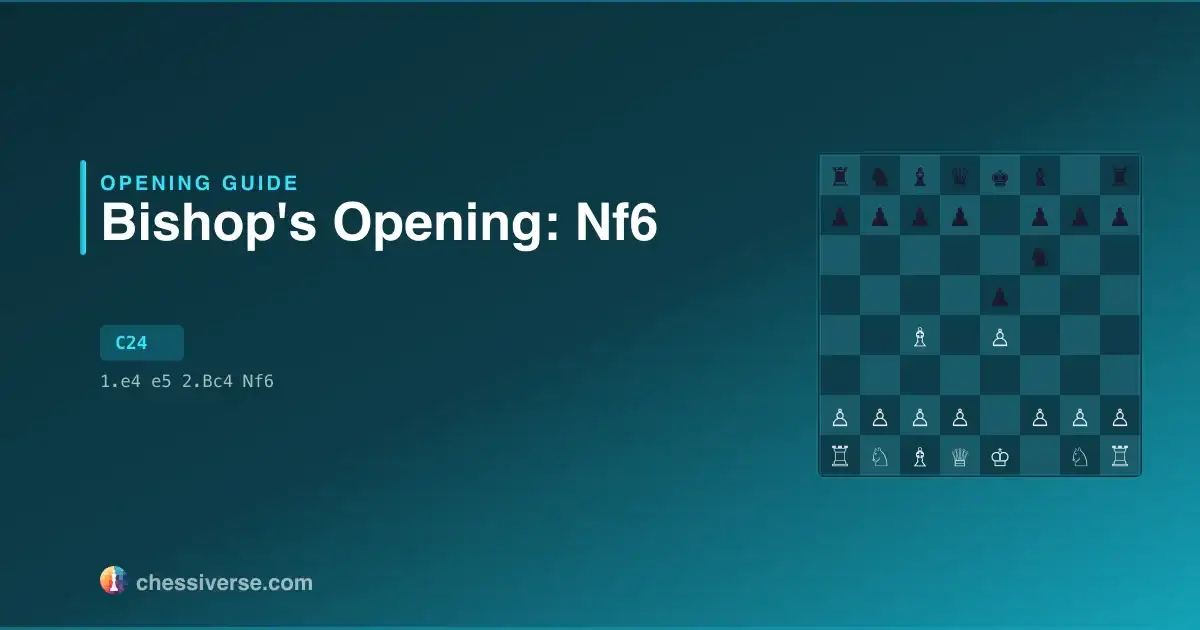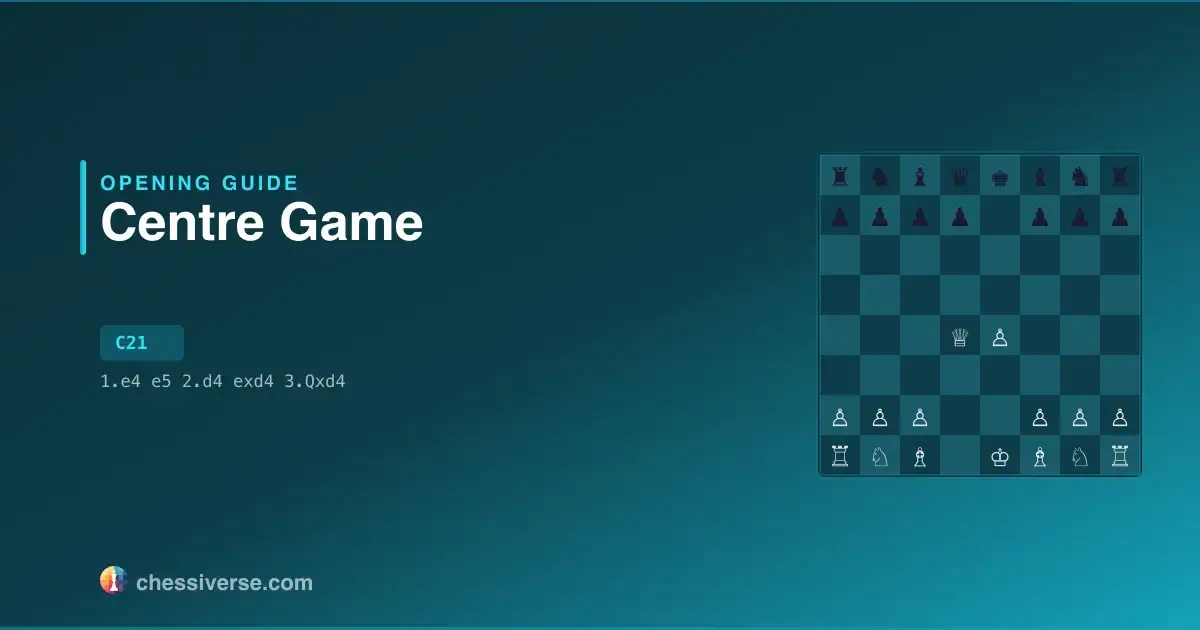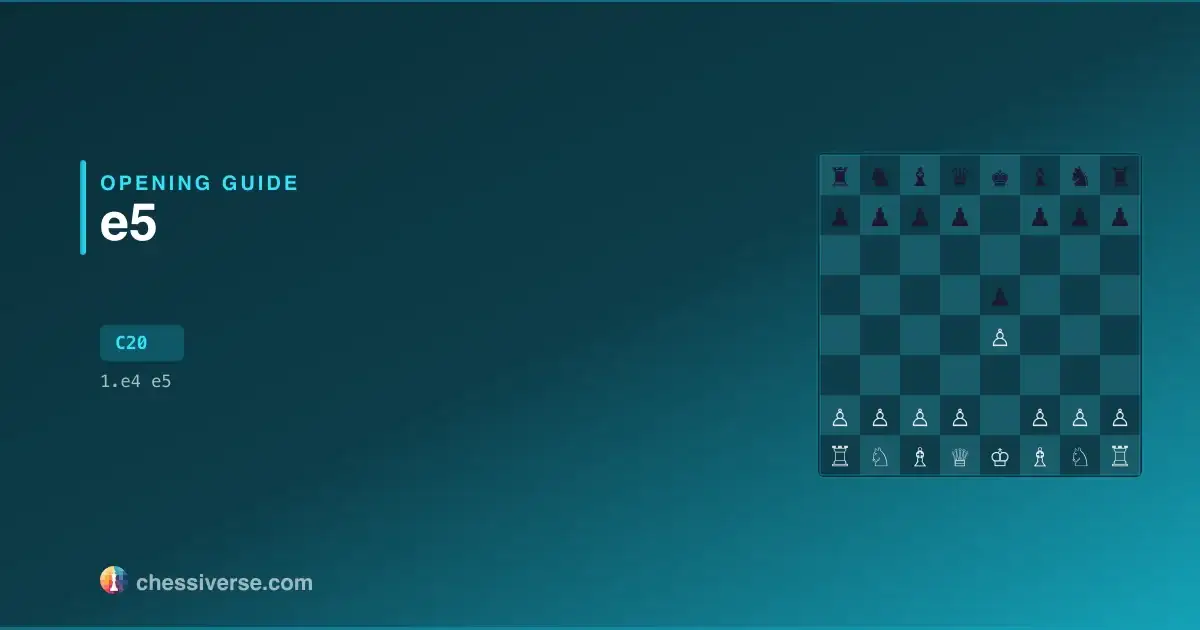




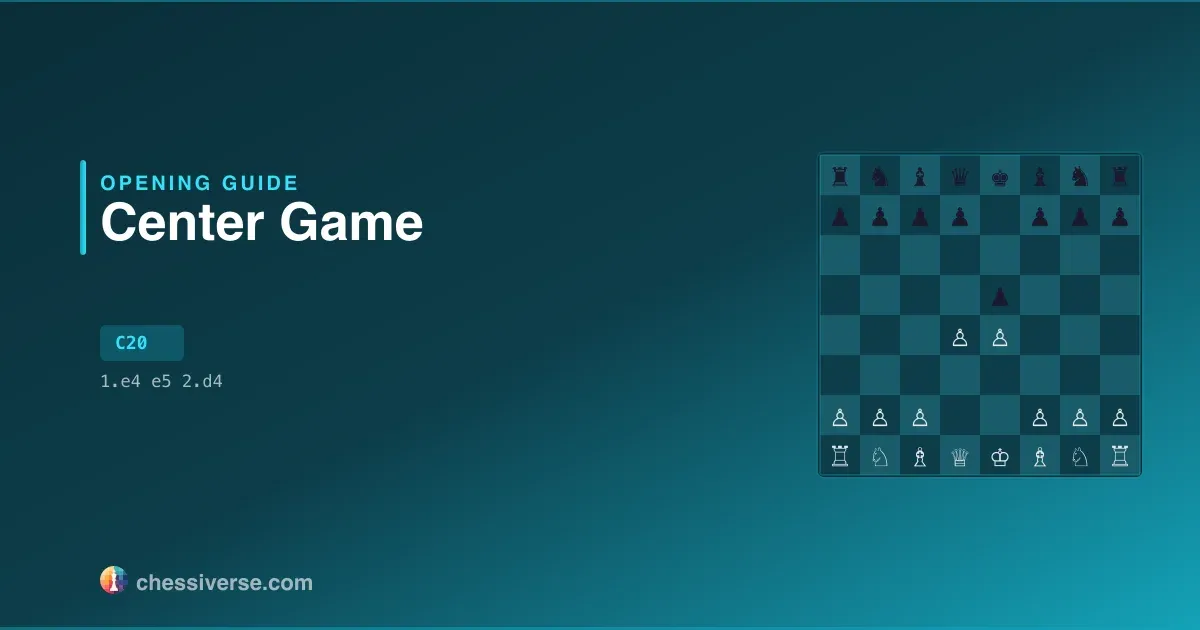
Starting from 1.e4 e5 2.d4, players enter the Center Game — ECO C20. With 84,637,318 games on record, the patterns below come from the largest practical sample available.
History and Notable Players
It arises from the Open Games (1...e5).
Performance Across Rating Levels
The picture changes a lot as you climb the rating ladder. Among 1200-rated players, it appears in 2.48% of games — 16,734,280 of them on record — with White winning 50.9% and Black 45.3%. At 1800 the opening surfaces in 1.26% of games; White wins 53.6%, Black 42.5%, draws 3.9%. At 2500, 0.26% of games go into this opening; draws sit at 8.8% — the line is well-mapped at this level.
Time Control Patterns
The Center Game skews toward rapid chess. In bullet, it appears in 1.38% of games (36,557,075); White wins 52.7%. Blitz shows 1.72% adoption across 61,683,797 games, White scoring 52%. In rapid, the share rises to 2.07% — 22,953,521 games, White 51%.
Move Diversity and Theory Depth
Move choice is far from uniform in the Center Game (2.d4). At 1200 Elo (16,734,280 games), the top reply is exd4, played 58.7% of the time. Two other moves each take at least 5% of games, and the top three moves account for 81.1% of games. Entropy: 2.15. By 2500 (34,852 games), exd4 dominates at 85.5% of replies; only one other move still reaches 5% and the top three moves account for 96.9% of games. Entropy drops to 0.84. That entropy collapse is the signature of a line where preparation pays off: at the top, players know the best move and play it.
Historical Trends
Long-term, the trajectory of this opening is informative. Adoption peaked in 2013 at 2.00% (57,642 games). By 2025 it sits at 1.76%, down 12% from that high, leaving the line in decline.
Main Lines and Variations
After 1.e4 e5 2.d4, the established follow-ups are:
Each branch leads to a different middlegame character — the resulting pawn structure decides what kind of game you get.
Common Mistakes
- Drifting away from main theory — At 400 Elo, the three most-played moves cover 66.6% of games, against 95.1% at 2000. The most popular deviation is Nc6 (played 19.8% of the time at 400, less so up top). It looks fine but quietly hands the better-prepared side an edge.
- Neglecting development — It can feel productive to make extra pawn moves early, but falling behind in piece development is what loses most amateur games — especially in open positions where active pieces find squares fast.
- Playing without a plan — Each Center Game middlegame demands a specific approach. Decide whether the position calls for attack, manoeuvre, or simplification before reaching for a move.
Practice on Chessiverse
Ready to try the Center Game against a bot? Pick an opponent at your level and play a game.