King's Indian Defence: 1.d4 Nf6 2.c4... 8.Re1

+20%
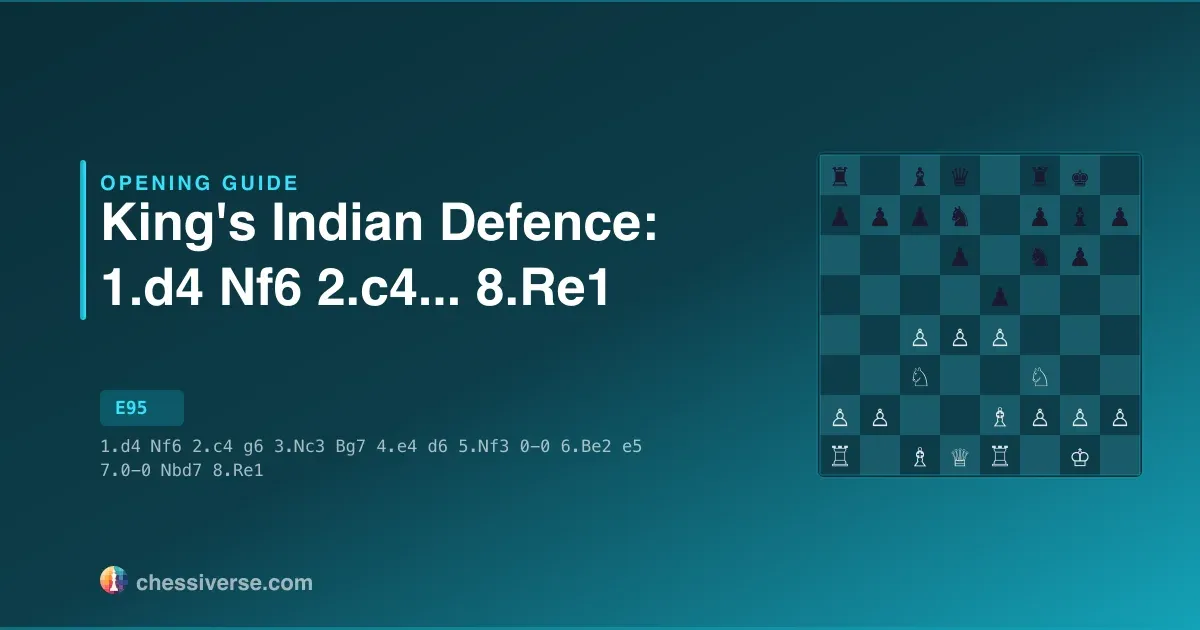
E951.d4 Nf6 2.c4 g6 3.Nc3 Bg7 4.e4 d6 5.Nf3 0-0 6.Be2 e5 7.0-0 Nbd7 8.Re1
Feb 20, 2026
Play this opening as...
TL;DR

The classical main line where Black plays ...e5, creating the signature King's Indian pawn tension. White typically aims for queenside expansion with c5 while Black builds a kingside attack, creating a fascinating strategic and tactical battle.

Written by

Chessiverse
Chessiverse TeamOpening Guides

Expert chess content backed by opening theory and our database of 600+ AI bots with unique playing styles and opening repertoires.

King's Indian Defence: 1.d4 Nf6 2.c4... 8.Re1: A Complete Guide
King's Indian Defence: 1.d4 Nf6 2.c4... 8.Re1 - Opening Moves
Summary

The King's Indian Defence: 1.d4 Nf6 2.c4... 8.Re1 arises after 1.d4 Nf6 2.c4 g6 3.Nc3 Bg7 4.e4 d6 5.Nf3 0-0 6.Be2 e5 7.0-0 Nbd7 8.Re1 and falls under ECO code E95. With 58,744 Lichess games across all rating levels, it is a specialized opening choice.

History and Notable Players

It arises from the King's Indian Defence: 1.d4 Nf6 2.c4... 7.0-0. Among the most prolific practitioners on the White side are Wlodzimierz Schmidt (15 games), Mark E Taimanov (14 games), Vladimir Epishin (13 games). On the Black side, notable exponents include Lothar Vogt (27 games), Rainer Knaak (24 games), Miguel Najdorf (17 games).

Statistics

Based on 58,633 Lichess games across all rating levels:

  • White wins: 53%
  • Black wins: 41.1%
  • Draws: 5.9%

The statistics show a roughly balanced opening where both sides have equal chances.

Main Lines and Variations

After 1.d4 Nf6 2.c4 g6 3.Nc3 Bg7 4.e4 d6 5.Nf3 0-0 6.Be2 e5 7.0-0 Nbd7 8.Re1, the main continuations include:

Each of these lines leads to distinct types of positions and requires its own understanding of the resulting pawn structures and piece placements.

Common Mistakes to Avoid

  • Allowing White to build an overwhelming center: Hypermodern openings allow White space in the center, but you need to strike back at the right moment. Delaying the counterattack too long can leave you without active play.

Practice on Chessiverse

The best way to learn the King's Indian Defence: 1.d4 Nf6 2.c4... 8.Re1 is through practice. On Chessiverse, you can play chess against computer opponents from any opening or custom position. Our AI bots range from beginner to grandmaster level, each with unique playing styles — from aggressive attackers to solid defenders. Choose a bot that matches your rating and work your way up as you master the opening's key ideas.

Quick Facts

Main Line1.d4 Nf6 2.c4 g6 3.Nc3 Bg7 4.e4 d6 5.Nf3 0-0 6.Be2 e5 7.0-0 Nbd7 8.Re1
FENr1bq1rk1/pppn1pbp/3p1np1/4p3/2PPP3/2N2N2/PP2BPPP/R1BQR1K1 b - - 3 8
DifficultyExpert
Style

Hypermodern openings let the opponent occupy the center with pawns, then attack it from the flanks with pieces and fianchettoed bishops. Control is exerted from a distance rather than by direct occupation.

58,744games on Lichess
53%
5.9%
41.1%
White wins Draws Black wins

Top Players

As Black

Data from Lichess opening explorer (blitz & rapid)

Most Popular At2500
SharpnessBalanced

Popularity by Rating

Percentage of all games at each rating bracket that feature this opening.

Data from Lichess opening explorer (blitz & rapid games)

Theory Adherence by Rating

How often players choose the single most popular move at this position. Higher = more predictable play.

Black to move after the opening line

Popularity Over Time

Share of all Lichess blitz + rapid games featuring this opening, by year.

Top Moves by Rating

Black to move after the opening line

RatingMost Popular2nd3rd
400exd450%c516.7%Re816.7%
1000exd430.4%Re830.4%c613%
1200exd439.8%Re822.2%b610.2%
1400exd440.6%Re815.9%b67.7%
1600exd443.5%Re815%c69.9%
1800exd435.5%Re816.3%c615.9%
2000exd426.6%c622.9%Re821%
2200c628.2%Re827.3%exd419.9%
2500Re834.9%c627.6%exd416.3%

Popularity by Time Control

Bullet
<0.01%27K
Blitz
<0.01%55K
Rapid
<0.01%4K
4% more decisive in bullet
Play this opening as...

Frequently Asked Questions

What is the King's Indian Defence: 1.d4 Nf6 2.c4... 8.Re1?

The King's Indian Defence: 1.d4 Nf6 2.c4... 8.Re1 begins with 1.d4 Nf6 2.c4 g6 3.Nc3 Bg7 4.e4 d6 5.Nf3 0-0 6.Be2 e5 7.0-0 Nbd7 8.Re1 and is classified under ECO code E95.

Is the King's Indian Defence: 1.d4 Nf6 2.c4... 8.Re1 good for beginners?

The King's Indian Defence: 1.d4 Nf6 2.c4... 8.Re1 can be played at any level. Beginners should focus on understanding the key strategic ideas rather than memorizing long theoretical lines. Our AI bots at various rating levels provide a great way to practice the opening concepts.

What are the main variations of the King's Indian Defence: 1.d4 Nf6 2.c4... 8.Re1?

The main continuations include: King's Indian Defence: 1.d4 Nf6 2.c4 g6 3.Nc3 Bg7 4.e4 d6 5.Nf3 0-0 6.Be2 e5 7.0-0 Nbd7 8.Re1 c6 9.Bf1 a5. Each variation leads to distinct types of positions with their own strategic themes.

What are the win rates for the King's Indian Defence: 1.d4 Nf6 2.c4... 8.Re1?

Across 58,744 Lichess games, White wins 53% of the time, Black wins 41.1%, and 5.9% are drawn. Notable master practitioners on the White side include Wlodzimierz Schmidt and Mark E Taimanov. On the Black side, Lothar Vogt and Rainer Knaak are among the most frequent practitioners.

Written by

Chessiverse
Chessiverse TeamOpening Guides

Expert chess content backed by opening theory and our database of 600+ AI bots with unique playing styles and opening repertoires.

Practice This Opening on Chessiverse

Play against 600+ AI bots with unique personalities and opening repertoires. From beginner-friendly to grandmaster-level opponents, find the perfect sparring partner for any opening.

Play Now
Back to Articles