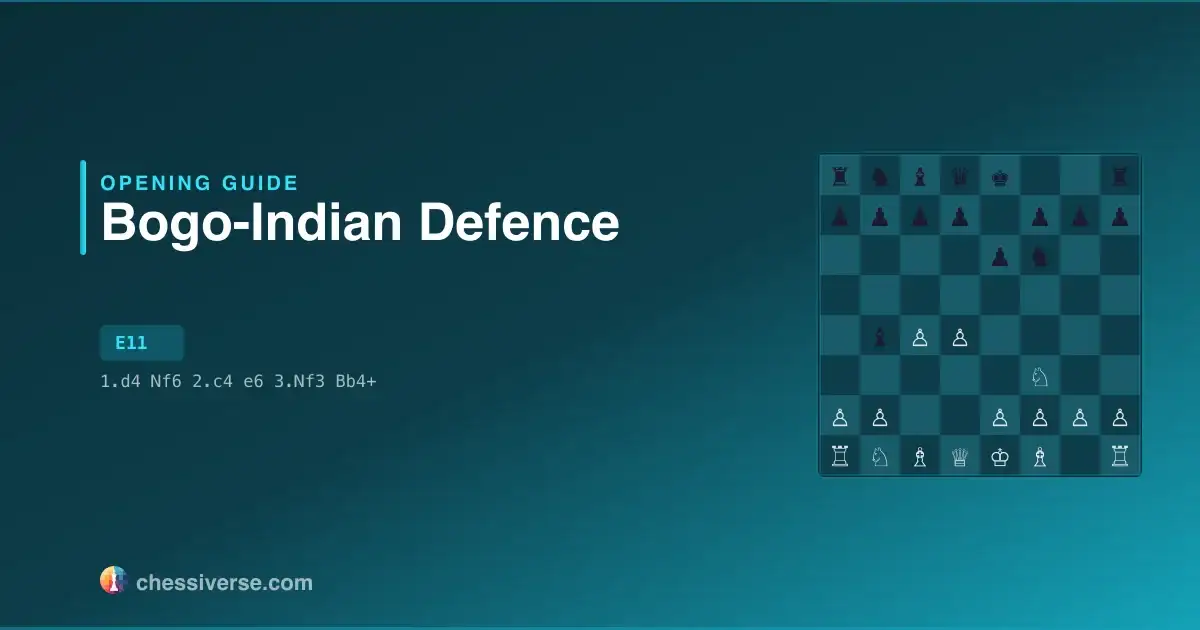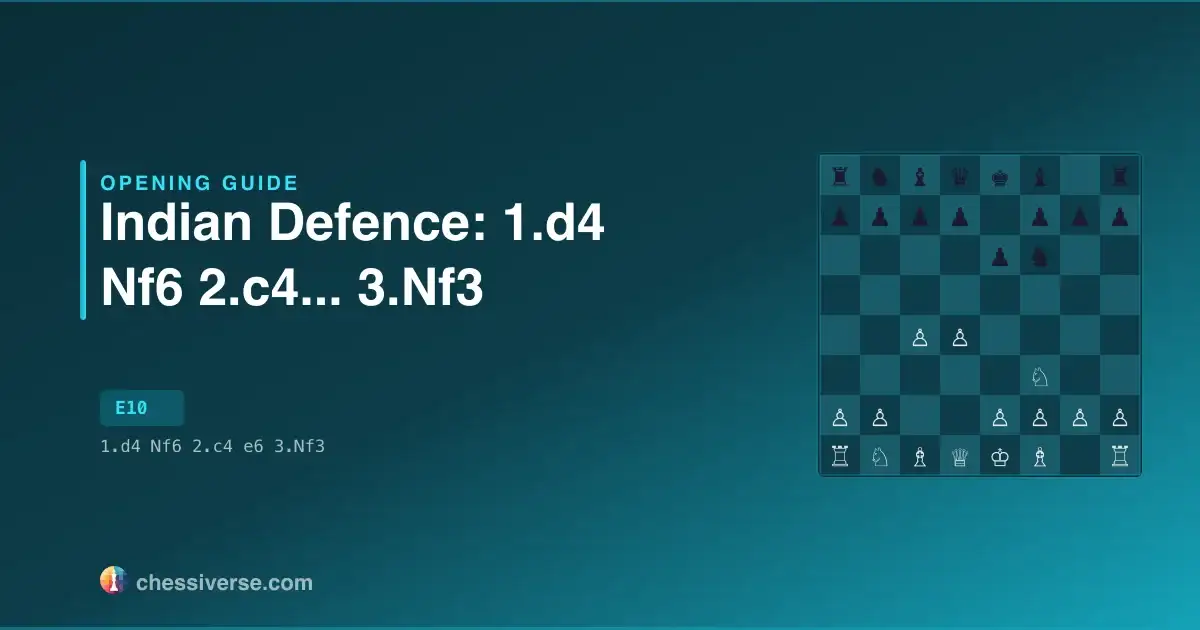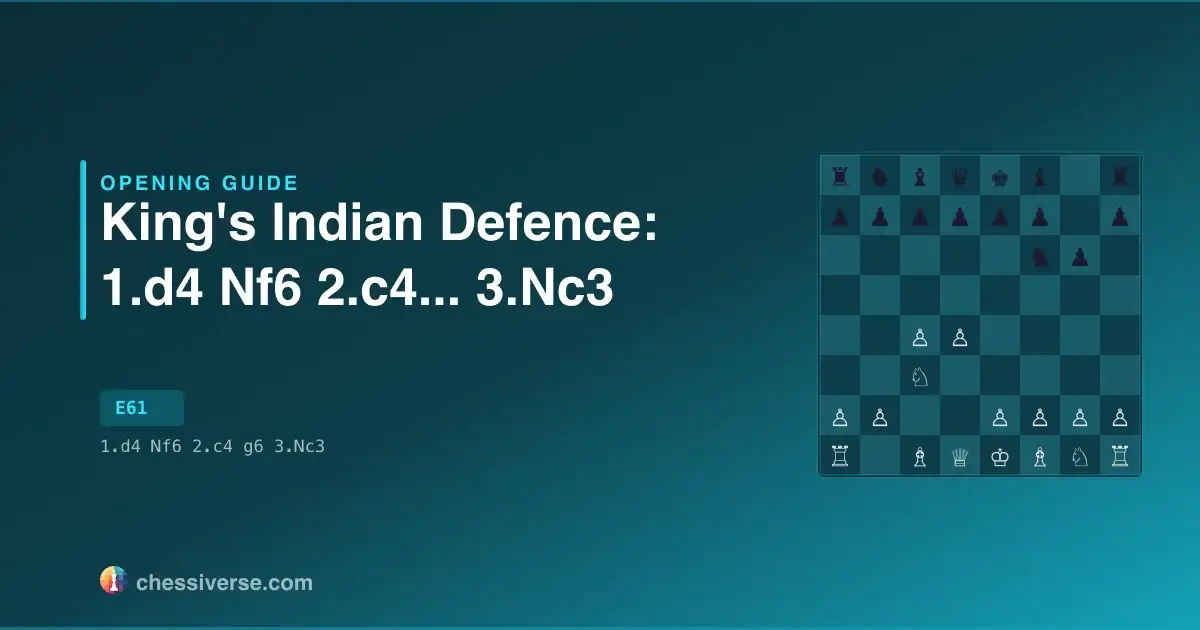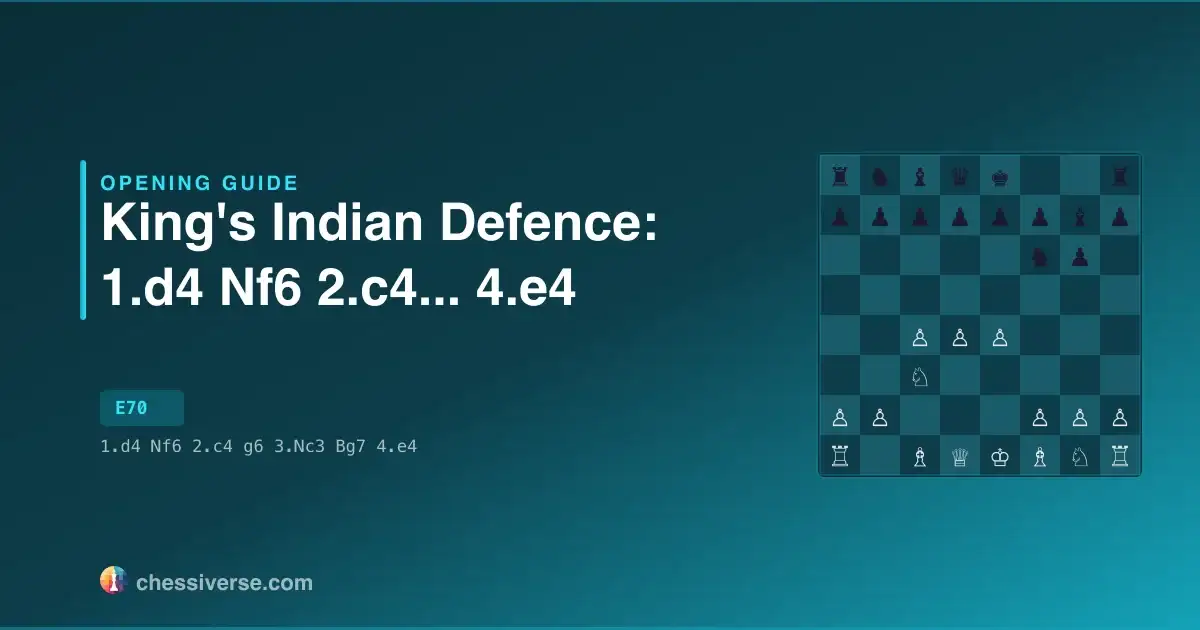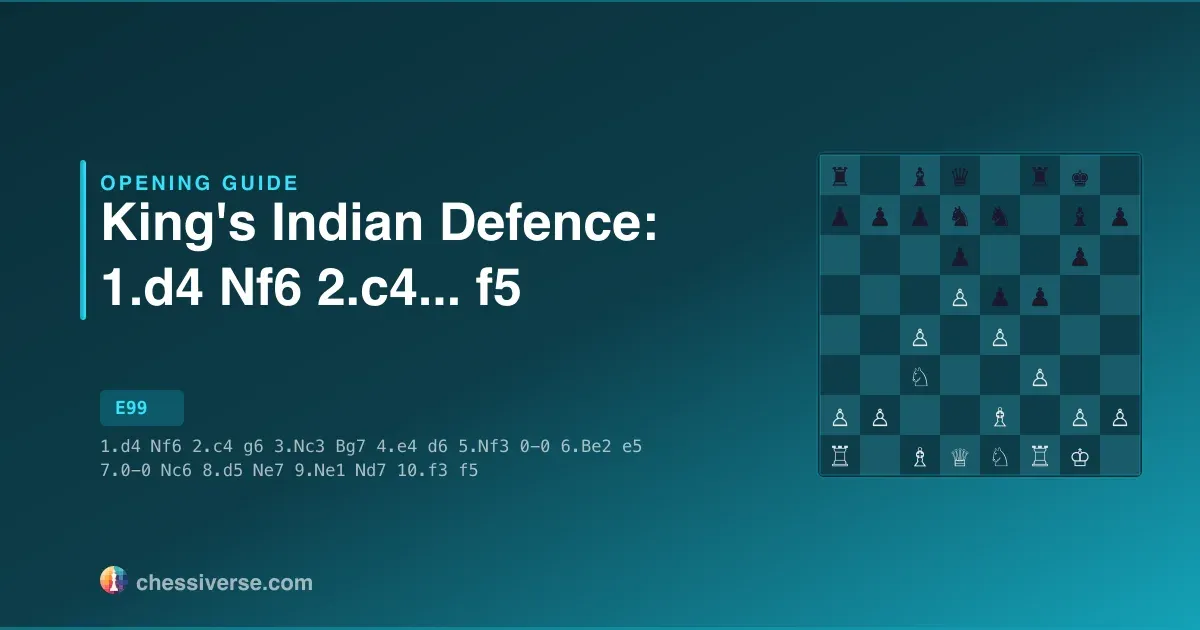
King's Indian Defence: 1.d4 Nf6 2.c4...... f5

+33%
E991.d4 Nf6 2.c4 g6 3.Nc3 Bg7 4.e4 d6 5.Nf3 0-0 6.Be2 e5 7.0-0 Nc6 8.d5 Ne7 9.Ne1 Nd7 10.f3 f5
Oct 15, 2028
TL;DR

The Bayonet-style Mar del Plata in full flight. Black launches ...f5 against White's king while White prepares c5 on the queenside. Famous Kasparov-Karpov battles started here — pure attacking chess on opposite flanks.

Reviewed by

IM John Bartholomew
IM John BartholomewCo-Founder & Chess Educator

International Master and chess educator. Co-founded Chessable and joined Chessiverse as co-founder. Best known for his "Climbing the Rating Ladder" YouTube series and structured opening courses.

King's Indian Defence: 1.d4 Nf6 2.c4...... f5: A Complete Guide
King's Indian Defence: 1.d4 Nf6 2.c4...... f5 - Opening Moves
Summary

1.d4 Nf6 2.c4 g6 3.Nc3 Bg7 4.e4 d6 5.Nf3 0-0 6.Be2 e5 7.0-0 Nc6 8.d5 Ne7 9.Ne1 Nd7 10.f3 f5 opens the King's Indian Defence: 1.d4 Nf6 2.c4... f5, ECO E99. Across rating levels it shows up in 28,682 recorded games — enough data to map exactly where it succeeds and where it stalls.

History and Notable Players

It arises from the King's Indian Defence: 1.d4 Nf6 2.c4... 9.Ne1. Among the most prolific White practitioners are Pal Kiss (15 games), Gyula Bordas (10 games), Peter Lukacs (10 games). Black-side regulars include Liren Ding (6 games), Aleksander Sznapik (5 games), Vasik G Rajlich (5 games).

Performance Across Rating Levels

Popularity and results vary sharply by rating level. At 1200 Elo, the opening shows up in 0.00% of games (9 samples). White scores 77.8%, Black 22.2%, draws 0%. By 1800, popularity is 0.00% and White's score is 53% to Black's 42.5%. At 2500, 0.01% of games go into this opening; draws sit at 8.7% — the line is well-mapped at this level. White's edge erodes by 26.3pp from 1200 to 2500 Elo, suggesting Black's counterplay is easier to find with experience.

Move Diversity and Theory Depth

Move choice is far from uniform in the King's Indian Defence: 1.d4 Nf6 2.c4... f5. At 1200 Elo, the top reply is Be3, played 77.8% of the time. There are 2 other moves seeing meaningful share, and 100% of games stick to established theory. Entropy: 0.76. By 2500, g4 dominates at 76.9% of replies; only 2 viable alternatives remain and 98.9% of moves are theory. Entropy drops to 1.02. Move diversity stays high even at master level, suggesting the opening doesn't force one specific response.

Common Mistakes

  • Playing outside main lines — At 400 Elo, only 0% of moves follow established theory — at 2000 that climbs to 97.8%. Most of the gap is players who pick a reasonable-looking move over the best one, and the position quietly drifts.
  • Neglecting development — It can feel productive to make extra pawn moves early, but falling behind in piece development is what loses most amateur games — especially in open positions where active pieces find squares fast.
  • Letting White own the centre — Hypermodern openings concede central space on purpose, but only if you strike back in time. Delay the counter-blow and you end up squeezed.

Practice on Chessiverse

Ready to try the King's Indian Defence: 1.d4 Nf6 2.c4... f5 against a bot? Pick an opponent at your level and play a game.

Quick Facts

Main Line1.d4 Nf6 2.c4 g6 3.Nc3 Bg7 4.e4 d6 5.Nf3 0-0 6.Be2 e5 7.0-0 Nc6 8.d5 Ne7 9.Ne1 Nd7 10.f3 f5
DifficultyExpert
Style

Hypermodern openings let the opponent occupy the center with pawns, then attack it from the flanks with pieces and fianchettoed bishops. Control is exerted from a distance rather than by direct occupation.

28,682games on Lichess
53.3%
5.8%
40.9%
White wins Draws Black wins

Top Players

As White
As Black

Data from Lichess opening explorer (blitz & rapid)

Most Popular At2500
SharpnessBalanced

Popularity by Rating

Percentage of all games at each rating bracket that feature this opening.

Data from Lichess opening explorer (blitz & rapid games)

Theory Adherence by Rating

How often players choose the single most popular move at this position. Higher = more predictable play.

White to move after the opening line

Popularity Over Time

Share of all Lichess blitz + rapid games featuring this opening, by year.

Top Moves by Rating

White to move after the opening line

RatingMost Popular2nd3rd
400
1000Be3100%
1200Be377.8%g422.2%
1400Be368.2%g419.3%Nd34.5%
1600Be370%g420.4%Nd36.2%
1800Be366%g426.4%Nd35%
2000Be350.2%g442.4%Nd35.3%
2200g468.2%Be327.6%Nd33.3%
2500g476.9%Be317.6%Nd34.4%

Popularity by Time Control

Bullet
<0.01%12K
Blitz
<0.01%27K
Rapid
<0.01%2K
2% more decisive in bullet
Raw data tables (Lichess blitz + rapid)
King's Indian Defence: 1.d4 Nf6 2.c4...... f5: popularity and win rates by player rating
Rating (Elo)Share %GamesWhite win %Black win %Draw %Sharpness
4000.0000.00.00.00.000
10000.00250.050.00.01.000
12000.00977.822.20.01.000
14000.008855.742.02.30.977
16000.0080352.344.03.70.963
18000.004,04953.042.54.40.956
20000.009,31553.741.05.40.946
22000.0113,02153.340.36.40.936
25000.011,39551.539.78.70.913
King's Indian Defence: 1.d4 Nf6 2.c4...... f5: move-choice theory adherence by rating
Rating (Elo)Top moveTop move %Viable movesTheory %Entropy
4000.000.00.000
1000Be3100.01100.00.000
1200Be377.82100.00.764
1400Be368.2292.01.497
1600Be370.0396.61.337
1800Be366.0397.51.312
2000Be350.2397.81.413
2200g468.2299.11.138
2500g476.9298.91.020
King's Indian Defence: 1.d4 Nf6 2.c4...... f5: popularity over time
YearShare %GamesWhite win %Black win %Draw %
20130.00977.822.20.0
20140.007236.152.811.1
20150.0019448.546.45.2
20160.0054548.147.54.4
20170.001,09054.540.15.4
20180.001,86253.141.95.0
20190.002,39050.743.36.0
20200.005,52353.640.65.8
20210.004,90053.140.66.3
20220.003,75754.639.75.7
20230.003,90653.041.15.9
20240.003,42155.039.45.6
20250.003,09854.040.35.7
King's Indian Defence: 1.d4 Nf6 2.c4...... f5: popularity by time control
FormatShare %GamesWhite win %Black win %Draw %Sharpness
bullet0.0011,51254.042.23.80.962
blitz0.0026,84253.440.75.80.942
rapid0.001,80251.243.15.80.942
King's Indian Defence: 1.d4 Nf6 2.c4...... f5: top candidate moves by rating bracket
Rating (Elo)1st move1st %2nd move2nd %3rd move3rd %
400
1000Be3100.0
1200Be377.8g422.2
1400Be368.2g419.3Nd34.5
1600Be370.0g420.4Nd36.2
1800Be366.0g426.4Nd35.0
2000Be350.2g442.4Nd35.3
2200g468.2Be327.6Nd33.3
2500g476.9Be317.6Nd34.4
King's Indian Defence: 1.d4 Nf6 2.c4...... f5: top practitioners by side
SidePlayerGames
WhitePal Kiss15
WhiteGyula Bordas10
WhitePeter Lukacs10
BlackLiren Ding6
BlackAleksander Sznapik5
BlackVasik G Rajlich5

Frequently Asked Questions

What is the King's Indian Defence: 1.d4 Nf6 2.c4... f5?

The King's Indian Defence: 1.d4 Nf6 2.c4... f5 begins with 1.d4 Nf6 2.c4 g6 3.Nc3 Bg7 4.e4 d6 5.Nf3 0-0 6.Be2 e5 7.0-0 Nc6 8.d5 Ne7 9.Ne1 Nd7 10.f3 f5 and is classified under ECO code E99.

Is the King's Indian Defence: 1.d4 Nf6 2.c4... f5 good for beginners?

The King's Indian Defence: 1.d4 Nf6 2.c4... f5 can be played at any level. Beginners should focus on understanding the key strategic ideas rather than memorizing long theoretical lines. Our AI bots at various rating levels provide a great way to practice the opening concepts.

What are the win rates for the King's Indian Defence: 1.d4 Nf6 2.c4... f5?

In a database of 28,682 master games, White wins 53.3% of the time, Black wins 40.9%, and 5.8% are drawn. Notable players on the White side include Pal Kiss and Gyula Bordas. On the Black side, Liren Ding and Aleksander Sznapik are among the most frequent practitioners.

How can I practice the King's Indian Defence: 1.d4 Nf6 2.c4... f5?

On Chessiverse, you can practice the King's Indian Defence: 1.d4 Nf6 2.c4... f5 by playing against our 600+ AI bots. Each bot has a unique playing style and opening repertoire, so you can find the perfect sparring partner for any level.

Reviewed by

IM John Bartholomew
IM John BartholomewCo-Founder & Chess Educator

International Master and chess educator. Co-founded Chessable and joined Chessiverse as co-founder. Best known for his "Climbing the Rating Ladder" YouTube series and structured opening courses.

Practice This Opening on Chessiverse

Play against 1000+ AI bots with unique personalities and opening repertoires. From beginner-friendly to grandmaster-level opponents, find the perfect sparring partner for any opening.

Play Now

Not sure which opening fits you? Take the free chess personality test — your style determines which openings will work with you.

Back to Articles