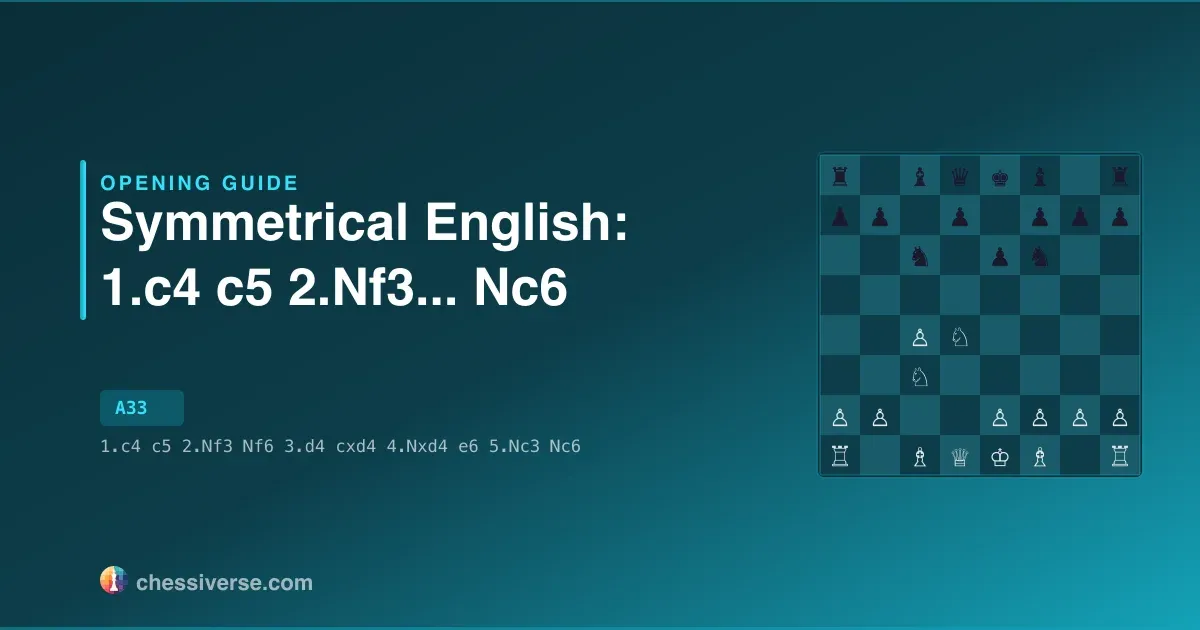
Starting from 1.c4 c5 2.Nf3 Nf6 3.d4 cxd4 4.Nxd4 e6 5.Nc3 Nc6, players enter the English Opening: Symmetrical Variation, Anti-Benoni Variation, Spielmann Defense (5...Nc6) — ECO A33. Lichess records 353,722 games in this line, which gives us a reliable view of how it actually performs in practice.
History and Notable Players
It arises from the English Opening: Symmetrical Variation, Anti-Benoni Variation, Spielmann Defense. On the White side, Viktor Korchnoi (42 games), Evgenij Agrest (28 games), Michal Krasenkow (21 games) top the database. Notable Black exponents: Nick E De Firmian (39 games), Maxime Vachier Lagrave (26 games), Krunoslav Hulak (23 games).
Performance Across Rating Levels
How well the English Opening: Symmetrical Variation, Anti-Benoni Variation, Spielmann Defense (5...Nc6) works depends on what level you're playing at. At 1200 Elo, the opening shows up in 0.00% of games (7,251 samples). White scores 46.4%, Black 50.3%, draws 3.3%. By 1800, popularity is 0.01% and White's score is 48.6% to Black's 45.9%. At 2500, 0.06% of games go into this opening; draws sit at 12.2% — the line is well-mapped at this level. Positions also become less sharp as level rises (sharpness 0.97 → 0.88).
Time Control Patterns
The English Opening: Symmetrical Variation, Anti-Benoni Variation, Spielmann Defense (5...Nc6) skews toward bullet chess. In bullet, it appears in 0.01% of games (378,797); White wins 48.6%. Blitz shows 0.01% adoption across 314,873 games, White scoring 48.1%. In rapid, the share rises to 0.00% — 38,849 games, White 46.5%. White's score swings 2.1pp across formats, so time control isn't just a stylistic choice here — it shifts the actual results.
Move Diversity and Theory Depth
Move choice is far from uniform in the English Opening: Symmetrical Variation, Anti-Benoni Variation, Spielmann Defense (5...Nc6). At 1200 Elo (7,251 games), the top reply is Nxc6, played 36.7% of the time. Four other moves each take at least 5% of games, and the top three moves account for 68.9% of games. Entropy: 2.73. By 2500 (8,212 games), g3 takes over as the top reply at 38.6%; five other moves reach 5% and the top three moves account for 69.2% of games. Entropy drops to 2.59.
Historical Trends
Tracking the English Opening: Symmetrical Variation, Anti-Benoni Variation, Spielmann Defense (5...Nc6) year over year shows a clear story. Adoption peaked in 2015 at 0.011% (2,471 games). By 2025 it sits at 0.007%, 41% below the peak but still 12% above its 2013 level, so the line is up over the full period despite easing from the high.
Common Mistakes
- Neglecting development — Extra pawn moves in the opening are tempting, especially when you "know the moves". Developing a piece each turn is the simple correction.
- Playing without a plan — Each English Opening: Symmetrical Variation, Anti-Benoni Variation, Spielmann Defense (5...Nc6) middlegame demands a specific approach. Decide whether the position calls for attack, manoeuvre, or simplification before reaching for a move.
Practice on Chessiverse
Ready to try the English Opening: Symmetrical Variation, Anti-Benoni Variation, Spielmann Defense (5...Nc6) against a bot? Pick an opponent at your level and play a game.