London System vs Indian

+391%
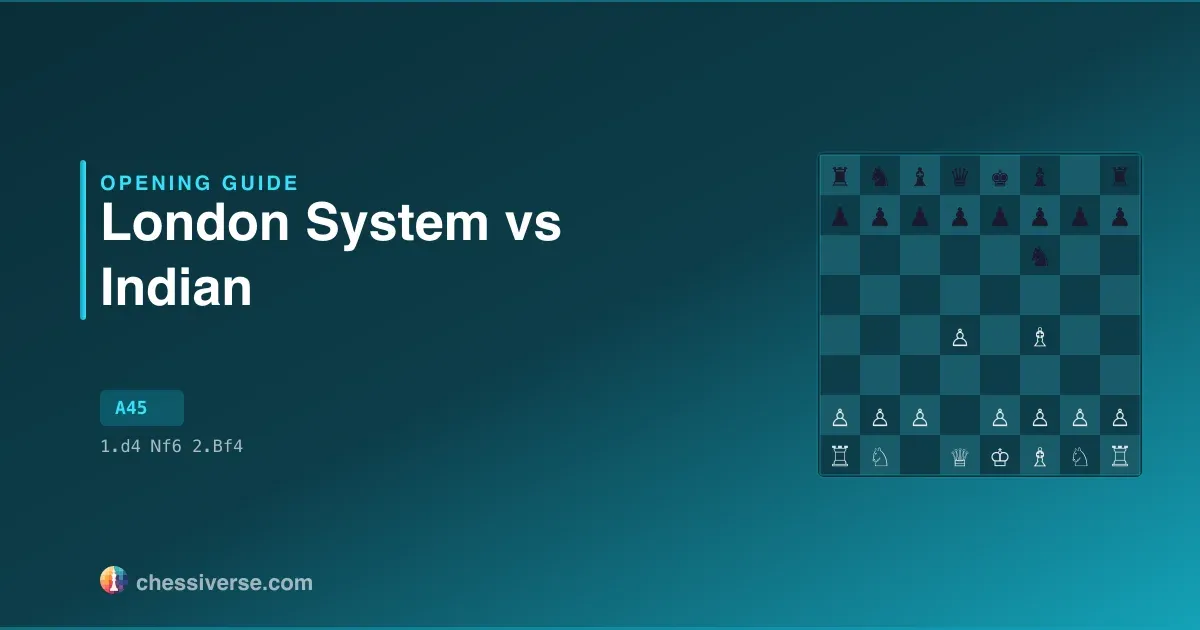
A451.d4 Nf6 2.Bf4
Sep 24, 2027
Play this opening as...
TL;DR

The same London recipe against 1...Nf6, with a twist: Black's uncommitted d-pawn unlocks King's Indian and Queen's Indian setups plus the annoying ...Qb6 hit on b2. Know those tries and the setup plays itself.

Reviewed by

IM John Bartholomew
IM John BartholomewCo-Founder & Chess Educator

International Master and chess educator. Co-founded Chessable and joined Chessiverse as co-founder. Best known for his "Climbing the Rating Ladder" YouTube series and structured opening courses.

London System vs Indian: A Complete Guide
London System vs Indian - Opening Moves
Summary

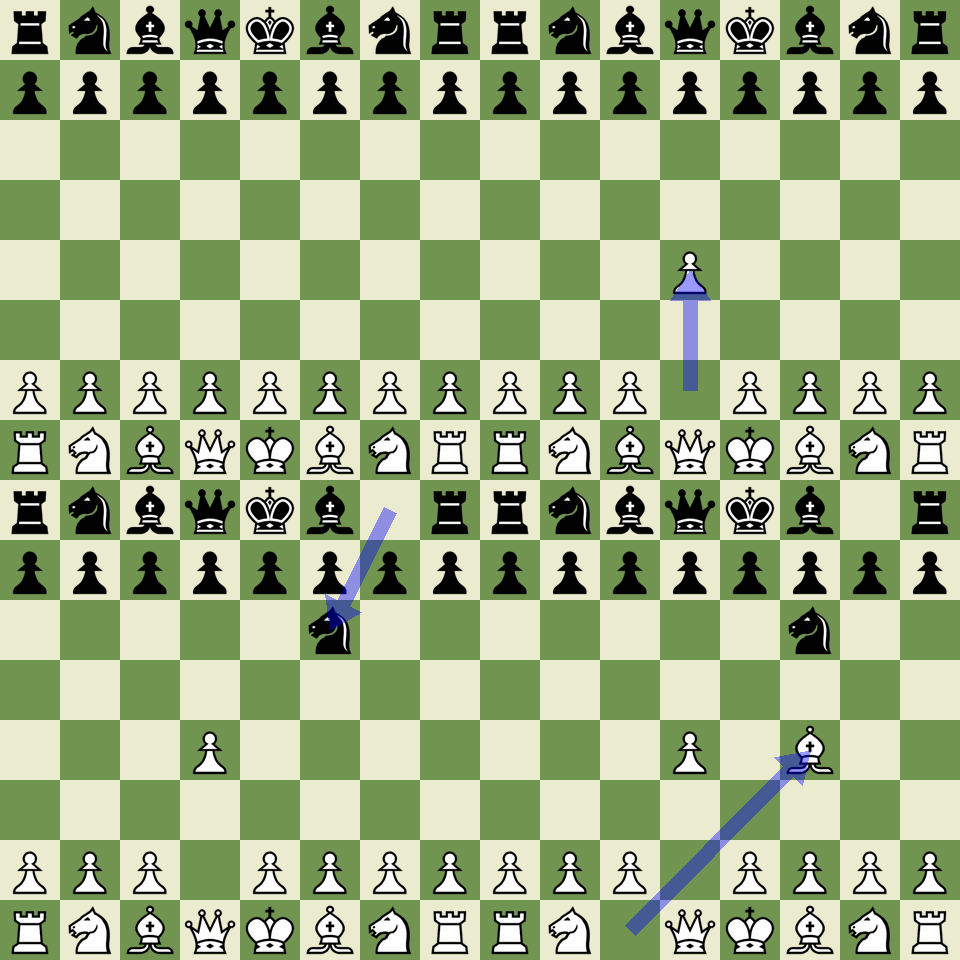
1.d4 Nf6 2.Bf4 opens the London System vs Indian, ECO A45. Same London, different examiner. With the d-pawn still at home, Black can answer with any Indian setup, and one cheeky queen move aims straight at the pawn White's bishop left behind.

Strategic Overview

White's intentions do not change against 1...Nf6: the bishop reaches f4 before e3, the pawn pyramid with c3 follows, and the pieces head for their usual squares. What changes is Black's freedom. With the d-pawn uncommitted, Black is not obliged to play 2...d5, which simply transposes to the main Accelerated London. Instead Black can play 2...g6 and set up King's Indian style with ...Bg7, ...d6 and a later ...c5, choose 2...b6 for a Queen's Indian arrangement with ...Bb7, ...e6 and ...Be7, or even combine both fianchettos. Against the ...g6 schemes the bishop on f4 earns its keep by discouraging Black's thematic ...e5 break, and a quiet h3 is useful insurance, giving it a retreat square on h2.

The move White must respect is 2...c5. After 3.e3 Qb6, Black targets b2, the pawn the bishop abandoned when it left c1, and this is the one moment where playing the London from memory can cost material on the spot. White needs a prepared answer, whether that means guarding the pawn or giving it up for activity, rather than a reflex developing move. At club level most of these games follow the same pattern: White does well when the standard setup arrives intact and the pieces flow to familiar squares, and Black does well when the early ...Qb6 jab or a patient fianchetto counterattack against d4 drags the game off script before White has castled.

History and Notable Players

It arises from the Indian Defense Systems.

Performance Across Rating Levels

Popularity and results vary sharply by rating level. At 1200 Elo, the opening shows up in 0.56% of games (3,793,591 samples). White scores 49.5%, Black 46.8%, draws 3.7%. Move up to 1800 Elo and the share shifts to 1.04%, with White winning 48.2% versus Black's 46.8%. At the top end (2500+ Elo), popularity is 1.06% with 9.5% draws — a clear sign of how much theory rules the line at master level. Positions also become less sharp as level rises (sharpness 0.96 → 0.91).

Time Control Patterns

Time control matters here: blitz players reach for this opening more than others. In bullet, it appears in 0.61% of games (16,132,040); White wins 49.3%. Blitz shows 0.82% adoption across 29,445,708 games, White scoring 48.8%. In rapid, the share rises to 0.72% — 7,951,500 games, White 47.9%.

Move Diversity and Theory Depth

What players actually play after the opening moves depends heavily on rating. At 1200 Elo, the top reply is g6, played 27.7% of the time. There are 5 other moves seeing meaningful share, and 70.1% of games stick to established theory. Entropy: 2.62. By 2500, g6 dominates at 24.8% of replies; only 5 viable alternatives remain and 68.3% of moves are theory. Entropy drops to 2.55. Even elite players don't fully agree on the best continuation here, which keeps the position dynamic.

Long-term, the trajectory of this opening is informative. Adoption peaked in 2020 at 0.84% (4,826,379 games). By 2025 it sits at 0.77% — a 391% shift overall, leaving the line on the rise.

Common Mistakes

  • Neglecting development — Extra pawn moves in the opening are tempting, especially when you "know the moves". Developing a piece each turn is the simple correction.
  • Letting White own the centre — Hypermodern openings concede central space on purpose, but only if you strike back in time. Delay the counter-blow and you end up squeezed.

Practice on Chessiverse

Ready to try the London System vs Indian against a bot? Pick an opponent at your level and play a game.


Quick Facts

Main Line1.d4 Nf6 2.Bf4
FENrnbqkb1r/pppppppp/5n2/8/3P1B2/8/PPP1PPPP/RN1QKBNR b KQkq - 2 2
DifficultyEasy
Style

Solid Defender openings aim for a rock-solid pawn structure and safe piece placement. They resist aggression, minimize weaknesses, and seek to outplay the opponent in the long run.

37,397,208games on Lichess
48.6%
4.7%
46.7%
White wins Draws Black wins

Data from Lichess opening explorer (blitz & rapid)

Most Popular At2200
SharpnessSharp

Popularity by Rating

Percentage of all games at each rating bracket that feature this opening.

Data from Lichess opening explorer (blitz & rapid games)

Theory Adherence by Rating

How often players choose the single most popular move at this position. Higher = more predictable play.

Black to move after the opening line

Popularity Over Time

Share of all Lichess blitz + rapid games featuring this opening, by year.

Top Moves by Rating

Black to move after the opening line

RatingMost Popular2nd3rd
400g623.6%d521.6%d618.3%
1000g626.6%d523.8%d616.9%
1200g627.7%d524.3%e618.1%
1400g627.5%d523.5%e621.9%
1600g626.6%e624%d522.2%
1800g625.4%e623.2%d521.5%
2000g624.8%e621.1%d521.1%
2200g625.6%d520.8%e620%
2500g624.8%d523%e620.5%

Popularity by Time Control

Bullet
0.61%16.1M
Blitz
0.82%29.4M
Rapid
0.72%8.0M
2% more decisive in bullet
Raw data tables (Lichess blitz + rapid)
London System vs Indian: popularity and win rates by player rating
Rating (Elo)Share %GamesWhite win %Black win %Draw %Sharpness
4000.27619,40749.646.53.90.961
10000.431,796,05949.546.73.80.962
12000.563,793,59149.546.83.70.963
14000.686,181,37649.247.03.80.962
16000.828,166,34648.747.04.30.957
18001.048,766,09448.246.85.00.950
20001.275,753,50247.746.36.00.940
22001.292,175,59747.645.17.30.927
25001.06145,23646.643.89.50.905
London System vs Indian: move-choice theory adherence by rating
Rating (Elo)Top moveTop move %Viable movesTheory %Entropy
400g623.6563.52.783
1000g626.6567.42.682
1200g627.7570.12.618
1400g627.5572.92.567
1600g626.6572.82.537
1800g625.4570.02.548
2000g624.8567.02.562
2200g625.6566.42.557
2500g624.8568.32.551
London System vs Indian: popularity over time
YearShare %GamesWhite win %Black win %Draw %
20130.164,51445.251.43.4
20140.2219,93645.650.24.3
20150.2657,16246.549.14.4
20160.32198,45046.249.14.7
20170.49558,32347.947.44.7
20180.651,214,37948.147.24.6
20190.702,009,88848.447.04.6
20200.844,826,37948.047.05.0
20210.826,240,46448.446.94.8
20220.815,953,92948.846.54.6
20230.776,092,99348.846.54.7
20240.775,714,86548.846.44.7
20250.775,705,61848.846.54.7
London System vs Indian: popularity by time control
FormatShare %GamesWhite win %Black win %Draw %Sharpness
bullet0.6116,132,04049.347.53.20.968
blitz0.8229,445,70848.846.64.70.953
rapid0.727,951,50047.947.15.00.950
London System vs Indian: top candidate moves by rating bracket
Rating (Elo)1st move1st %2nd move2nd %3rd move3rd %
400g623.6d521.6d618.3
1000g626.6d523.8d616.9
1200g627.7d524.3e618.1
1400g627.5d523.5e621.9
1600g626.6e624.0d522.2
1800g625.4e623.2d521.5
2000g624.8e621.1d521.1
2200g625.6d520.8e620.0
2500g624.8d523.0e620.5
Play this opening

Pick your side — then choose where to start.

Guided Play

Practice the London System vs Indian with a coach

John follows this exact line and grades every move — green for best, red for blunders — with hints on demand and a blunder guard watching your back.

Frequently Asked Questions

What is the London System vs Indian?

The London System vs Indian begins with 1.d4 Nf6 2.Bf4 and is classified under ECO code A45. White develops their dark-squared bishop, so that they may play e3 to support the d4 pawn without leaving the bishop stuck behind the pawn chain.

Is the London System vs Indian good for beginners?

Yes, the London System vs Indian is an excellent choice for beginners. The plans are relatively straightforward, and the key ideas are easy to understand. As you improve, you can explore deeper theoretical lines. Practice against our beginner-level bots to build confidence.

What are the win rates for the London System vs Indian?

In a database of 54,252,617 master games, White wins 48.8% of the time, Black wins 47%, and 4.3% are drawn.

How can I practice the London System vs Indian?

On Chessiverse, you can practice the London System vs Indian by playing against our 600+ AI bots. Each bot has a unique playing style and opening repertoire, so you can find the perfect sparring partner for any level.

Reviewed by

IM John Bartholomew
IM John BartholomewCo-Founder & Chess Educator

International Master and chess educator. Co-founded Chessable and joined Chessiverse as co-founder. Best known for his "Climbing the Rating Ladder" YouTube series and structured opening courses.

Practice This Opening on Chessiverse

Play against 1000+ AI bots with unique personalities and opening repertoires. From beginner-friendly to grandmaster-level opponents, find the perfect sparring partner for any opening.

Play Now

Not sure which opening fits you? Take the free chess personality test — your style determines which openings will work with you.

Back to Articles