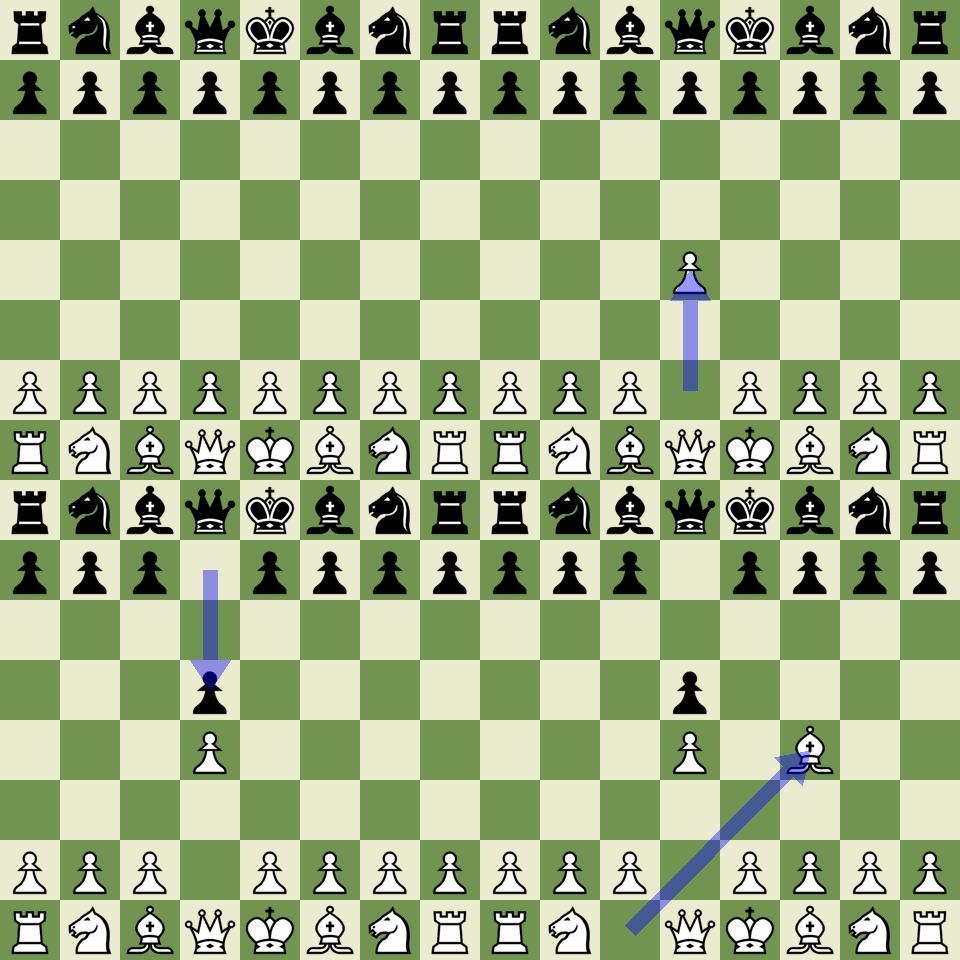
The Accelerated London System begins with 1.d4 d5 2.Bf4 (ECO D00). One bishop move announces the whole plan: the same d4, e3, c3 pyramid, game after game, with every piece already knowing its square. The trick is that Bf4 comes out before the pawn chain can lock it in.
- White builds the same sturdy structure with d4, Bf4, e3, c3, Bd3 and Nbd2, carrying a smaller body of theory than most openings.
- A key plan is planting a knight on e5, propped up by the d4-pawn and the f4-bishop.
- Playing Bf4 before Nf3 dodges the early ...c5 lines that give Black an improved version against the classical London move order.
Strategic Overview
The Accelerated London rests on one small refinement of move order: the dark-squared bishop steps out to f4 before White plays e3, so it never gets buried behind its own pawn chain. From there the setup is famously repeatable. White builds the pawn pyramid with d4, e3 and c3, develops with Nf3, Bd3 and Nbd2, castles short, and only then decides where the game is going. The signature middlegame idea is a knight planted on e5, protected by the d4 pawn and covered again by the bishop on f4. Once that knight is stable and the d3 bishop points at h7, the classic bishop sacrifice on h7 against a castled king becomes a real threat, with the queen swinging to h5 to follow up.
Black does best to challenge the setup before it settles: ...c5 hits d4, ...Nc6 and ...e6 develop naturally, and ...Bd6 offers to trade off White's best piece. The sharpest jab is an early ...Qb6, because Bf4 left the b2 pawn behind, and London players on autopilot can simply lose it. That autopilot is the typical club-level mistake for White, playing the same seven moves without looking, while Black's typical mistake is passivity, letting the setup finish unchallenged and then wondering where the kingside attack came from. At higher levels White more often inserts Nf3 before Bf4, but against 1...d5 the immediate bishop move is fully reliable and shows the plan at once.
History and Notable Players
It arises from the Queen's Pawn Systems (1...d5).
James Mason was already using the London setup regularly in the 1880s, but the name comes from the 1922 London tournament, where it appeared in games involving Capablanca, Alekhine and Rubinstein. The modern 2.Bf4 move order became common after Johnsen and Kovacevic's 2005 book Win with the London System; players including Carlsen, Kramnik and Kamsky have employed the opening.
Named after: Named for the London 1922 tournament, where the setup appeared repeatedly in top-level games; the 'accelerated' version plays Bf4 on move two, before Nf3.
Notable players: Magnus Carlsen, Vladimir Kramnik, Gata Kamsky, Ding Liren
The London earned world-championship fame in 2023, when Ding Liren used it to beat Ian Nepomniachtchi in game 6 of their title match.
Performance Across Rating Levels
How well the Accelerated London System works depends on what level you're playing at. The 1200 bracket has 18,603,385 games (2.76% of all games at that level); White wins 52.7%, Black 43.4%, 3.9% are drawn. By 1800, popularity is 1.85% and White's score is 50.5% to Black's 44.2%. At 2500, 0.90% of games go into this opening; draws sit at 10.8% — the line is well-mapped at this level. White's edge erodes by 5.1pp from 1200 to 2500 Elo, suggesting Black's counterplay is easier to find with experience.
Time Control Patterns
Time control matters here: rapid players reach for this opening more than others. In bullet, it appears in 1.55% of games (41,253,908); White wins 52%. Blitz shows 2.13% adoption across 76,640,619 games, White scoring 51.5%. In rapid, the share rises to 2.48% — 27,490,058 games, White 51.9%.
Move Diversity and Theory Depth
What players actually play after the opening moves depends heavily on rating. At 1200 Elo (18,603,385 games), the top reply is Nc6, played 35.9% of the time. Three other moves each take at least 5% of games, and the top three moves account for 73.4% of games. Entropy: 2.54. By 2500 (122,084 games), Nf6 takes over as the top reply at 43.4%; three other moves reach 5% and the top three moves account for 82.5% of games. Entropy drops to 2.19.
Historical Trends
Year-over-year data tells you whether this opening is a contemporary fixture or a fading one. Adoption peaked in 2025 at 2.28% (16,921,405 games). 2025 marks the high — the opening is rising, currently at 2.28%.
Common Mistakes
- Neglecting development — Extra pawn moves in the opening are tempting, especially when you "know the moves". Developing a piece each turn is the simple correction.
- Playing without a plan — Each Accelerated London System middlegame demands a specific approach. Decide whether the position calls for attack, manoeuvre, or simplification before reaching for a move.
Practice on Chessiverse
Ready to try the Accelerated London System against a bot? Pick an opponent at your level and play a game.