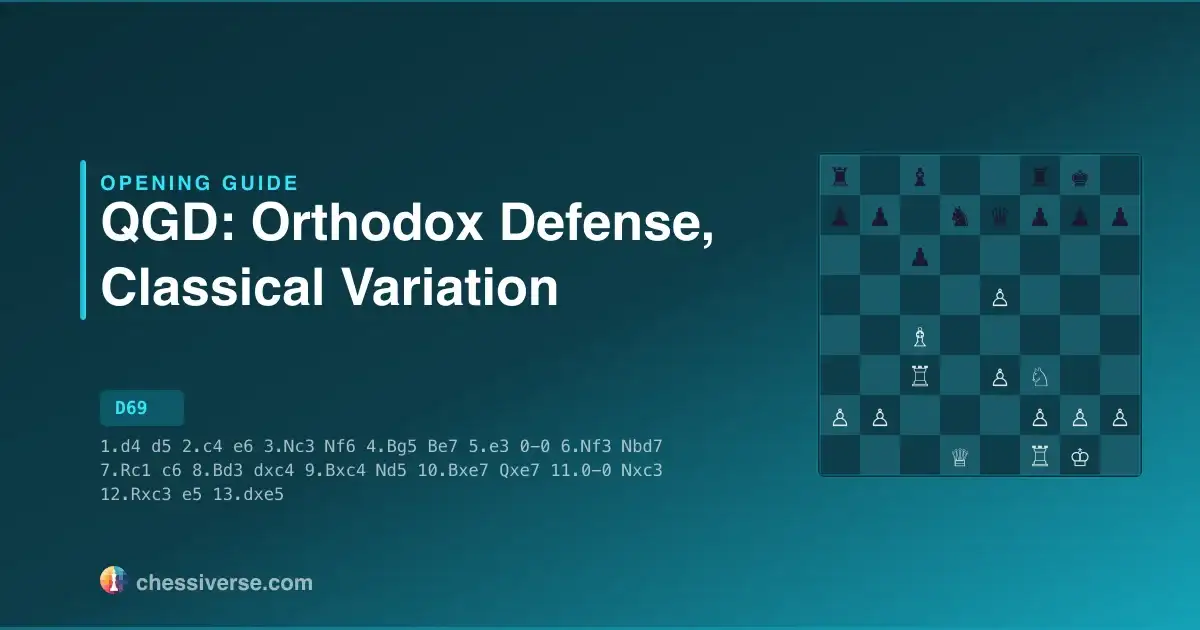




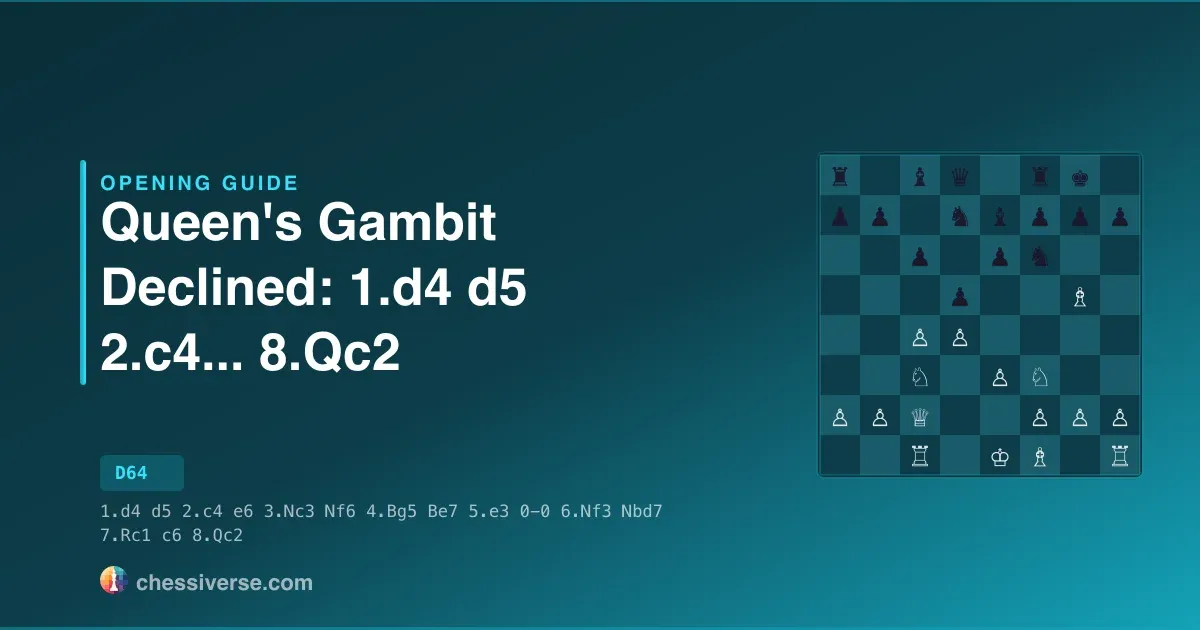
1.d4 d5 2.c4 e6 3.Nc3 Nf6 4.Bg5 Be7 5.e3 0-0 6.Nf3 Nbd7 7.Rc1 c6 8.Qc2 opens the Queen's Gambit Declined: Orthodox Defense, Rubinstein Attack, ECO D64. Lichess records 52,868 games in this line, which gives us a reliable view of how it actually performs in practice.
History and Notable Players
It arises from the Queen's Gambit Declined: Orthodox Defense, Main Line. Among the most prolific White practitioners are Ernst Gruenfeld (14 games), Alexander Alekhine (14 games), Efim Bogoljubow (9 games). Black-side regulars include Frederick Yates (15 games), Geza Maroczy (11 games), Jose Raul Capablanca (9 games).
Move Diversity and Theory Depth
Move choice is far from uniform in the Queen's Gambit Declined: Orthodox Defense, Rubinstein Attack. At 1200 Elo (124 games), the top reply is h6, played 28.4% of the time. Six other moves each take at least 5% of games, and the top three moves account for 56.9% of games. Entropy: 3.13. By 2500 (529 games), h6 is still the top reply, at 31.3%; only four other moves still reach 5% and the top three moves account for 72% of games. Entropy drops to 2.45. The narrowing is significant — strong players consolidate around a small set of best moves, while amateurs scatter across many plausible-looking options.
Main Lines and Variations
After 1.d4 d5 2.c4 e6 3.Nc3 Nf6 4.Bg5 Be7 5.e3 0-0 6.Nf3 Nbd7 7.Rc1 c6 8.Qc2, the established follow-ups are:
Each branch leads to a different middlegame character — the resulting pawn structure decides what kind of game you get.
Common Mistakes
- Playing outside main lines — At 1200 Elo, only 56.9% of games stay with the three most-played moves; at 2000 that climbs to 69.2%. Most of the gap is players who pick a reasonable-looking move over the best one, and the position quietly drifts.
- Neglecting development — It can feel productive to make extra pawn moves early, but falling behind in piece development is what loses most amateur games — especially in open positions where active pieces find squares fast.
- Overextending the attack — Gambits look like permission to throw everything forward. They aren't — every attacking move should improve a piece. Random checks and threats burn the initiative once they fail to coordinate.
Practice on Chessiverse
Ready to try the Queen's Gambit Declined: Orthodox Defense, Rubinstein Attack against a bot? Pick an opponent at your level and play a game.