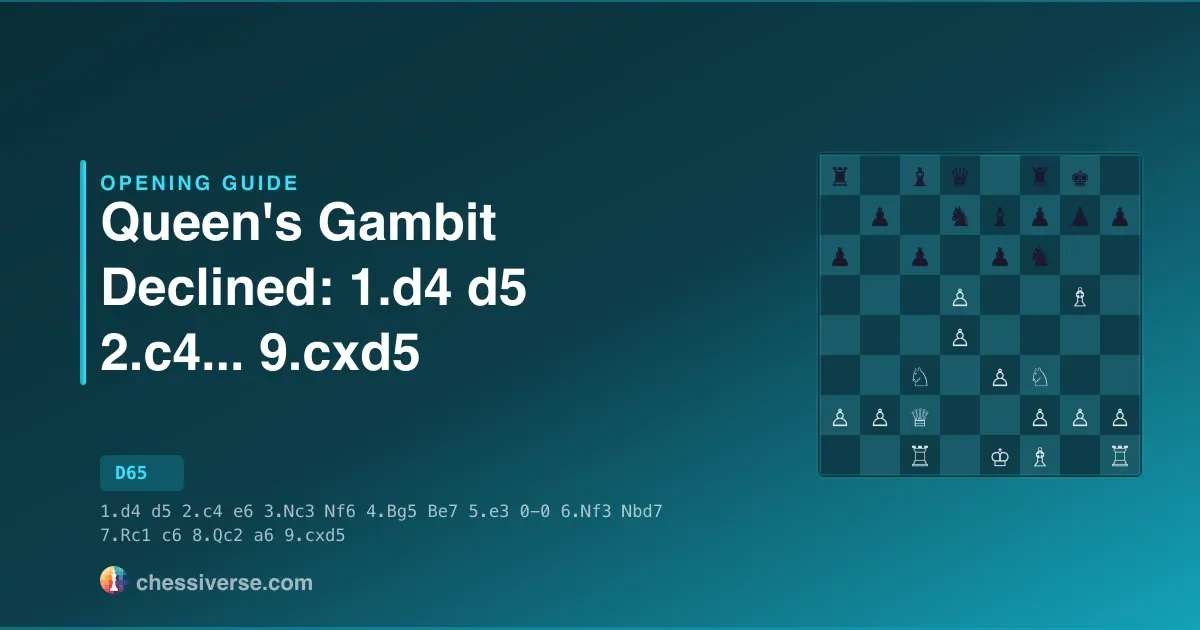
The Queen's Gambit Declined: Orthodox Defense, Rubinstein Attack (8...a6) begins with 1.d4 d5 2.c4 e6 3.Nc3 Nf6 4.Bg5 Be7 5.e3 0-0 6.Nf3 Nbd7 7.Rc1 c6 8.Qc2 a6 9.cxd5 (ECO D65). Across rating levels it shows up in 1,841 recorded games — enough data to map exactly where it succeeds and where it stalls.
History and Notable Players
It arises from the Queen's Gambit Declined: Orthodox Defense, Rubinstein Attack. On the White side, Roberto Grau (2 games), Vladislav Nevednichy (2 games), Alexander Alekhine (2 games) top the database. Notable Black exponents: Frederick Yates (3 games), Romeo Sorin Milu (2 games), Vsevolod Rauzer (2 games).
Move Diversity and Theory Depth
What players actually play after the opening moves depends heavily on rating. Below 1600 the samples are small (7 games at 1200, 52 at 1400), so the comparison starts at 1600, with 190 games. There, the top reply is exd5, played 44.2% of the time. Two other moves each take at least 5% of games, and the top three moves account for 100% of games. Entropy: 1.48. By 2200 (352 games), exd5 dominates at 79.3% of replies; two other moves reach 5% and the top three moves account for 100% of games. Entropy drops to 0.91. The narrowing is significant — strong players consolidate around a small set of best moves, while amateurs scatter across many plausible-looking options.
Common Mistakes
- Neglecting development — Extra pawn moves in the opening are tempting, especially when you "know the moves". Developing a piece each turn is the simple correction.
- Overextending the attack — Gambits look like permission to throw everything forward. They aren't — every attacking move should improve a piece. Random checks and threats burn the initiative once they fail to coordinate.
Practice on Chessiverse
Ready to try the Queen's Gambit Declined: Orthodox Defense, Rubinstein Attack (8...a6) against a bot? Pick an opponent at your level and play a game.