




The black Chessiverse mascot army in a solid defensive stance
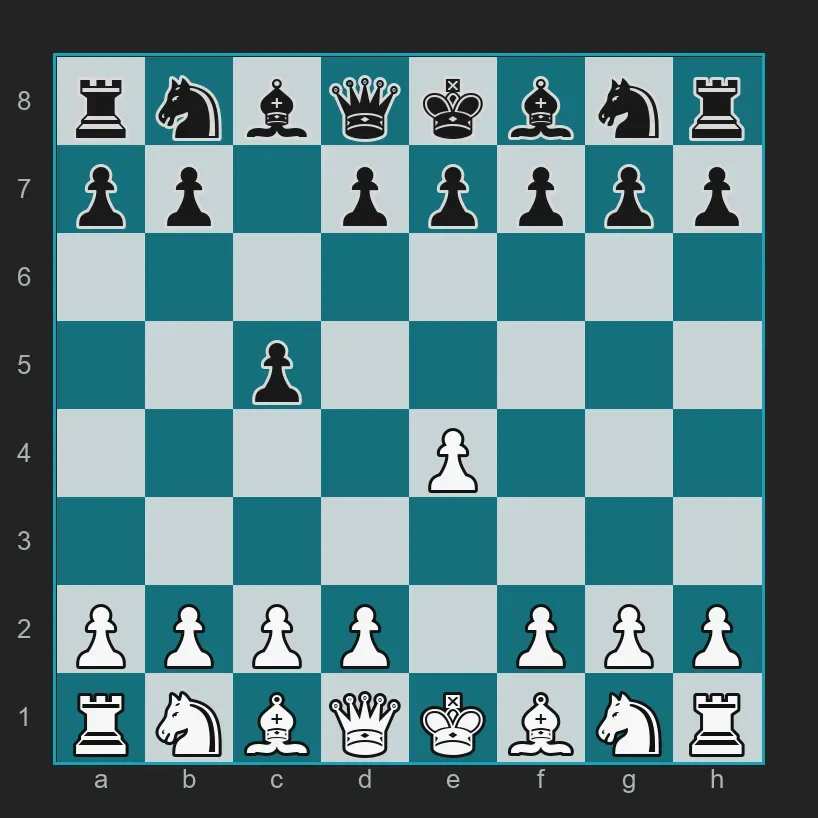
Sicilian Defense position after 1.e4 c5
Summary
The best chess openings for Black do two jobs at once: neutralize White's first-move initiative and create real winning chances. Because White moves first, a complete Black repertoire needs one answer to 1.e4 and one to 1.d4. This guide covers four defenses that work at every level, the Sicilian, the Caro-Kann, the Queen's Gambit Declined, and the King's Indian, plus more options and ready-made repertoire pairings.
Practice every defense against 1000+ human-like bots on Chessiverse - free
Contents
- What makes an opening good for Black
- Against 1.e4: Sicilian
- Against 1.e4: Caro-Kann
- Against 1.d4: Queen's Gambit Declined
- Against 1.d4: King's Indian
- More defenses at a glance
- Build your repertoire
- Reading White's setup
- FAQ
- Sources
What makes an opening good for Black
Playing Black means starting half a tempo behind, so the opening must be honest about its job: a sound pawn structure, clear development, and a plan that does not depend on White's mistakes. The four defenses below meet that bar from beginner to grandmaster level. They also cover both of White's serious first moves, which is the definition of a complete repertoire: whatever your opponent starts with, you already know the battlefield and the plan that comes with it.
| Defense | Against | Character | Best for |
|---|---|---|---|
| Sicilian | 1.e4 | Sharp, unbalanced | Playing for a win |
| Caro-Kann | 1.e4 | Solid, structured | Safety-first players |
| Queen's Gambit Declined | 1.d4 | Classical, reliable | One answer forever |
| King's Indian | 1.d4 | Counterattacking | Tacticians |
1. The Sicilian Defense: the fighting choice
The Sicilian (1...c5) is the most popular reply to 1.e4 at every level, and database statistics explain why: it scores better for Black than any other defense (Lichess opening explorer, no-follow). Answering a center pawn with a wing pawn unbalances the game from move one.
Animated Open Sicilian sequence: 1.e4 c5 2.Nf3 d6 3.d4 cxd4 4.Nxd4 Nf6
The price and how to pay it
Sharpness cuts both ways: White gets attacking chances, and main-line theory runs deep. Start with a system approach, the same setup against everything, before diving into open Sicilian theory. Best for ambitious players who want to win with Black, not just equalize.
The weakness of the Sicilian
The Sicilian's one real drawback is the theory burden: White chooses from the Open Sicilian, the Alapin, the Grand Prix, and more, so you must know several plans. The half-open d-file and a slightly loose structure also mean one careless move can invite a crushing attack.
2. The Caro-Kann Defense: the solid wall
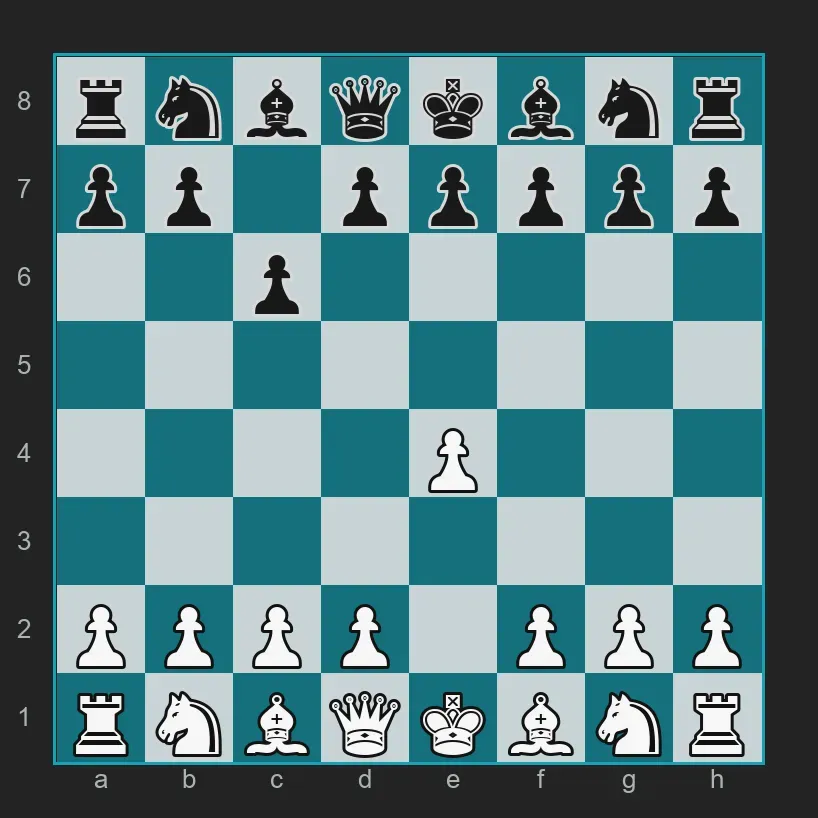
Caro-Kann Defense position after 1.e4 c6
The Caro-Kann (1...c6) prepares 2...d5, challenging the center immediately while keeping the light-squared bishop's diagonal open, the exact problem the French Defense never solves. World champions from Capablanca to Carlsen have trusted it.
Why improvers love it
The pawn structures are healthy, the plans are repeatable, and the endgames are famously comfortable. You will rarely be blown off the board in twenty moves. Best for players who value solidity and hate being attacked.
Also solid vs 1.e4: the French Defense
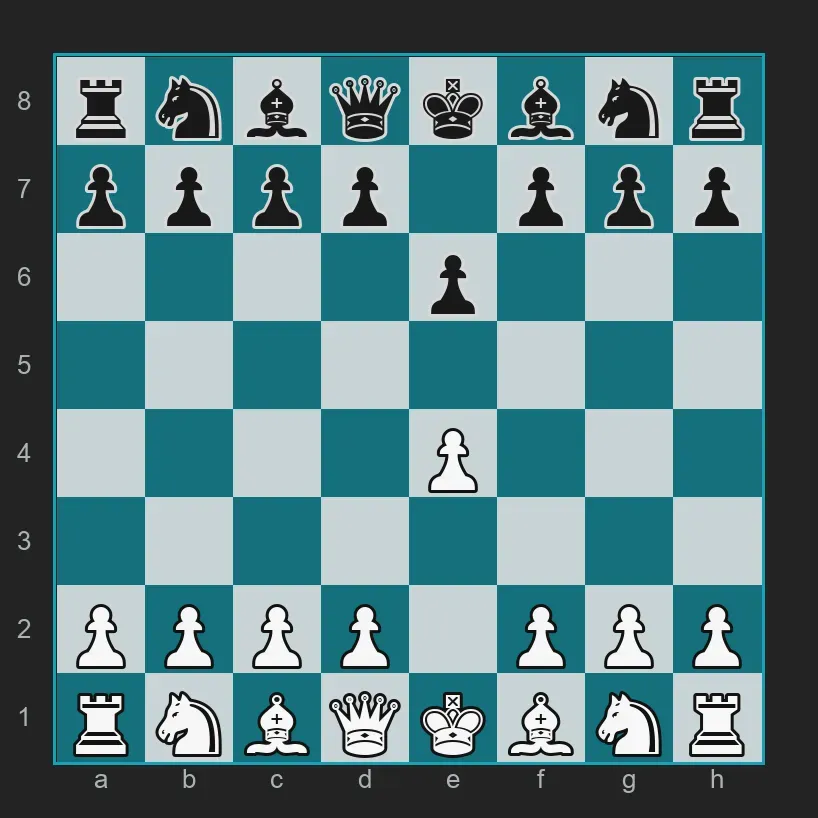
French Defense position after 1.e4 e6
The French (1...e6, preparing 2...d5) builds a firm pawn chain and invites White to overextend. The trade-off is the light-squared bishop, which can stay passive behind the pawns. It rewards players who enjoy patient defense and a well-timed counter with ...c5 against White's center.
Also worth knowing: 1...e5, the classical answer
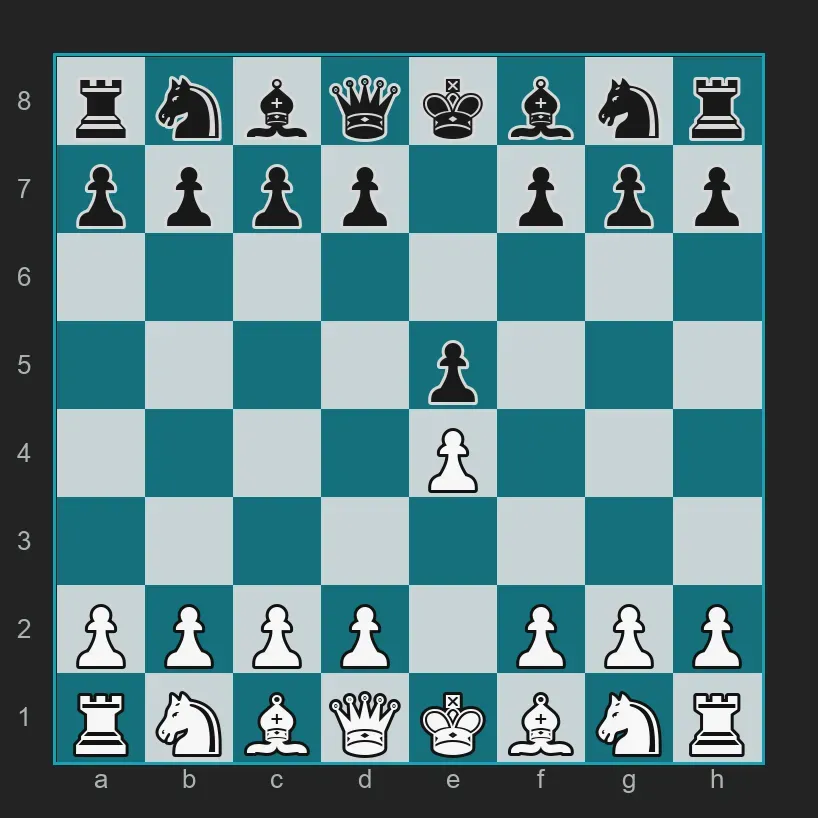
Classical open game position after 1.e4 e5
Meeting 1.e4 with 1...e5 is the oldest, most principled reply, leading into the Italian and Ruy Lopez battlegrounds. It is excellent chess education with one caveat: White picks the system, so you must know several. It pairs perfectly with studying our Italian Game guide from the other side.
3. The Queen's Gambit Declined: the classical fortress
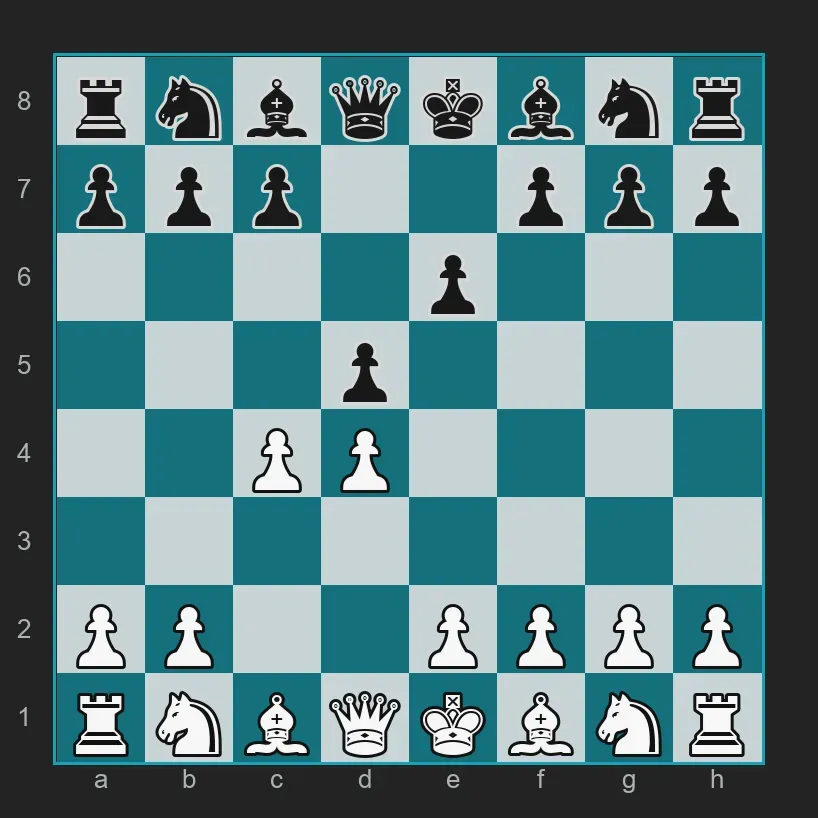
Queen's Gambit Declined position after 1.d4 d5 2.c4 e6
Declining the gambit with 2...e6 gives Black one of the most reliable structures in chess. Develop behind a solid pawn chain, castle early, and free your game with the ...c5 or ...e5 break at the right moment.
A century of proof
The QGD has anchored Black repertoires in world championship matches for a hundred years because it simply does not crack (Wikipedia, no-follow). Best for players who want one dependable answer to 1.d4 forever.
4. The King's Indian Defense: the counterattack
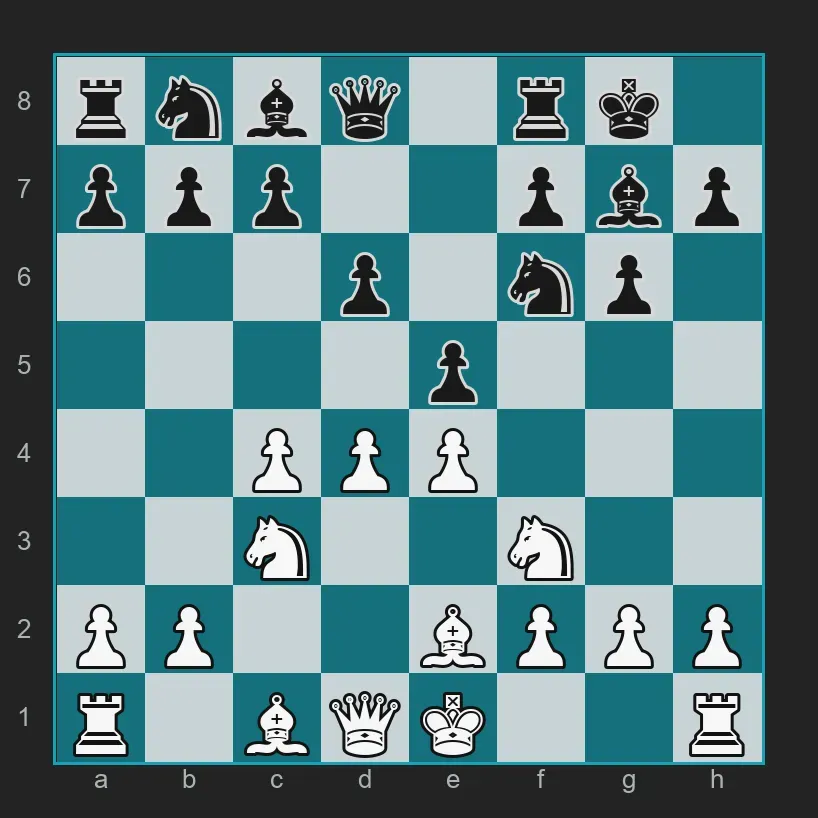
King's Indian Defense setup with the fianchettoed bishop on g7
The King's Indian lets White build a big center, then attacks it with everything: ...e5 or ...c5 breaks, followed by a kingside pawn storm while White plays on the other wing. Fischer and Kasparov made careers of it.
Races favor the prepared
Opposite-wing attacks become races, and races favor the player who knows the plans. Study the standard attacking schemes before your first tournament outing. Best for tactical players who would rather attack than equalize.
More defenses at a glance
A repertoire only needs one answer to each first move, but it helps to know the wider menu. These are sound, popular alternatives worth exploring once your main pair feels natural.
| Defense | Against | Character | Best for |
|---|---|---|---|
| French Defense | 1.e4 | Solid, counterpunching | Patient defenders |
| Scandinavian (1...d5) | 1.e4 | Simple, direct | Low-theory players |
| Pirc / Modern | 1.e4 | Flexible, hypermodern | Counterattackers |
| Slav Defense | 1.d4 | Rock-solid | QGD alternative |
| Nimzo-Indian | 1.d4 | Strategic, pin-based | Positional players |
| Dutch Defense | 1.d4 | Aggressive, kingside | Attackers |
How to use this menu
Do not learn all of them. Pick your one answer to 1.e4 and one to 1.d4 from the detailed sections above, then dip into this list only when you want variety or a specific style. Breadth is for browsing; depth in one pair is what actually raises your rating.
How to build your Black repertoire
Pick exactly one defense per White first move and keep the pair for a month of games:
- Balanced start: Caro-Kann + Queen's Gambit Declined.
- Maximum fight: Sicilian + King's Indian.
- Classical education: 1...e5 + Queen's Gambit Declined.
Train the pair against human-like bots
Repetition against realistic opposition is what turns theory into instinct. Chessiverse bots meet your Caro-Kann with the same natural, imperfect moves your real opponents play, so the middlegame plans become familiar. Ten games tonight, no queues, no cheating, takebacks allowed while learning. Combine the games with our guide on how to get better at chess, and for video repertoire study, IM John Bartholomew's YouTube channel (external link) is a goldmine.
Train your Black repertoire against a bot now
Reading White's setup: the first three moves tell you everything
Strong Black players spend the opening's first seconds classifying the game ahead.
The quick classification
| White starts with | Expect | Your mindset |
|---|---|---|
| 1.e4 + quick Bc4 ideas | Open, tactical game | Develop fast, watch f7 |
| 1.e4 + 2.Nf3 main roads | Theory battle | Follow your repertoire |
| 1.d4 + 2.c4 | Strategic struggle | Fight for e4 and c5 breaks |
| System setups (London, Colle) | Autopilot opponent | Unbalance early with ...c5 |
Why classification beats memorization
Once you know which of the four games you are in, half your moves choose themselves even outside preparation. That is the real skill behind every good Black repertoire: recognizing the battlefield before the battle starts, then trusting the plans you have rehearsed. Memorized lines run out by move ten in most club games; a correct classification keeps guiding you until the endgame.
Typical mistakes when playing Black
- Playing for tricks instead of equality. Cheap traps that fail leave you a tempo down in a worse position.
- Copying White's moves too long. Symmetry hands White a permanent initiative; break it as soon as theory allows.
- Switching defenses after every loss. Losses are the tuition fee for learning a defense; changing openings resets the meter to zero.

A dark mascot meeting White's move head on
Frequently asked questions
What is the best chess opening for Black?
No single opening is best, but the Sicilian scores highest against 1.e4 in practice, and the Queen's Gambit Declined is the most reliable answer to 1.d4. Real strength comes from knowing your chosen defense's plans deeply rather than collecting many of them.
Which opening has the highest win rate for Black?
In large game databases the Sicilian gives Black the best results against 1.e4, because its unbalanced positions reward the better-prepared player instead of fizzling into a draw. Win rate always depends on how well you know the resulting middlegames.
What is the most aggressive opening for Black?
The Sicilian and the King's Indian lead the field: both invite sharp, double-edged play where Black attacks rather than equalizes. The Dutch Defense against 1.d4 is another combative choice for players who want to seize the initiative early.
What is the best opening for Black against 1.e4 and 1.d4?
Against 1.e4, the Sicilian for fighters and the Caro-Kann for solid players. Against 1.d4, the Queen's Gambit Declined for reliability and the King's Indian for counterattack. Any of these pairs forms a complete, sound repertoire on its own.
What does Magnus Carlsen play against 1.d4?
Carlsen varies deliberately, but the Nimzo-Indian and Queen's Gambit Declined structures appear often, alongside occasional King's Indian and Grunfeld outings. Club players improve faster with one consistent answer to 1.d4 than by imitating that flexibility.
How long does it take to learn a defense?
Faster than most players think, if you stay consistent. The core plans of the Caro-Kann or Queen's Gambit Declined feel familiar after roughly twenty focused games, especially when you review each loss briefly. The mistake that resets progress is switching defenses after a bad week.
Start playing free on Chessiverse
Keep learning: best chess openings for White, Italian Game complete guide, or play vs the computer.

A dark king mascot safely castled behind its pawns
Sources
External links are no-follow.
- Lichess opening explorer (defense statistics from master games) - https://lichess.org/opening
- Wikipedia: Queen's Gambit Declined (history) - https://en.wikipedia.org/wiki/Queen%27s_Gambit_Declined
- John Bartholomew, YouTube (repertoire study on video) - https://www.youtube.com/@johnbartholomew