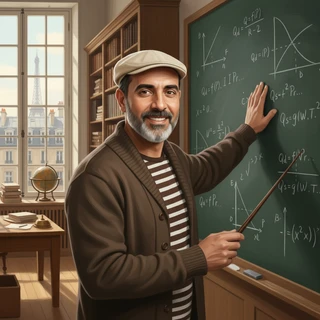
Bonjour, mon ami...welcome to my little symposium! Every move here is an investment in _equity_, and I promise the endgame pays the finest dividends, n'est-ce pas? Pull up a chair, pour a café...and let us begin our market tango ♞
Louie Endgame is a 45-year-old economist from France who models global markets in Paris. His estimated rating of 3042 places him at super-grandmaster, engine-tier strength, a level that beats nearly all human masters and plays close to theoretically perfect chess. The bot's backstory stresses patience, forecasting trends and adjusting plans with a steady hand, and his lucky charm is a gold pocket watch. His favorite quote is "Every piece has value; every move, a strategy. Balance today for tomorrow's checkmate." As White, Louie has played the Indian Game mainlines in 738 games and the Queen's Gambit in 400. As Black, he has chosen the Najdorf in 69 games and the Nimzo-Indian in 49. Those numbers show a clear preference for d4 systems with White and well-known defenses with Black. Anyone sitting down opposite Louie should expect a defensive, simplifying opponent who trades pieces patiently and converts endgames with near-flawless accuracy.
How Louie plays
Louie favors defensive setups and strongly prefers trading pieces to keeping tension, which keeps positions clear and controlled. His style sits near the middle between solid and sharp, and between offbeat and mainline theory, so he stays flexible rather than dogmatic. With White he leans on the Queen's Gambit and Indian Game structures, while the Najdorf and Nimzo-Indian appear with Black. Patient pressure and clean endgame technique define his play.
Who should play Louie
Players rated roughly 2400 and above, including masters, will find Louie a demanding test, since a 3042 rating is far beyond human reach. Because he plays defensively and trades down, the matchup teaches attackers how to create winning chances against a patient opponent, and it teaches endgame technique under constant pressure. Ambitious club players around 1800 to 2200 can also study how precise simplification works.