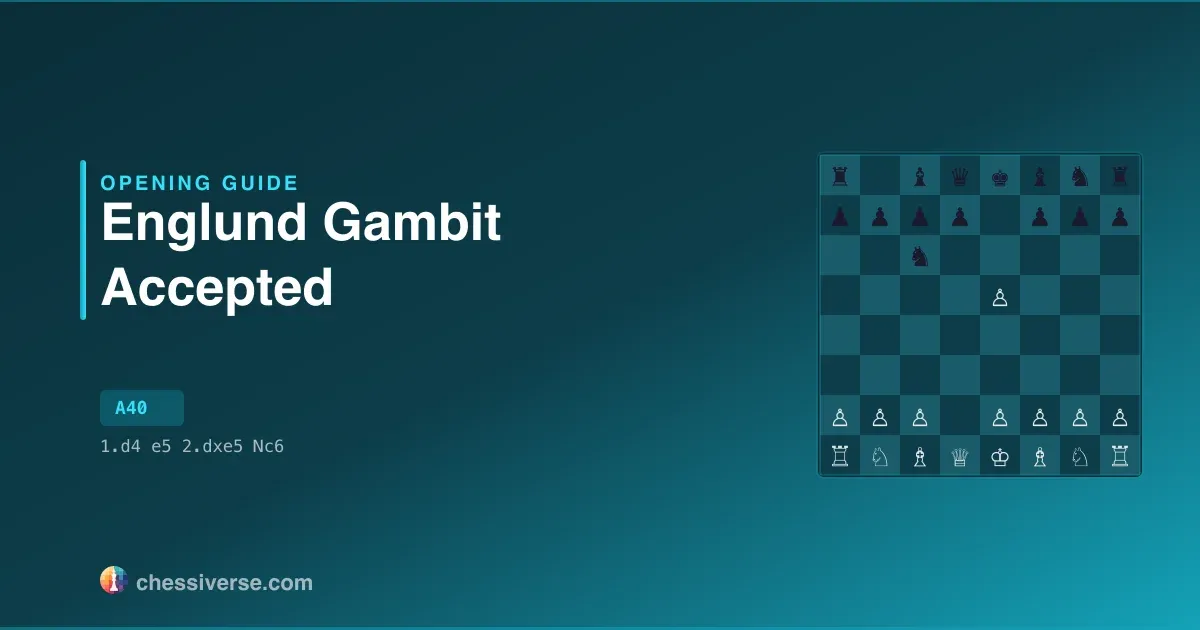
Starting from 1.d4 e5 2.dxe5 Nc6, players enter the Englund Gambit Accepted — ECO A40. Most 1.d4 players sit down expecting a slow, solid game. The Englund Gambit Accepted cancels that plan by move two: the e-pawn is already gone, Black's pieces are already coming, and the questions start immediately.
Strategic Overview
Black's whole idea is visible inside two moves: give up the e-pawn, open lines, and develop with threats before White settles in. The knight comes to c6 and hits e5 at once, and ...Qe7 usually follows, planning to win the pawn back or, if White clings on clumsily, to start making real threats against the queenside. The positions Black wants are messy and fast, with open diagonals and a White opponent thinking alone on move three of a queen's pawn game. What Black fears is the opposite script: White develops calmly, gives nothing away, and the game becomes a normal one where Black is simply a pawn short with an early-committed queen.
For White, the golden rule is that greed is optional. 3.Nf3 is the natural move, defending e5 while developing a piece, and with accurate play White can often keep the pawn outright. But returning it at a moment of your choosing is just as strong, because a clean lead in development and a healthy centre beat a shaky extra pawn every time. The real danger is not the gambit but its tricks, above all the famous queen check on b4 aimed at b2 in the main line, which is why one tidy prepared setup is worth its weight in gold. At club level, White loses these games by grabbing material while pieces sit at home, and Black loses them by treating the opening as a pure trap and drifting when the trap does not spring.
History and Notable Players
It arises from the Englund Gambit.
Performance Across Rating Levels
How well the Englund Gambit Accepted works depends on what level you're playing at. Among 1200-rated players, it appears in 0.43% of games — 2,920,626 of them on record — with White winning 47.6% and Black 49%. Move up to 1800 Elo and the share shifts to 0.37%, with White winning 49.5% versus Black's 46.2%. Among 2500-rated players the line appears in 0.07% of games and draws spike to 8.1%, indicating tight preparation.
Time Control Patterns
Look at the same opening across time controls and bullet stands out. In bullet, it appears in 0.41% of games (10,772,484); White wins 48.6%. Blitz shows 0.40% adoption across 14,472,627 games, White scoring 48.6%. In rapid, the share rises to 0.35% — 3,889,257 games, White 48.4%.
Move Diversity and Theory Depth
Looking at move selection shows how forcing — or not — the position really is. At 1200 Elo (2,920,626 games), the top reply is Nf3, played 67% of the time. Two other moves each take at least 5% of games, and the top three moves account for 90.8% of games. Entropy: 1.67. By 2500 (9,719 games), Nf3 dominates at 87.4% of replies; only one other move still reaches 5% and the top three moves account for 97.3% of games. Entropy drops to 0.81. The narrowing is significant — strong players consolidate around a small set of best moves, while amateurs scatter across many plausible-looking options.
Historical Trends
Long-term, the trajectory of this opening is informative. Adoption peaked in 2022 at 0.44% (3,272,472 games). By 2025 it sits at 0.40%, 11% below the peak but still 254% above its 2013 level, so the line is up over the full period despite easing from the high.
Main Lines and Variations
The main branches off 1.d4 e5 2.dxe5 Nc6 include:
Each branch leads to a different middlegame character — the resulting pawn structure decides what kind of game you get.
Common Mistakes
- Neglecting development — Extra pawn moves in the opening are tempting, especially when you "know the moves". Developing a piece each turn is the simple correction.
- Overextending the attack — Gambits look like permission to throw everything forward. They aren't — every attacking move should improve a piece. Random checks and threats burn the initiative once they fail to coordinate.
Practice on Chessiverse
Ready to try the Englund Gambit Accepted against a bot? Pick an opponent at your level and play a game.