

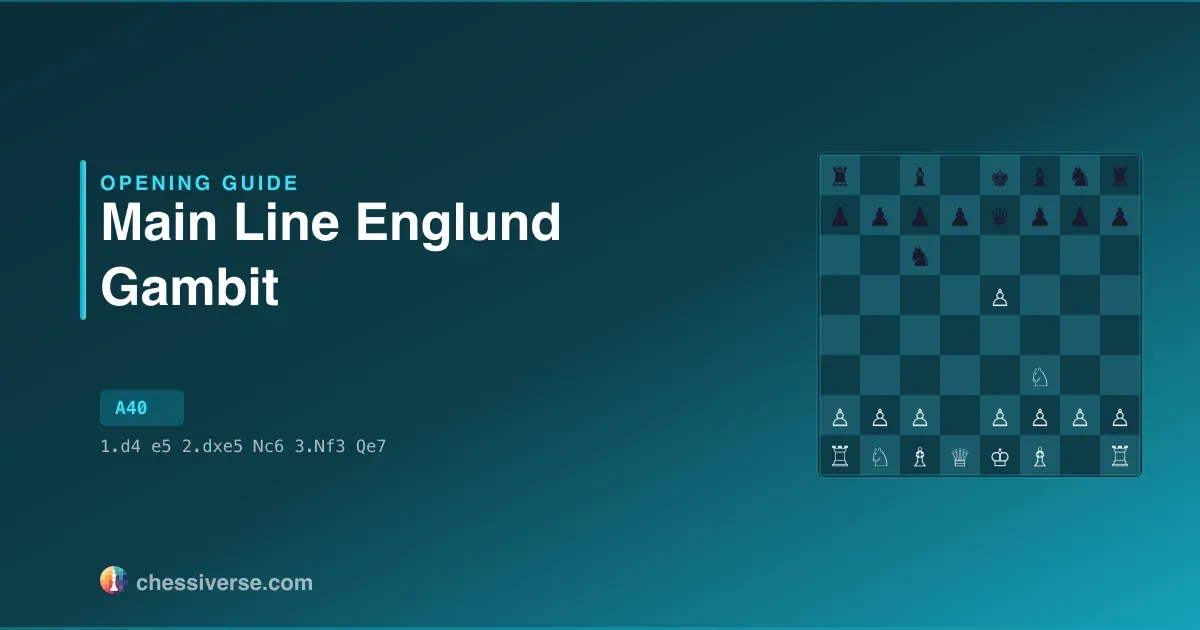
The Main Line Englund Gambit begins with 1.d4 e5 2.dxe5 Nc6 3.Nf3 Qe7 (ECO A40). Roughly 15 million lichess games reach this position, and it is famous for one thing: a queen check on b4 that has claimed everything from the b2-pawn to the a1-rook to White's king itself.
- Black gives up a pawn on move one to dodge closed queen's-pawn structures and pull White into open, tactical play right away.
- The queen sortie ...Qe7 followed by ...Qb4+ harasses White's b2-pawn and bishop, setting traps for careless defenders.
- If White develops calmly and sidesteps the tricks, the extra pawn tends to count, so Black must keep creating threats against White's loose pieces.
Strategic Overview
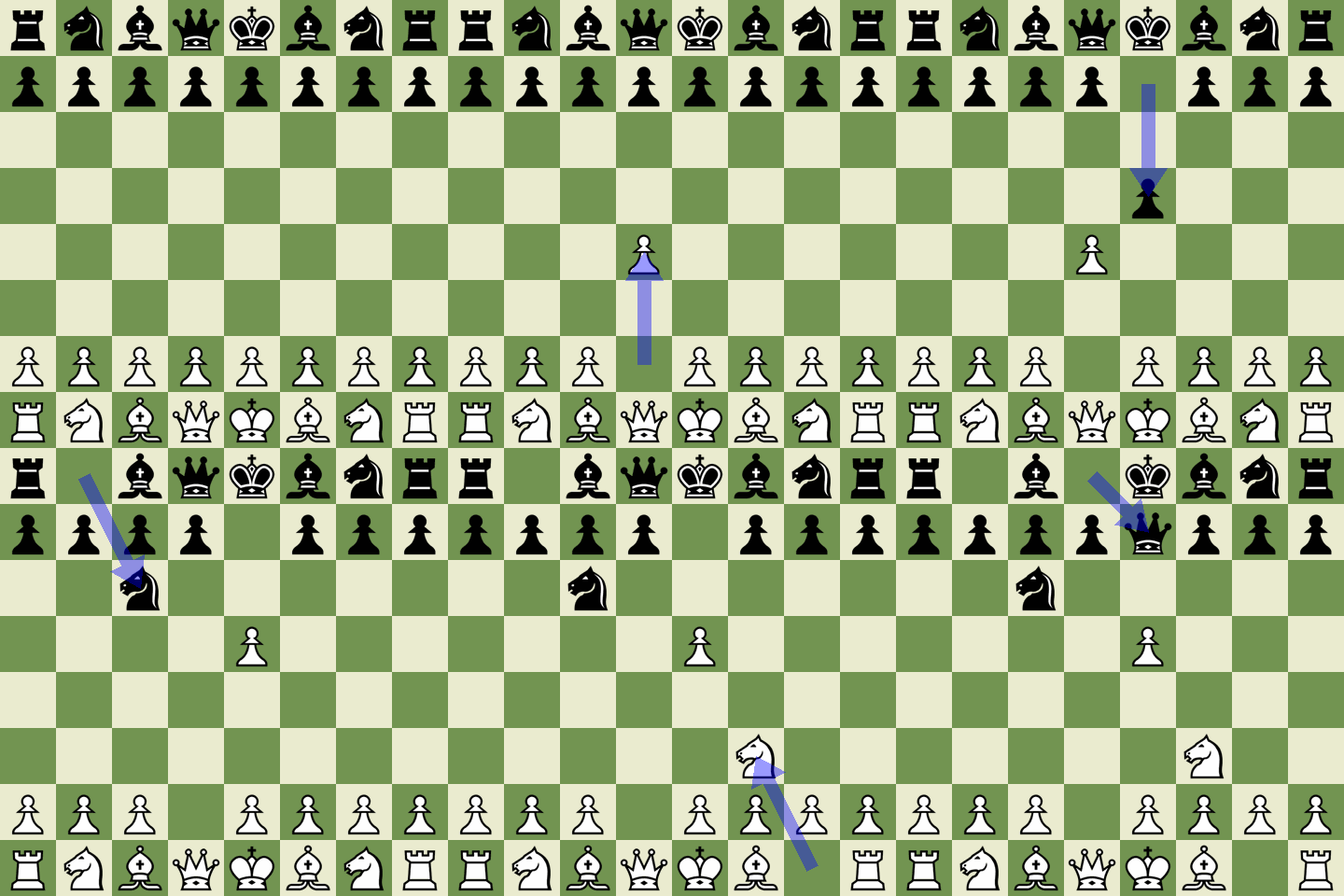
Everything here revolves around one idea. After 3.Nf3 Qe7, Black is not really asking for the e5-pawn back politely; the queen is waiting for White to play the natural 4.Bf4, so that ...Qb4+ can arrive and fork the b2-pawn and the bishop in a single move. This is where countless quick games end. If White reacts carelessly, Black's queen swallows b2 and eyes the rook in the corner, and in the most famous sequence, where White blocks the check with the bishop and then chases the queen with that same bishop, Black forces checkmate with a bishop pin and a queen landing on c1. Every losing White move looks completely natural, which is exactly why the trap keeps working.
The good news for White is that the antidote is short and clean. The calmest cure is 4.Nc3, putting a knight on c3 so the queen check never lands with effect. The braver cure is to walk straight in: after 4.Bf4 Qb4+ 5.Bd2 Qxb2, White plays 6.Nc3 and the hunting queen suddenly becomes the hunted one, while White keeps the extra pawn and a serious lead in development. For Black this stays a fun, instructive weapon that punishes autopilot chess and teaches piece activity. Just be honest about the fine print: against a prepared opponent you are a pawn down with your queen far from home. For White, the only real mistake is not knowing this page exists.
History and Notable Players
It arises from the Englund Gambit Accepted.
The gambit idea was introduced in the early 1890s by Henry Charlick, the second Australian champion, using 2...d6. The main line with 2...Nc6 and 3...Qe7 was worked out by Karlis Betins. The opening took its modern name from Fritz Englund's 1932-33 thematic tournament and has stayed a rare guest in master play ever since.
Named after: Fritz Englund (1871-1933), a Swedish player who sponsored a thematic tournament on the gambit in 1932-33.
Notable players: Henry Charlick, Karlis Betins, Paul Keres
In the trap line 4.Bf4 Qb4+ 5.Bd2 Qxb2, the natural-looking 6.Bc3 loses on the spot to 6...Bb4 - and Boris Avrukh has called 1...e5 the worst possible reply to 1.d4.
Performance Across Rating Levels
Popularity and results vary sharply by rating level. Among 1200-rated players, it appears in 0.22% of games — 1,455,208 of them on record — with White winning 44.7% and Black 52.3%. By 1800, popularity is 0.22% and White's score is 49.8% to Black's 45.9%. Among 2500-rated players the line appears in 0.03% of games and draws spike to 8%, indicating tight preparation. White's score improves by 5.1pp from the 1200 bracket to the 2500 bracket — the line rewards preparation.
Time Control Patterns
Time control matters here: blitz players reach for this opening more than others. In bullet, it appears in 0.19% of games (5,107,379); White wins 48.5%. Blitz shows 0.22% adoption across 7,731,022 games, White scoring 47.6%. In rapid, the share rises to 0.19% — 2,137,419 games, White 46.7%.
Move Diversity and Theory Depth
What players actually play after the opening moves depends heavily on rating. At 1200 Elo (1,455,208 games), the top reply is Bf4, played 45.4% of the time. Four other moves each take at least 5% of games, and the top three moves account for 76.1% of games. Entropy: 2.46. By 2500 (4,044 games), Nc3 takes over as the top reply at 31.5%; five other moves reach 5% and the top three moves account for 71.7% of games. Entropy rises to 2.61. Even elite players don't fully agree on the best continuation here, which keeps the position dynamic.
Historical Trends
Tracking the Main Line Englund Gambit year over year shows a clear story. Adoption peaked in 2022 at 0.25% (1,836,656 games). By 2025 it sits at 0.20%, 18% below the peak but still 314% above its 2013 level, so the line is up over the full period despite easing from the high.
Common Mistakes
- Neglecting development — It can feel productive to make extra pawn moves early, but falling behind in piece development is what loses most amateur games — especially in open positions where active pieces find squares fast.
- Overextending the attack — Gambits look like permission to throw everything forward. They aren't — every attacking move should improve a piece. Random checks and threats burn the initiative once they fail to coordinate.
Practice on Chessiverse
Ready to try the Main Line Englund Gambit against a bot? Pick an opponent at your level and play a game.