





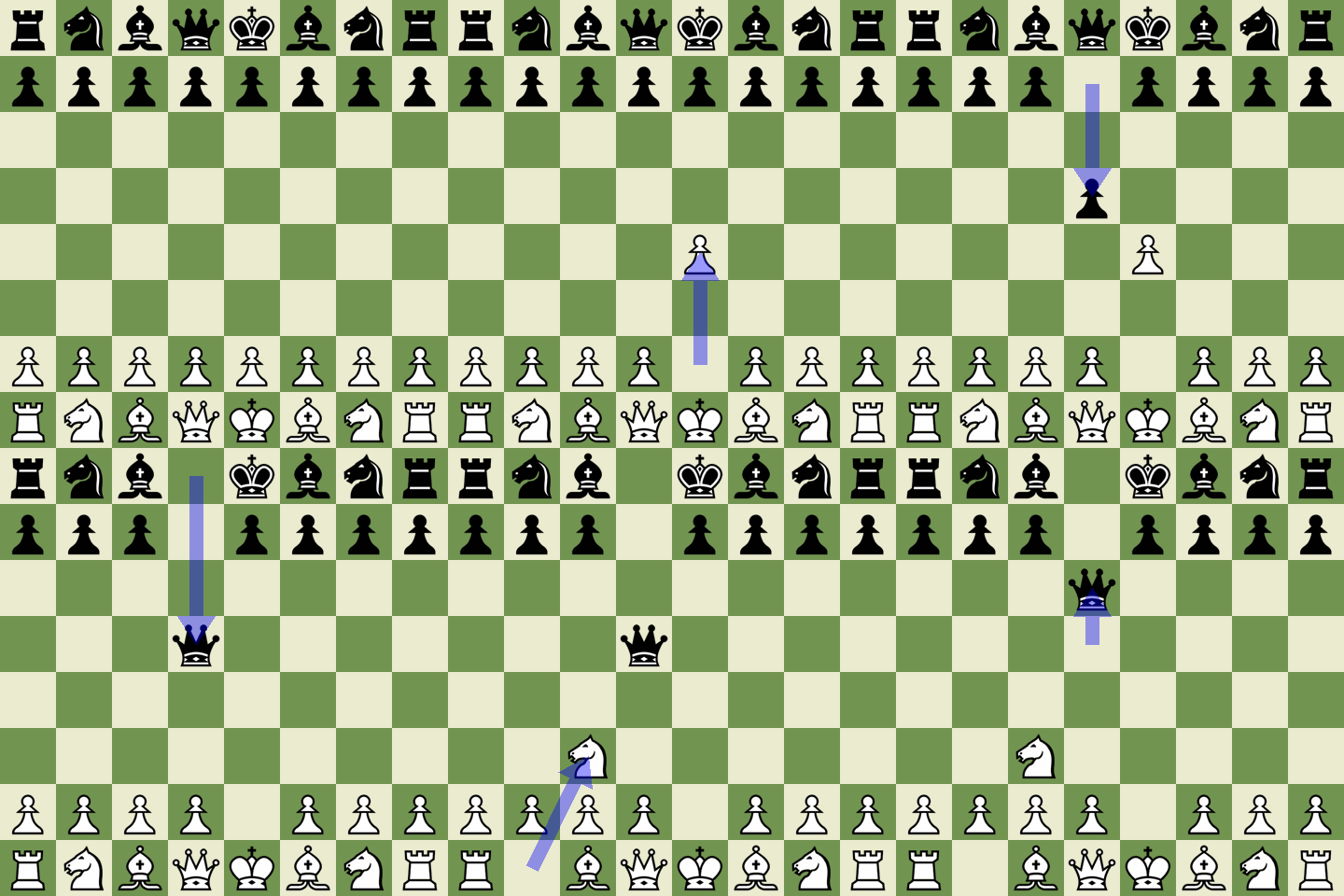
Starting from 1.e4 d5 2.exd5 Qxd5 3.Nc3 Qd6, players enter the Gubinsky-Melts Scandinavian — ECO B01. Rather than tucking the queen away on a5 or d8, the Gubinsky-Melts keeps it planted on d6: central, flexible, and just provocative enough to tempt White into wasting moves chasing it.
- Black stakes a claim in the centre with 1...d5 and accepts losing a tempo after 2...Qxd5 3.Nc3 in exchange for simple, easy development.
- On d6 the queen must watch out for harassment by Nb5 or Bf4 — the tactical point that made critics dismiss the move for years.
- An effective recipe for White is d4, Nf3, g3, Bg2 and castling, then planting a knight on e5 with an active position.
Strategic Overview
The d6-square is the Scandinavian's compromise between safety and ambition. Standing in the middle of the board, the queen controls a fistful of important squares, supports ...e5 as a future break, and keeps its options open, sliding along the sixth rank toward the kingside or dropping to b4. The price, and the entire debate around this line, is that d6 is easier to hit than a5 or the home square d8. White's tactical toolkit writes itself: Nb5 attacks the queen and c7 in one jump, and a bishop landing on f4 stares straight at d6. Black's whole setup exists to defuse those ideas before they land. The moves ...a6 or ...c6 take b5 away from the knight, ...Nf6 and a bishop on g4 or f5 develop with purpose, and ...e6 completes a compact shell the queen can duck behind.
White should grab the centre with d4, develop with Nf3, and only bother the queen when a real threat comes attached, because empty prods just hand Black free developing moves. The club-level mistakes here are wonderfully predictable. White players chase the queen three moves in a row and end up behind in development; Black players skip the prophylaxis and discover what Nb5 does to an unguarded c7. Get ...a6 or ...c6 in on time and the central queen turns from target into strength, which is exactly the trade this system offers.
History and Notable Players
It arises from the Mieses-Kotroc Scandinavian.
For years 3...Qd6 was written off because the queen looks vulnerable to tricks like Nb5 or Bf4. From the mid-1990s a stream of high-level grandmaster games showed the move is fully playable, and Michael Melts gave the line thorough theoretical backing in a 2001 book.
Named after: The line is called both the Gubinsky-Melts Defense and the Pytel Variation, the latter after Krzysztof Pytel and Bożena Pytel.
Its parent Scandinavian is arguably the oldest recorded opening — depicted in the Catalan poem Scachs d'amor around 1475 — yet it only reached a world championship match in 1995, when Anand got an excellent position with it against Kasparov.
Performance Across Rating Levels
How well the Gubinsky-Melts Scandinavian works depends on what level you're playing at. Among 1200-rated players, it appears in 0.15% of games — 1,017,070 of them on record — with White winning 52.6% and Black 43.6%. Move up to 1800 Elo and the share shifts to 0.18%, with White winning 47% versus Black's 47.6%. At the top end (2500+ Elo), popularity is 0.27% with 10.4% draws — a clear sign of how much theory rules the line at master level. White's edge erodes by 6.1pp from 1200 to 2500 Elo, suggesting Black's counterplay is easier to find with experience.
Time Control Patterns
Look at the same opening across time controls and blitz stands out. In bullet, it appears in 0.17% of games (4,623,828); White wins 47.9%. Blitz shows 0.18% adoption across 6,353,507 games, White scoring 48.8%. In rapid, the share rises to 0.12% — 1,274,722 games, White 51.8%. White's score swings 3.9pp across formats, so time control isn't just a stylistic choice here — it shifts the actual results.
Move Diversity and Theory Depth
What players actually play after the opening moves depends heavily on rating. At 1200 Elo (1,017,070 games), the top reply is Nf3, played 47.8% of the time. Three other moves each take at least 5% of games, and the top three moves account for 80% of games. Entropy: 2.31. By 2500 (36,199 games), d4 takes over as the top reply at 67.5%; three other moves reach 5% and the top three moves account for 91.1% of games. Entropy drops to 1.55. The narrowing is significant — strong players consolidate around a small set of best moves, while amateurs scatter across many plausible-looking options.
Historical Trends
Year-over-year data tells you whether this opening is a contemporary fixture or a fading one. Adoption peaked in 2020 at 0.23% (1,300,222 games). By 2025 it sits at 0.13%, 45% below the peak but still 34% above its 2013 level, so the line is up over the full period despite easing from the high.
Common Mistakes
- Drifting away from main theory — At 400 Elo, the three most-played moves cover 70.8% of games, against 91.5% at 2000. The most popular deviation is Bb5+ (played 8.6% of the time at 400, much less so up top). It looks fine but quietly hands the better-prepared side an edge.
- Neglecting development — Extra pawn moves in the opening are tempting, especially when you "know the moves". Developing a piece each turn is the simple correction.
- Playing without a plan — Each Gubinsky-Melts Scandinavian middlegame demands a specific approach. Decide whether the position calls for attack, manoeuvre, or simplification before reaching for a move.
Practice on Chessiverse
Ready to try the Gubinsky-Melts Scandinavian against a bot? Pick an opponent at your level and play a game.