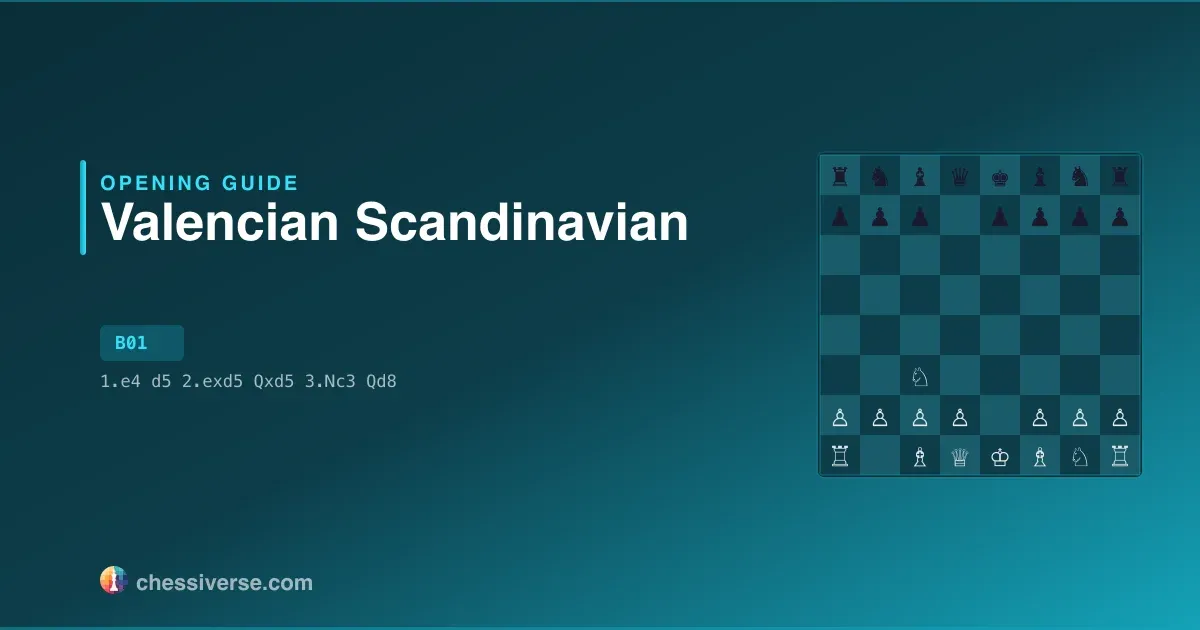
Starting from 1.e4 d5 2.exd5 Qxd5 3.Nc3 Qd8, players enter the Valencian Scandinavian — ECO B01. 3...Qd8 walks the queen straight back home, and it is the oldest Scandinavian move on record, appearing in the 15th-century Valencia game between Castellvi and Vinyoles that gave the line its name. Black spends a full tempo to buy a position with no targets at all.
- A playable but somewhat passive line: Black spends a second tempo returning the queen to its home square.
Strategic Overview
The Valencian is the most honest move in the Mieses-Kotroc family: instead of hunting for a clever square, the queen simply goes home, and Black stakes the game on a structure without weaknesses. History took it seriously. It was treated as the main line for centuries, Staunton called it best in the 1800s, and Bronstein revived it against Fuderer in 1959, sparking fresh grandmaster interest in fianchetto treatments from players like Robatsch. Modern practice, with IM John Bartholomew among its best-known advocates, keeps proving the same point: White gets an extra developing move, but nothing to attack with it.
Black's classical plan follows Bronstein's game: 4.d4 Nf6, then ...c6, the light-squared bishop out to f5 or g4 before ...e6 seals the chain, and quick, safe castling. Robatsch's alternative geometry runs 4.d4 g6, fianchettoing the bishop and rerouting the knight via h6 toward f5, where it leans on d4. White should take the centre with d4, develop naturally, and resist forcing matters, because every premature lunge gives this compact position exactly the target it was waiting for. Black's danger is the mirror image: pure passivity. Without a well-timed ...c5 or ...e5 break the space deficit slowly becomes a squeeze. Played patiently the line is fully sound, if a touch passive by modern taste, and its light theory load makes it a superb practical choice at club level.
History and Notable Players
It arises from the Mieses-Kotroc Scandinavian.
The 3...Qd8 retreat appears in the c. 1475 poem Scachs d'amor, and before the 20th century it was often treated as the main line, with Staunton calling it best. It was gradually overtaken by 3...Qa5, and a well-known miniature loss by Robatsch to Bobby Fischer at the 1962 Olympiad hurt its standing, though the line is still regarded as playable.
Named after: Valencia, Spain, setting of the 15th-century poem Scachs d'amor; the name was proposed in 2023 by two authors in the Spanish magazine Peon de Rey.
Notable players: David Bronstein, John Bartholomew, David Garcia Ilundain, Nikola Djukic
The retreat to d8 appears in the fictional game of the Catalan poem Scachs d'amor, written around 1475 and set in Valencia - possibly the earliest documented game played with the modern queen's moves.
Performance Across Rating Levels
The picture changes a lot as you climb the rating ladder. At 1200 Elo, the opening shows up in 0.75% of games (5,028,306 samples). White scores 52.2%, Black 43.4%, draws 4.4%. By 1800, popularity is 0.70% and White's score is 49.9% to Black's 44.5%. At 2500, 0.20% of games go into this opening; draws sit at 13% — the line is well-mapped at this level. White's edge erodes by 7.6pp from 1200 to 2500 Elo, suggesting Black's counterplay is easier to find with experience.
Time Control Patterns
The Valencian Scandinavian skews toward bullet chess. In bullet, it appears in 1.16% of games (30,933,721); White wins 47.9%. Blitz shows 0.75% adoption across 26,854,052 games, White scoring 50.4%. In rapid, the share rises to 0.56% — 6,146,711 games, White 53.1%. White's score swings 5.2pp across formats, so time control isn't just a stylistic choice here — it shifts the actual results.
Move Diversity and Theory Depth
Move choice is far from uniform in the Valencian Scandinavian. At 1200 Elo (5,028,306 games), the top reply is Nf3, played 46.4% of the time. Two other moves each take at least 5% of games, and the top three moves account for 85.1% of games. Entropy: 2.20. By 2500 (27,314 games), d4 takes over as the top reply at 65%; two other moves reach 5% and the top three moves account for 94.3% of games. Entropy drops to 1.51. The narrowing is significant — strong players consolidate around a small set of best moves, while amateurs scatter across many plausible-looking options.
Historical Trends
Year-over-year data tells you whether this opening is a contemporary fixture or a fading one. Adoption peaked in 2024 at 0.73% (5,425,719 games). By 2025 it sits at 0.72%, 1% below the peak but still 66% above its 2013 level, so the line is up over the full period despite easing from the high.
Common Mistakes
- Drifting away from main theory — At 400 Elo, the three most-played moves cover 81.2% of games, against 94.1% at 2000. The most popular deviation is Bb5+ (played 9% of the time at 400, much less so up top). It looks fine but quietly hands the better-prepared side an edge.
- Neglecting development — It can feel productive to make extra pawn moves early, but falling behind in piece development is what loses most amateur games — especially in open positions where active pieces find squares fast.
- Playing without a plan — Each Valencian Scandinavian middlegame demands a specific approach. Decide whether the position calls for attack, manoeuvre, or simplification before reaching for a move.
Practice on Chessiverse
Ready to try the Valencian Scandinavian against a bot? Pick an opponent at your level and play a game.