Main Line Scandinavian

+65%
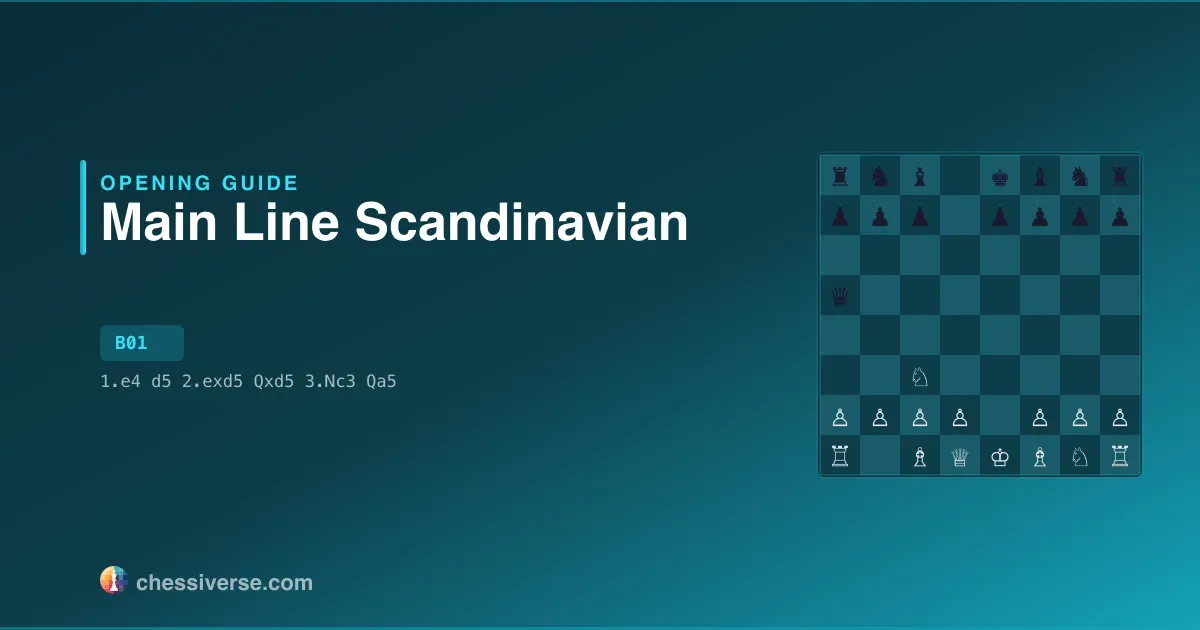
B011.e4 d5 2.exd5 Qxd5 3.Nc3 Qa5
Sep 2, 2027
Play this opening as...
TL;DR

The classical Scandinavian: queen to a5, pawn to c6, bishop out before ...e6, and a structure that bends without breaking. A sound, plan-driven defence to 1.e4 where knowing one tactic, the Bd2 discovery, keeps you out of nearly all the trouble.

Brought to you by

IM John Bartholomew
IM John BartholomewCo-Founder & Chess Educator

International Master and chess educator. Co-founded Chessable and joined Chessiverse as co-founder. Best known for his "Climbing the Rating Ladder" YouTube series and structured opening courses.

Main Line Scandinavian: A Complete Guide
Main Line Scandinavian - Opening Moves
Summary

Starting from 1.e4 d5 2.exd5 Qxd5 3.Nc3 Qa5, players enter the Main Line Scandinavian — ECO B01. On a5 the queen looks sidelined, but it is quietly doing three jobs at once: staying out of reach, supporting a future ...e5 break, and pinning the c3-knight the instant White plays d4. This is the classical heart of the Scandinavian, the position every 1.e4 player has to prepare for.

  • In the main line Black's pawns on c6 and e6 give a structure resembling the Caro-Kann Defense.
  • Black develops the light-squared bishop to f5 before shutting the diagonal with ...e6.
  • Unusually, both sides can castle on either wing.

Strategic Overview

The main line starts 4.d4, a move with a built-in catch: once the d2-square empties, the a5-queen pins the c3-knight against White's king. White accepts this happily, because Bd2 both breaks the pin and loads a trick, since any knight move now uncovers the bishop's attack on the queen. A well-timed Nd5 can hit c7 and gain a tempo in the same breath. That single tactic explains most of Black's setup. The move ...c6 comes early and always: it takes d5 away from the knight, builds a Caro-Kann-style wall, and hands the queen an escape hatch. Around it Black plays ...Nf6, develops the light-squared bishop to f5 or g4 before ...e6 closes the door, rerouting it via h5 to g6 if White chases with h3 and g4. Later the queen can slide to b6, eyeing d4 and b2 at once.

White's compensation is smooth, fast development: Nf3, Bc4 and quick castling in almost any order, then central pressure at the moment of White's choosing. The romantic alternative is 4.b4, the Leonhardt gambit, giving up the b-pawn for open lines and tempo; Lasker, Capablanca and Keres all tried it, and engines rate the sacrifice roughly level. Preparing it with 4.Rb1 fails to the simple 4...c5. At club level Black's most common sin is delaying ...c6 and walking into the Nd5 discovery, while White's is chasing the queen with pawn lunges that weaken d4 instead of finishing development.

History and Notable Players

It arises from the Mieses-Kotroc Scandinavian.

Blackburne and Mieses played it often around the turn of the 20th century and did much to build its theory; Capablanca scored two wins with it at New York in 1915. Larsen's defeat of world champion Karpov at Montreal 1979 spurred a revival, and in 1995 Anand brought it into a world championship match with Kasparov.

Named after: The Scandinavian masters whose analysis rehabilitated the defence, with the name honouring Collijn's role in particular.

Notable players: Jacques Mieses, José Raúl Capablanca, Bent Larsen, Viswanathan Anand

Did you know?

Game 14 of the 1995 PCA title match was the first time a Scandinavian ever appeared in a world championship: Anand got an excellent position against Kasparov, though Kasparov ultimately won the game.

Performance Across Rating Levels

Popularity and results vary sharply by rating level. Among 1200-rated players, it appears in 0.61% of games — 4,120,794 of them on record — with White winning 49.8% and Black 46.8%. By 1800, popularity is 0.75% and White's score is 46.8% to Black's 48.5%. At 2500, 0.46% of games go into this opening; draws sit at 9.9% — the line is well-mapped at this level. White's edge erodes by 4.9pp from 1200 to 2500 Elo, suggesting Black's counterplay is easier to find with experience.

Time Control Patterns

Look at the same opening across time controls and blitz stands out. In bullet, it appears in 0.55% of games (14,627,941); White wins 47.6%. Blitz shows 0.68% adoption across 24,403,496 games, White scoring 47.7%. In rapid, the share rises to 0.55% — 6,066,396 games, White 49.5%.

Move Diversity and Theory Depth

Move choice is far from uniform in the Main Line Scandinavian. At 1200 Elo, the top reply is Nf3, played 41.6% of the time. There are 4 other moves seeing meaningful share, and 79% of games stick to established theory. Entropy: 2.47. By 2500, d4 dominates at 59.9% of replies; only 4 viable alternatives remain and 87.9% of moves are theory. Entropy drops to 1.82. The narrowing is significant — strong players consolidate around a small set of best moves, while amateurs scatter across many plausible-looking options.

Year-over-year data tells you whether this opening is a contemporary fixture or a fading one. Adoption peaked in 2025 at 0.69% (5,117,946 games). 2025 marks the high — the opening is rising, currently at 0.69%.

Common Mistakes

  • Drifting away from main theory — At 400 Elo, theory adherence sits at 70.8% — versus 86.2% at 2000. The most popular deviation is Bb5+ (played 9.5% of the time at 400, much less so up top). It looks fine but quietly hands the better-prepared side an edge.
  • Neglecting development — Extra pawn moves in the opening are tempting, especially when you "know the moves". Developing a piece each turn is the simple correction.
  • Playing without a plan — Each Main Line Scandinavian middlegame demands a specific approach. Decide whether the position calls for attack, manoeuvre, or simplification before reaching for a move.

Practice on Chessiverse

Ready to try the Main Line Scandinavian against a bot? Pick an opponent at your level and play a game.


Quick Facts

Main Line1.e4 d5 2.exd5 Qxd5 3.Nc3 Qa5
FENrnb1kbnr/ppp1pppp/8/q7/8/2N5/PPPP1PPP/R1BQKBNR w KQkq - 2 4
DifficultyIntermediate
Style

Solid Defender openings aim for a rock-solid pawn structure and safe piece placement. They resist aggression, minimize weaknesses, and seek to outplay the opponent in the long run.

30,469,892games on Lichess
48.1%
4.2%
47.7%
White wins Draws Black wins

Data from Lichess opening explorer (blitz & rapid)

Most Popular At1800
SharpnessBalanced

Popularity by Rating

Percentage of all games at each rating bracket that feature this opening.

Data from Lichess opening explorer (blitz & rapid games)

Theory Adherence by Rating

How often players choose the single most popular move at this position. Higher = more predictable play.

White to move after the opening line

Popularity Over Time

Share of all Lichess blitz + rapid games featuring this opening, by year.

Top Moves by Rating

White to move after the opening line

RatingMost Popular2nd3rd
4004.Nf335.8%4.d425.4%4.Bb5+9.5%
10004.Nf340.6%4.d425.4%4.d39.4%
12004.Nf341.6%4.d425.8%4.d311.6%
14004.Nf339.7%4.d428.7%4.d311.9%
16004.Nf336.4%4.d433.8%4.Bc49.8%
18004.d439.1%4.Nf333.1%4.Bc412.3%
20004.d443.3%4.Nf328.2%4.Bc414.6%
22004.d449.2%4.Nf321.7%4.Bc415.9%
25004.d459.9%4.Nf315.6%4.Bc412.5%

Popularity by Time Control

Bullet
0.55%14.6M
Blitz
0.68%24.4M
Rapid
0.55%6.1M
2% more decisive in bullet
Raw data tables (Lichess blitz + rapid)
Main Line Scandinavian: popularity and win rates by player rating
Rating (Elo)Share %GamesWhite win %Black win %Draw %Sharpness
4000.24557,33152.144.53.40.966
10000.471,968,69151.245.53.40.966
12000.614,120,79449.846.83.40.966
14000.696,232,54848.348.03.70.963
16000.747,304,06847.148.84.10.959
18000.756,306,22446.848.54.70.953
20000.683,064,38347.547.15.40.946
22000.51852,75647.645.76.70.933
25000.4663,09744.945.19.90.901
Main Line Scandinavian: move-choice theory adherence by rating
Rating (Elo)Top moveTop move %Viable movesTheory %Entropy
4004.Nf335.8670.82.700
10004.Nf340.6475.42.558
12004.Nf341.6479.02.467
14004.Nf339.7480.22.409
16004.Nf336.4480.02.349
18004.d439.1484.52.242
20004.d443.3486.22.149
22004.d449.2486.92.045
25004.d459.9487.91.822
Main Line Scandinavian: popularity over time
YearShare %GamesWhite win %Black win %Draw %
20130.4212,03349.446.64.0
20140.4338,95447.647.94.5
20150.54119,83949.146.84.1
20160.55336,97648.947.04.1
20170.53599,66948.247.64.2
20180.52972,03748.047.84.2
20190.531,526,43647.947.94.1
20200.573,253,54147.847.74.5
20210.634,815,75048.347.54.2
20220.624,575,77448.147.84.1
20230.614,825,41148.047.74.2
20240.675,035,43648.047.94.2
20250.695,117,94648.047.94.1
Main Line Scandinavian: popularity by time control
FormatShare %GamesWhite win %Black win %Draw %Sharpness
bullet0.5514,627,94147.649.62.80.972
blitz0.6824,403,49647.748.24.20.958
rapid0.556,066,39649.546.14.40.956
Main Line Scandinavian: top candidate moves by rating bracket
Rating (Elo)1st move1st %2nd move2nd %3rd move3rd %
4004.Nf335.84.d425.44.Bb5+9.5
10004.Nf340.64.d425.44.d39.4
12004.Nf341.64.d425.84.d311.6
14004.Nf339.74.d428.74.d311.9
16004.Nf336.44.d433.84.Bc49.8
18004.d439.14.Nf333.14.Bc412.3
20004.d443.34.Nf328.24.Bc414.6
22004.d449.24.Nf321.74.Bc415.9
25004.d459.94.Nf315.64.Bc412.5
Play this opening

Pick your side — then choose where to start.

Guided Play

Practice this opening with a coach

John follows this exact line and grades every move — green for best, red for blunders — with hints on demand and a blunder guard watching your back.

Frequently Asked Questions

Main Line Scandinavian

What is this opening?

This opening begins with 1.e4 d5 2.exd5 Qxd5 3.Nc3 Qa5 and is classified under ECO code B01. Black moves the queen to a5.

Is this opening good for beginners?

Yes, this opening is an excellent choice for beginners. The plans are relatively straightforward, and the key ideas are easy to understand. As you improve, you can explore deeper theoretical lines. Practice against our beginner-level bots to build confidence.

What are the win rates for this opening?

In a database of 45,469,615 games, White wins 47.9% of the time, Black wins 48.3%, and 3.8% are drawn.

How can I practice this opening?

On Chessiverse, you can practice this opening by playing against our 600+ AI bots. Each bot has a unique playing style and opening repertoire, so you can find the perfect sparring partner for any level.

Sources

Brought to you by

IM John Bartholomew
IM John BartholomewCo-Founder & Chess Educator

International Master and chess educator. Co-founded Chessable and joined Chessiverse as co-founder. Best known for his "Climbing the Rating Ladder" YouTube series and structured opening courses.

Practice This Opening on Chessiverse

Play against 1000+ AI bots with unique personalities and opening repertoires. From beginner-friendly to grandmaster-level opponents, find the perfect sparring partner for any opening.

Play Now

Not sure which opening fits you? Take the free chess personality test — your style determines which openings will work with you.

Back to Articles