



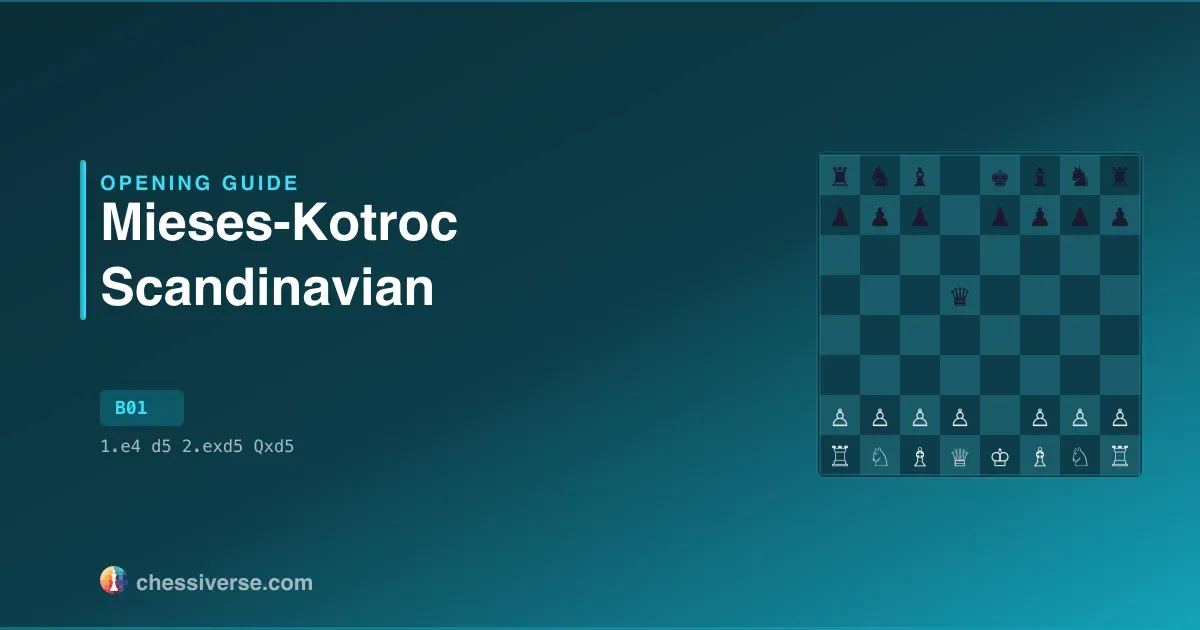
1.e4 d5 2.exd5 Qxd5 opens the Mieses-Kotroc Scandinavian, ECO B01. Recapturing with the queen on move two breaks the oldest rule in the book, yet it is the choice in the overwhelming majority of Scandinavian games from club level to masters. Every major system in the opening, 3...Qa5, 3...Qd6 or 3...Qd8, starts from this exact crossroads.
- Black challenges e4 on the very first move, forcing an open game and denying White a broad pawn centre.
- The early queen recapture invites 3.Nc3 with tempo, so Black needs a ready queen plan - retreating to a5 is the main choice.
- A typical setup mirrors the Caro-Kann: pawns on c6 and e6, with the light-squared bishop developed to f5 before ...e6.
Strategic Overview
Black has already banked the Scandinavian's core promise: White's e4-pawn is gone, and the big two-pawn centre that most 1.e4 openings enjoy will never exist. The bill arrives as the exposed queen on d5, and the whole variation is a negotiation over how much that queen will cost. White's most natural move is 3.Nc3, developing with tempo, and Black must pick a home: a5, the classical main line, d6, the flexible Gubinsky-Melts system, or the modest retreat to d8, the old Valencian line. Each square defines a different opening, which is why this position is the hub of Scandinavian theory.
White's slyer plan is to delay Nc3 with 3.Nf3 or 3.d4, keeping the c-pawn free to advance to c4 and grab queenside space that the knight would otherwise block. Black should meet it with fast pressure: 3...Bg4, ...Nc6 and castling long as early as move five, leaning on d4 before White consolidates. The one move White must never play is the immediate 3.c4, when 3...Qe4+ wins the c4- or g2-pawn outright or forces a queen trade that favours Black. Club players on both sides get the same lesson here: for Black, one lost tempo is fine as long as development continues with purpose, and for White, prodding the queen only counts as progress when each prod comes with a developing move attached.
History and Notable Players
It arises from the Scandinavian Defense.
Originally the Center Counter, it took its current name in Bent Larsen's era, acknowledging Ludvig Collijn and the Scandinavian masters whose late-1800s analysis showed it was playable. Blackburne and Mieses played it frequently and pushed its theory forward around the turn of the 20th century, and Larsen's defeat of Karpov at Montreal 1979 sparked a rise in popularity.
Named after: Jacques Mieses, who helped develop the opening's theory, and Jan Kotrč, a Czech master who was also a chess problemist and magazine editor.
Notable players: Joseph Henry Blackburne, Jacques Mieses, Bent Larsen, Magnus Carlsen
It is arguably the oldest recorded opening: the c.1475 Catalan poem Scachs d'amor, perhaps the earliest documented game with the modern queen, opens with a Scandinavian. Carlsen used it to beat Caruana at the 2014 Olympiad.
Performance Across Rating Levels
Popularity and results vary sharply by rating level. At 1200 Elo, the opening shows up in 3.14% of games (21,187,025 samples). White scores 52.9%, Black 43%, draws 4.1%. At 1800 the opening surfaces in 2.77% of games; White wins 48.8%, Black 46.1%, draws 5.1%. Among 2500-rated players the line appears in 1.26% of games and draws spike to 10.8%, indicating tight preparation. White's edge erodes by 7.8pp from 1200 to 2500 Elo, suggesting Black's counterplay is easier to find with experience.
Time Control Patterns
The Mieses-Kotroc Scandinavian skews toward bullet chess. In bullet, it appears in 3.40% of games (90,297,458); White wins 48.5%. Blitz shows 2.96% adoption across 106,342,990 games, White scoring 50.2%. In rapid, the share rises to 2.41% — 26,636,446 games, White 53.3%. White's score swings 4.8pp across formats, so time control isn't just a stylistic choice here — it shifts the actual results.
Move Diversity and Theory Depth
Looking at move selection shows how forcing — or not — the position really is. At 1200 Elo (21,187,025 games), the top reply is Nc3, played 82.4% of the time. One other move takes at least 5% of games, and the top three moves account for 94.2% of games. Entropy: 1.09. By 2500 (172,452 games), Nc3 dominates at 81.2% of replies; one other move reaches 5% and the top three moves account for 98.2% of games. Entropy drops to 0.96.
Historical Trends
Year-over-year data tells you whether this opening is a contemporary fixture or a fading one. Adoption peaked in 2024 at 2.88% (21,504,683 games). By 2025 it sits at 2.85%, 1% below the peak but still 28% above its 2013 level, so the line is up over the full period despite easing from the high.
Main Lines and Variations
The main branches off 1.e4 d5 2.exd5 Qxd5 include:
Each branch leads to a different middlegame character — the resulting pawn structure decides what kind of game you get.
Common Mistakes
- Playing outside main lines — At 400 Elo, only 84.8% of games stay with the three most-played moves; at 2000 that climbs to 95.2%. Most of the gap is players who pick a reasonable-looking move over the best one, and the position quietly drifts.
- Neglecting development — It can feel productive to make extra pawn moves early, but falling behind in piece development is what loses most amateur games — especially in open positions where active pieces find squares fast.
- Playing without a plan — Each Mieses-Kotroc Scandinavian middlegame demands a specific approach. Decide whether the position calls for attack, manoeuvre, or simplification before reaching for a move.
Practice on Chessiverse
Ready to try the Mieses-Kotroc Scandinavian against a bot? Pick an opponent at your level and play a game.