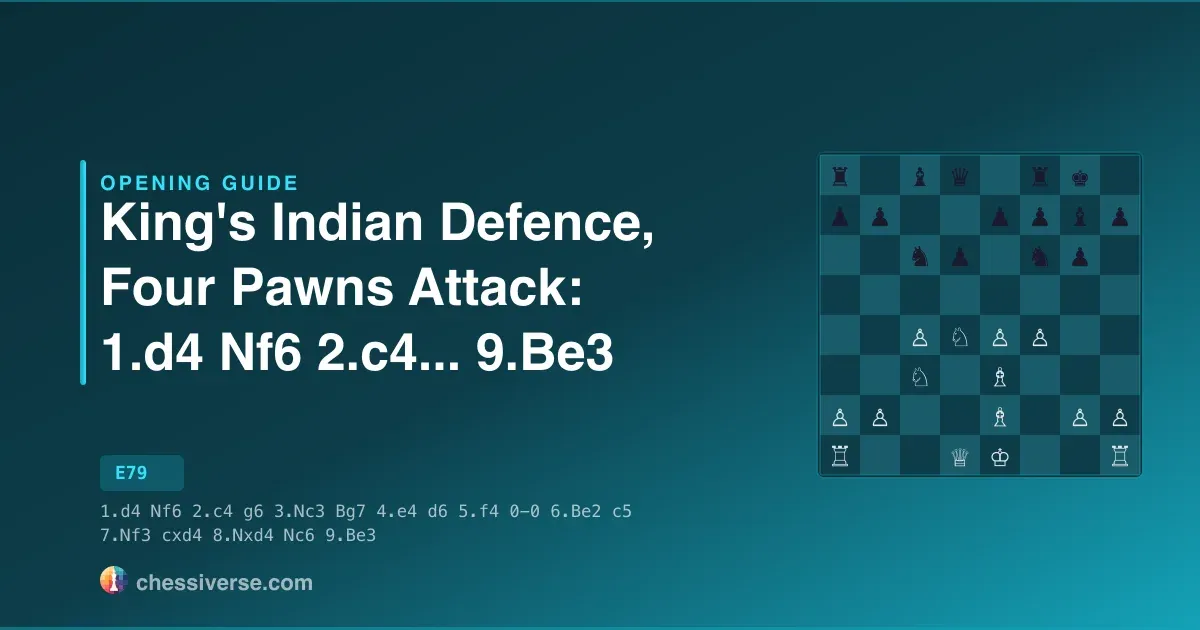
1.d4 Nf6 2.c4 g6 3.Nc3 Bg7 4.e4 d6 5.f4 0-0 6.Be2 c5 7.Nf3 cxd4 8.Nxd4 Nc6 9.Be3 opens the King's Indian Defense: Four Pawns Attack, Exchange Variation, ECO E79. Across rating levels it shows up in 17,276 recorded games — enough data to map exactly where it succeeds and where it stalls.
History and Notable Players
It arises from the King's Indian Defense: Four Pawns Attack, Fluid Attack. On the White side, Wolfgang Uhlmann (16 games), William E Martz (15 games), Mario Bertok (8 games) top the database. Notable Black exponents: Svetozar Gligoric (7 games), Werner Golz (4 games), Samuel Herman Reshevsky (4 games).
Move Diversity and Theory Depth
Move choice is far from uniform in the King's Indian Defense: Four Pawns Attack, Exchange Variation. Below 1400 the samples are small (72 games at 1200), so the comparison starts at 1400, with 420 games. There, the top reply is e5, played 25.1% of the time. Six other moves each take at least 5% of games, and the top three moves account for 54.9% of games. Entropy: 3.11. By 2500 (181 games), Bd7 takes over as the top reply at 24.4%; six other moves reach 5% and the top three moves account for 57.2% of games. Entropy drops to 2.97.
Common Mistakes
- Neglecting development — Extra pawn moves in the opening are tempting, especially when you "know the moves". Developing a piece each turn is the simple correction.
- Letting White own the centre — Hypermodern openings concede central space on purpose, but only if you strike back in time. Delay the counter-blow and you end up squeezed.
Practice on Chessiverse
Ready to try the King's Indian Defense: Four Pawns Attack, Exchange Variation against a bot? Pick an opponent at your level and play a game.