

Knight Variation French

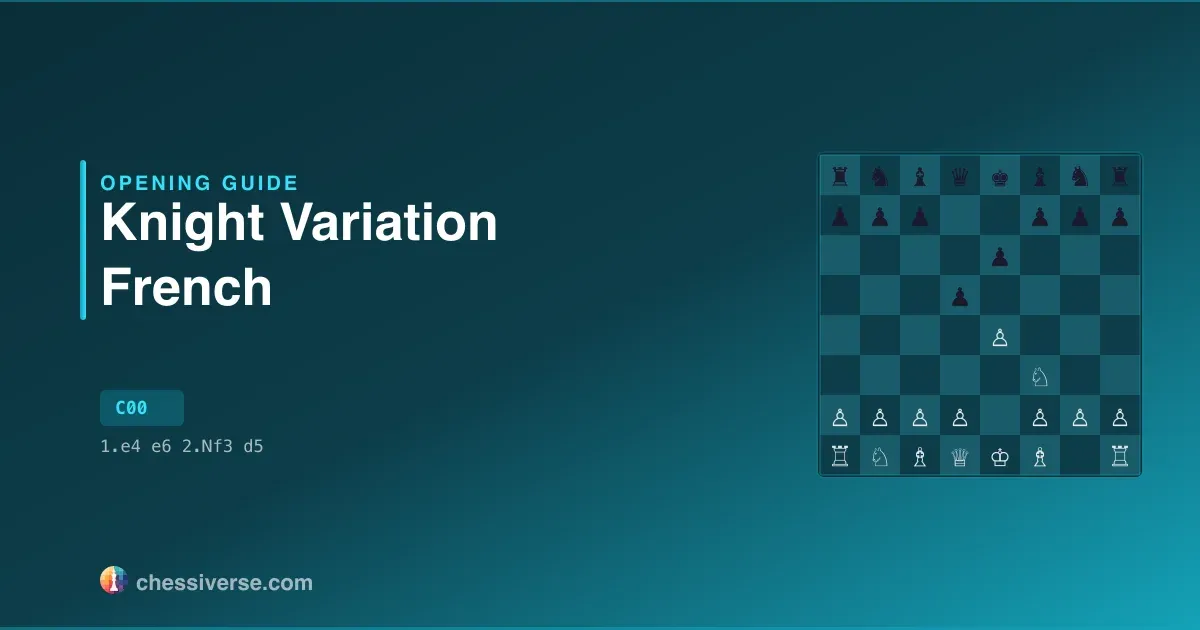
C001.e4 e6 2.Nf3 d5
Sep 18, 2027
Play this opening as...
TL;DR

2.Nf3 against the French is a sidestep with teeth: White skips Winawer and Classical theory while keeping Nc3 piece play, the Perseus Gambit, and Advance-style e5 pushes in reserve. Black equalises with the usual French recipe, as long as ...f6 stays off the board at the wrong moment.

Reviewed by

IM John Bartholomew
IM John BartholomewCo-Founder & Chess Educator

International Master and chess educator. Co-founded Chessable and joined Chessiverse as co-founder. Best known for his "Climbing the Rating Ladder" YouTube series and structured opening courses.

Knight Variation French: A Complete Guide
Knight Variation French - Opening Moves
Summary

The Knight Variation French begins with 1.e4 e6 2.Nf3 d5 (ECO C00). White meets the French with a small heresy: no 2.d4, just a quiet knight move and a polite refusal to enter the Winawer debate. The centre fight still comes, only on move orders most French players have never studied.

Strategic Overview

The Knight Variation is a theory dodge with real content. By delaying d4, White declines the Winawer and Classical highways where French players spend their study time, and after 2...d5 the game splits into three different fights. 3.Nc3 keeps developing pieces instead of pawns: Black can push ...d4 to kick the knight and grab space, or play 3...Nf6, allow 4.e5 Nfd7, and undermine White's centre later in pure Advance style. 3.d4 is the Perseus Gambit, offering the e4-pawn for quick play: after 3...dxe4 4.Ne5 the knight lands where no pawn can immediately kick it, and the natural-looking 4...f6 loses on the spot to 5.Qh5+. And 3.e5 heads for Advance territory, transposing to the Nimzowitsch system after 3...c5 4.d4 unless White prefers the 4.b4 Wing Gambit.

Black's compass barely moves in any branch. The e6-d5 centre is the French, and ...c5 remains the counterblow that justifies it. If a gambit pawn arrives, take it politely and give it back rather than make concessions, and never touch ...f6 while a white knight eyes e5. The club mistakes are symmetrical. French players autopilot into their 2.d4 setups, get confused when familiar structures never appear, and start inventing. White players treat 2.Nf3 as a clever waiting move but never pick a plan, discovering too late that without d4 there is no lasting grip on the centre. Decide before the game which branch is yours: piece pressure with Nc3, the Perseus pawn offer, or the e5 space clamp.

History and Notable Players

It arises from the French Defense.

Performance Across Rating Levels

The picture changes a lot as you climb the rating ladder. The 1200 bracket has 6,413,913 games (0.95% of all games at that level); White wins 47%, Black 49.1%, 3.9% are drawn. By 1800, popularity is 1.20% and White's score is 45.3% to Black's 49.4%. Among 2500-rated players the line appears in 0.31% of games and draws spike to 9.3%, indicating tight preparation. Positions also become less sharp as level rises (sharpness 0.96 → 0.91).

Time Control Patterns

Time control matters here: bullet players reach for this opening more than others. In bullet, it appears in 1.32% of games (35,014,173); White wins 47%. Blitz shows 1.07% adoption across 38,565,593 games, White scoring 46.2%. In rapid, the share rises to 0.89% — 9,847,399 games, White 45.2%.

Move Diversity and Theory Depth

What players actually play after the opening moves depends heavily on rating. At 1200 Elo, the top reply is exd5, played 51.7% of the time. There are 3 other moves seeing meaningful share, and 88% of games stick to established theory. Entropy: 1.98. By 2500, e5 dominates at 36.9% of replies; only 3 viable alternatives remain and 95.7% of moves are theory. Entropy drops to 1.81.

Tracking the Knight Variation French year over year shows a clear story. Adoption peaked in 2019 at 1.08% (3,087,211 games). By 2025 it sits at 1.05% — a 9% shift overall, leaving the line flat.

Common Mistakes

  • Drifting away from main theory — At 400 Elo, theory adherence sits at 71.5% — versus 97.4% at 2000. The most popular deviation is d3 (played 10.6% of the time at 400, much less so up top). It looks fine but quietly hands the better-prepared side an edge.
  • Neglecting development — Extra pawn moves in the opening are tempting, especially when you "know the moves". Developing a piece each turn is the simple correction.
  • Drifting into passivity — These openings are solid, but solid is not synonymous with passive. Look for the right moment to break with a central pawn advance — without it, your pieces stay cramped.

Practice on Chessiverse

Ready to try the Knight Variation French against a bot? Pick an opponent at your level and play a game.


Quick Facts

Main Line1.e4 e6 2.Nf3 d5
FENrnbqkbnr/ppp2ppp/4p3/3p4/4P3/5N2/PPPP1PPP/RNBQKB1R w KQkq - 0 3
DifficultyIntermediate
Parent OpeningFrench Defense
Style

Theoretician openings have deep, well-studied lines where knowledge of specific variations gives a significant advantage. Preparation and memorization of key lines are essential.

48,412,992games on Lichess
46%
4.7%
49.3%
White wins Draws Black wins

Data from Lichess opening explorer (blitz & rapid)

Most Popular At1800
SharpnessSharp

Popularity by Rating

Percentage of all games at each rating bracket that feature this opening.

Data from Lichess opening explorer (blitz & rapid games)

Theory Adherence by Rating

How often players choose the single most popular move at this position. Higher = more predictable play.

White to move after the opening line

Popularity Over Time

Share of all Lichess blitz + rapid games featuring this opening, by year.

Top Moves by Rating

White to move after the opening line

RatingMost Popular2nd3rd
400exd534.2%e519.8%Nc317.5%
1000exd543.1%e526.4%Nc312%
1200exd551.7%e528.2%Nc38.2%
1400exd560.3%e526.2%Nc35.8%
1600exd568.8%e521.4%Nc35%
1800exd571.8%e517.3%Nc37.7%
2000exd563.8%e518.6%Nc315%
2200exd545%e527.9%Nc324.6%
2500e536.9%Nc329.6%exd529.1%

Popularity by Time Control

Bullet
1.3%35.0M
Blitz
1.1%38.6M
Rapid
0.89%9.8M
2% more decisive in bullet
Raw data tables (Lichess blitz + rapid)
Knight Variation French: popularity and win rates by player rating
Rating (Elo)Share %GamesWhite win %Black win %Draw %Sharpness
4000.581,334,71447.248.54.30.957
10000.803,341,65247.448.64.00.960
12000.956,413,91347.049.13.90.961
14001.089,790,08446.149.94.10.959
16001.1911,782,86745.549.94.60.954
18001.2010,066,09745.349.45.40.946
20001.014,579,92645.848.16.10.939
22000.631,061,06646.746.27.10.929
25000.3142,67348.342.49.30.907
Knight Variation French: move-choice theory adherence by rating
Rating (Elo)Top moveTop move %Viable movesTheory %Entropy
400exd534.2471.52.685
1000exd543.1481.52.323
1200exd551.7388.01.977
1400exd560.3392.31.663
1600exd568.8395.31.383
1800exd571.8396.71.292
2000exd563.8397.41.460
2200exd545.0397.51.702
2500e536.9395.71.807
Knight Variation French: popularity over time
YearShare %GamesWhite win %Black win %Draw %
20130.9627,62844.751.53.8
20140.9081,11444.750.64.6
20150.91201,38142.952.64.5
20160.92567,37943.152.34.6
20170.981,123,17544.750.74.6
20181.051,963,95145.549.94.6
20191.083,087,21145.949.64.5
20201.025,859,50145.050.24.9
20210.957,245,54745.749.54.8
20220.936,865,14146.449.04.6
20230.967,625,82846.349.04.7
20240.997,422,00246.548.84.8
20251.057,774,30746.548.84.7
Knight Variation French: popularity by time control
FormatShare %GamesWhite win %Black win %Draw %Sharpness
bullet1.3235,014,17347.049.73.30.967
blitz1.0738,565,59346.249.14.70.953
rapid0.899,847,39945.249.94.90.951
Knight Variation French: top candidate moves by rating bracket
Rating (Elo)1st move1st %2nd move2nd %3rd move3rd %
400exd534.2e519.8Nc317.5
1000exd543.1e526.4Nc312.0
1200exd551.7e528.2Nc38.2
1400exd560.3e526.2Nc35.8
1600exd568.8e521.4Nc35.0
1800exd571.8e517.3Nc37.7
2000exd563.8e518.6Nc315.0
2200exd545.0e527.9Nc324.6
2500e536.9Nc329.6exd529.1
Play this opening

Pick your side — then choose where to start.

Guided Play

Practice the Knight Variation French with a coach

John follows this exact line and grades every move — green for best, red for blunders — with hints on demand and a blunder guard watching your back.

Frequently Asked Questions

What is the Knight Variation French?

The Knight Variation French begins with 1.e4 e6 2.Nf3 d5 and is classified under ECO code C00. Black continues playing in the spirit of the French defence.

Is the Knight Variation French good for beginners?

The Knight Variation French can be played at any level. Beginners should focus on understanding the key strategic ideas rather than memorizing long theoretical lines. Our AI bots at various rating levels provide a great way to practice the opening concepts.

What are the win rates for the Knight Variation French?

In a database of 84,634,082 master games, White wins 46.4% of the time, Black wins 49.5%, and 4.1% are drawn.

How can I practice the Knight Variation French?

On Chessiverse, you can practice the Knight Variation French by playing against our 600+ AI bots. Each bot has a unique playing style and opening repertoire, so you can find the perfect sparring partner for any level.

Reviewed by

IM John Bartholomew
IM John BartholomewCo-Founder & Chess Educator

International Master and chess educator. Co-founded Chessable and joined Chessiverse as co-founder. Best known for his "Climbing the Rating Ladder" YouTube series and structured opening courses.

Practice This Opening on Chessiverse

Play against 1000+ AI bots with unique personalities and opening repertoires. From beginner-friendly to grandmaster-level opponents, find the perfect sparring partner for any opening.

Play Now

Not sure which opening fits you? Take the free chess personality test — your style determines which openings will work with you.

Back to Articles