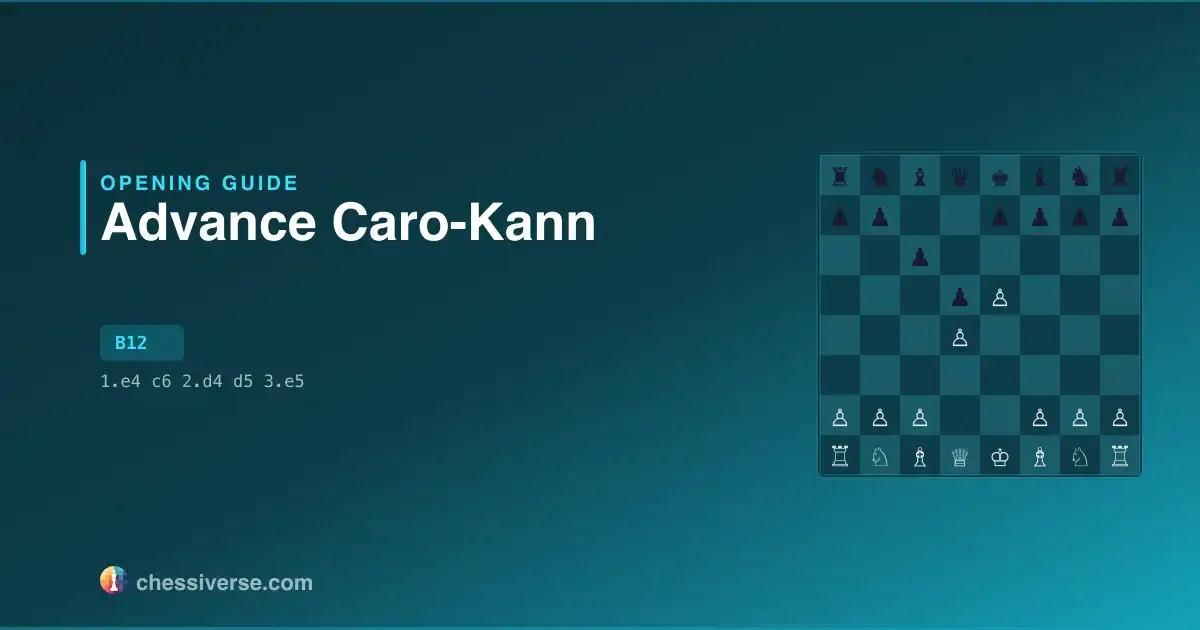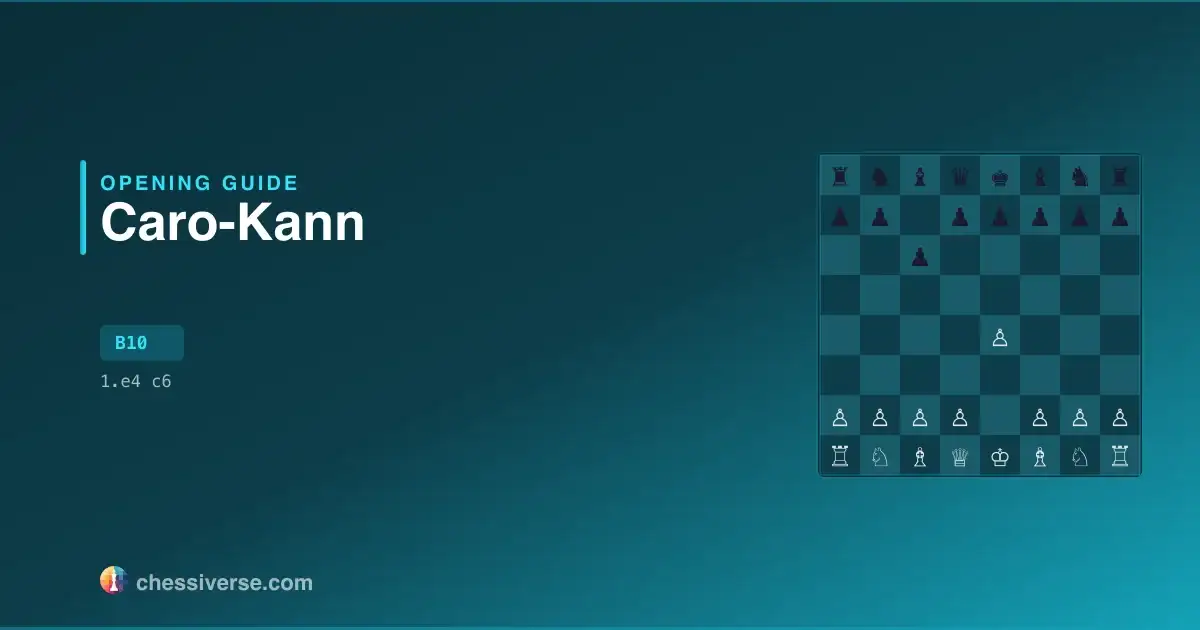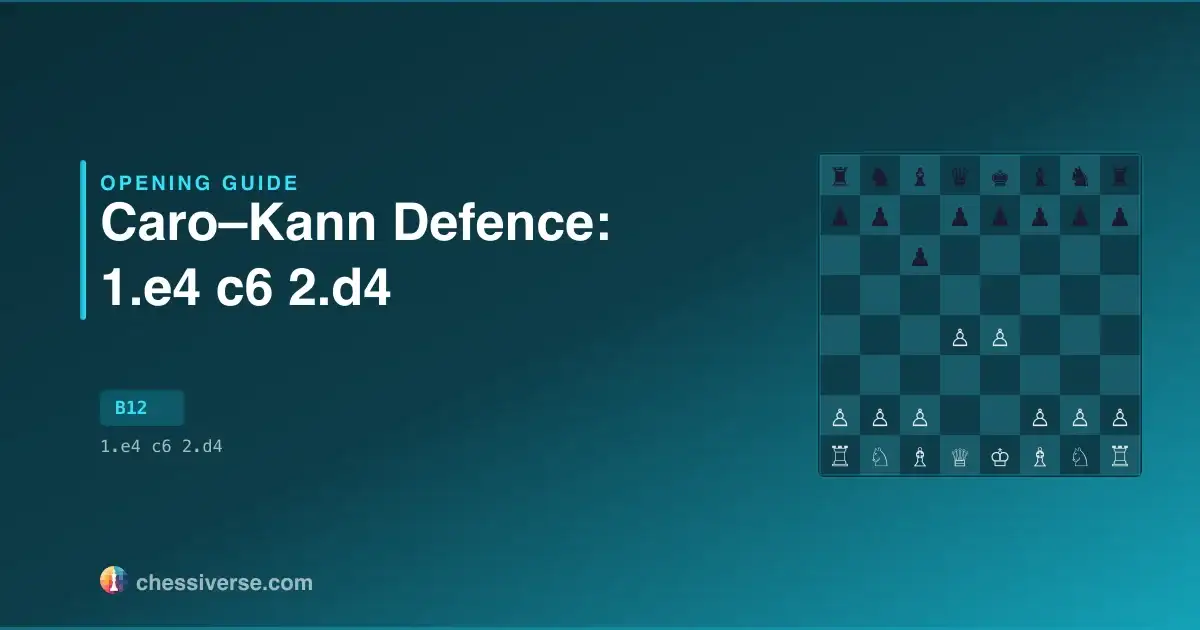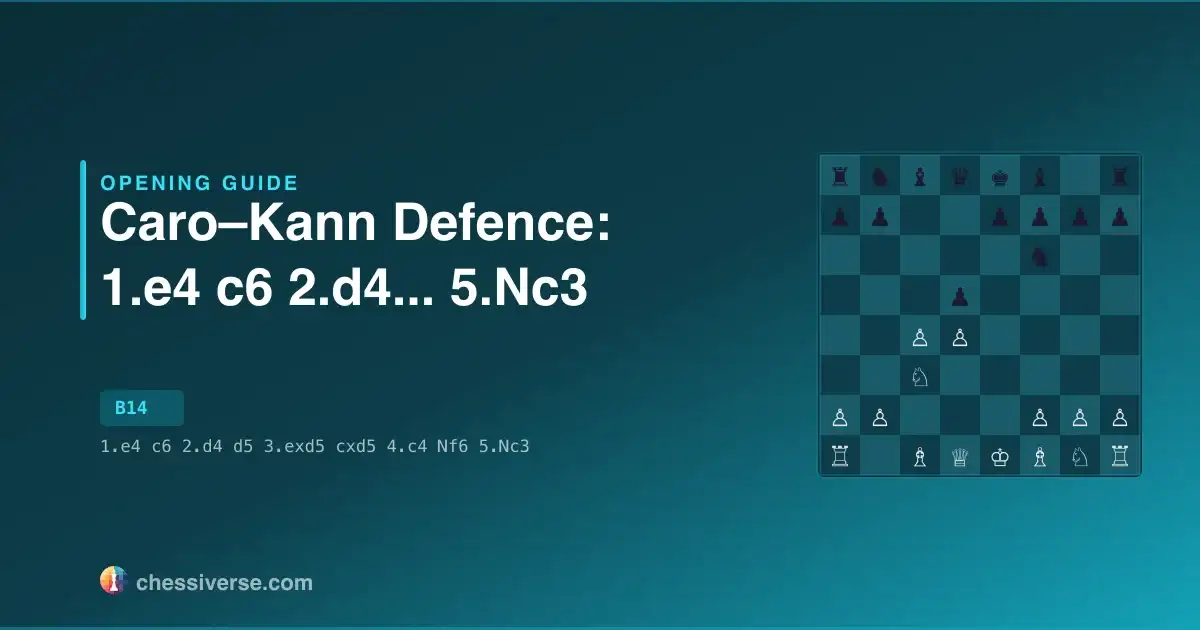




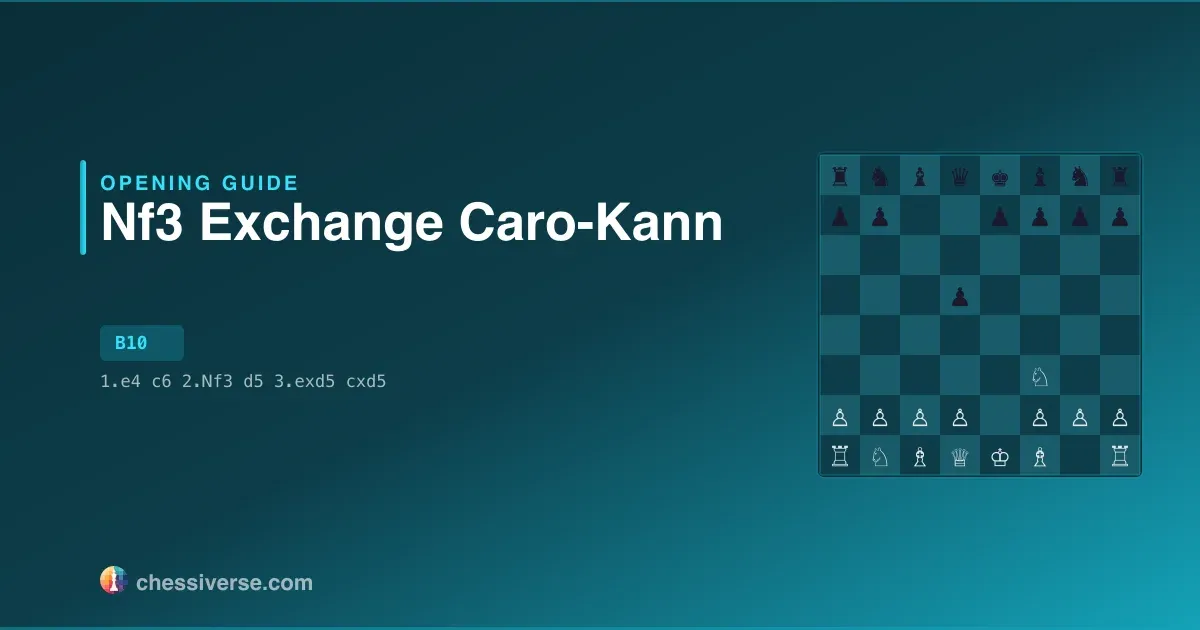
Starting from 1.e4 c6 2.Nf3 d5 3.exd5 cxd5, players enter the Nf3 Exchange Caro-Kann — ECO B10. The pawns come off, the d-pawns mirror each other, and the position looks like a handshake. It is not: White's early Nf3 brings Ne5 lunges and one-move d4 builds, while Black quietly enjoys the easiest development the Caro-Kann offers.
- The pawn skeleton is a Carlsbad structure with colours reversed, so many plans are borrowed from the Exchange Variation of the Queen's Gambit Declined.
- In the standard Exchange setup White puts the bishop on d3 early, developing while denying Black's bishop its favourite f5 square.
- With the knight already on f3, White has the extra option 4.Ne5, the Apocalypse Attack, instead of the normal 4.d4 transposition.
Strategic Overview
After 3.exd5 cxd5 the game lands in the Exchange Caro-Kann structure, symmetrical d-pawns with a half-open e-file for White and a half-open c-file for Black, but reached with White's king knight already developed and the d-pawn still at home. That last detail is the point. White can play d4 in one clean move and stand in a normal Exchange position, can try a quick Bb5 to pin the knight that arrives on c6, or can lunge 4.Ne5, the Apocalypse Attack, before Black is fully organised. Black, in return, gets the friendliest development the Caro-Kann offers: ...Nf6 and ...Nc6 come naturally, and the thematic ...Bg4, pinning the f3-knight against the queen, activates the problem bishop before ...e6 closes the door behind it.
Symmetry here means clarity, not a handshake, and the position shows up in roughly 56 million lichess games. The plans are legible: White builds with d4, uses the half-open e-file, and dreams of a supported knight on e5, while Black works on the half-open c-file with ...Rc8 and queenside pressure. The club mistakes are timing mistakes. White players fire off Ne5 or Bb5 without asking what the move threatens and trade themselves into a level position, while Black players delay ...Bg4 one move too long, find h3 has taken the pin away, and settle for less than the setup offered. In a symmetric structure the first careless move tends to write the story of the game.
History and Notable Players
It arises from the Nf3 Caro-Kann.
The parent Caro-Kann was analysed by Caro and Kann in 1886. In the Exchange Variation White swaps pawns on d5 early; its main line after 4.Bd3 is reckoned to leave White marginally the more comfortable side, and Bobby Fischer gave it an outing. The 2.Nf3 move order is an unusual route into the same structure, and Fischer experimented with that too.
Named after: The Caro-Kann is named after English player Horatio Caro and Austrian player Marcus Kann, who both analysed the defence in 1886.
Notable players: Bobby Fischer
Bobby Fischer's fingerprints are on both halves of this line: the Exchange Variation was one of his occasional anti-Caro-Kann weapons, and the offbeat 2.Nf3 move order was a Fischer experiment too.
Performance Across Rating Levels
Popularity and results vary sharply by rating level. Among 1200-rated players, it appears in 0.58% of games — 3,901,457 of them on record — with White winning 46.8% and Black 49.2%. At 1800 the opening surfaces in 0.84% of games; White wins 44.3%, Black 50.1%, draws 5.6%. At 2500, 0.16% of games go into this opening; draws sit at 10.5% — the line is well-mapped at this level. Positions also become less sharp as level rises (sharpness 0.96 → 0.90).
Time Control Patterns
Look at the same opening across time controls and bullet stands out. In bullet, it appears in 0.90% of games (23,830,629); White wins 45.9%. Blitz shows 0.71% adoption across 25,668,061 games, White scoring 45.5%. In rapid, the share rises to 0.55% — 6,063,807 games, White 45.2%.
Move Diversity and Theory Depth
Looking at move selection shows how forcing — or not — the position really is. At 1200 Elo (3,901,457 games), the top reply is d4, played 58.6% of the time. Two other moves each take at least 5% of games, and the top three moves account for 88.1% of games. Entropy: 1.98. By 2500 (21,728 games), d4 dominates at 51% of replies; only one other move still reaches 5% and the top three moves account for 95% of games. Entropy drops to 1.57.
Historical Trends
Tracking the Nf3 Exchange Caro-Kann year over year shows a clear story. Adoption peaked in 2025 at 0.76% (5,662,826 games). 2025 marks the high — the opening is rising, currently at 0.76%.
Common Mistakes
- Drifting away from main theory — At 400 Elo, the three most-played moves cover 80.8% of games, against 91.9% at 2000. The most popular deviation is Nc3 (played 29.3% of the time at 400, much less so up top). It looks fine but quietly hands the better-prepared side an edge.
- Neglecting development — Extra pawn moves in the opening are tempting, especially when you "know the moves". Developing a piece each turn is the simple correction.
- Drifting into passivity — These openings are solid, but solid is not synonymous with passive. Look for the right moment to break with a central pawn advance — without it, your pieces stay cramped.
Practice on Chessiverse
Ready to try the Nf3 Exchange Caro-Kann against a bot? Pick an opponent at your level and play a game.