



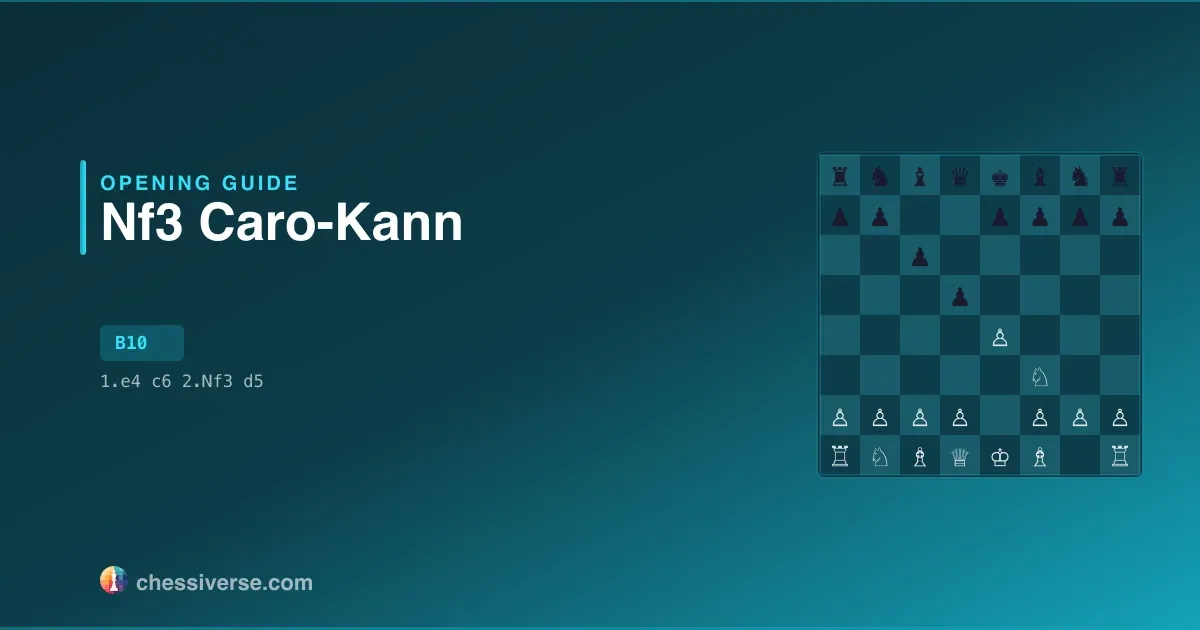
Starting from 1.e4 c6 2.Nf3 d5, players enter the Nf3 Caro-Kann — ECO B10. One developing move, zero information. 2.Nf3 lets White decide later whether the game becomes an Exchange Caro-Kann, a Two Knights Attack, or a queenless grind, and Black must be ready for all three.
- For White, 2.Nf3 is mostly a move-order tool: after 2...d5 play usually transposes to the Two Knights with 3.Nc3 or the Exchange Variation with 3.exd5.
- White can also offer an early queen trade with 3.d3, heading for a queenless middlegame.
- Black just plays normal Caro-Kann chess: a solid, principled stake in the centre with ...d5 that does not shut in the queen's bishop.
Strategic Overview
2.Nf3 gives Black no target and no information. White refuses to commit a centre pawn until Black shows a hand, and after the natural 2...d5 every road stays open. 3.exd5 cxd5 4.d4 Nc6 is simply the Exchange Variation reached through another door, while 4.Ne5, the Apocalypse Attack, hurls the knight forward before Black has developed a piece. 3.Nc3 transposes into the Two Knights Attack, a piece-first setup where the ...Bg4 pin is Black's most natural reply. And 3.d3 is the quiet trick: after 3...dxe4 4.dxe4 Black can force a queenless middlegame with 4...Qxd1+ 5.Kxd1, where White bets on understanding the position better, or White can veer into a sharp gambit with 4.Ng5 instead.
Black's answer to all of this is reassuringly boring. The c6 and d5 pawns are the whole point of the Caro-Kann, and calm development handles every branch. The club-level failure modes are predictable. Black players panic against knight lunges like Ne5 and Ng5, moving pawns instead of pieces, or dodge the queen trade in the d3 line and drift into passivity. White players make the opposite mistake: they choose 2.Nf3 for surprise value but attach no plan to it, slide into a normal Exchange structure they never studied, and wonder where the advantage went. As White, pick your transposition before the game. As Black, trust the structure you already know.
History and Notable Players
It arises from the Caro-Kann Defense.
The parent Caro-Kann was analysed by Caro and Kann in 1886, first appearing in the journal Bruederschaft. The early 2.Nf3 treatment is a fairly unusual move order that Bobby Fischer sometimes used, and it normally steers play back into standard Caro-Kann territory such as the Two Knights or Exchange lines.
Named after: The Caro-Kann is named after English player Horatio Caro and Austrian player Marcus Kann, who both analysed the defence in 1886.
Notable players: Bobby Fischer
A quiet-looking sideline hides a dramatic name: after 3.exd5 cxd5, the knight lunge 4.Ne5 is known as the Apocalypse Attack.
Performance Across Rating Levels
The picture changes a lot as you climb the rating ladder. At 1200 Elo, the opening shows up in 1.11% of games (7,501,958 samples). White scores 46.9%, Black 49.2%, draws 3.9%. At 1800 the opening surfaces in 1.26% of games; White wins 45.1%, Black 49.6%, draws 5.3%. Among 2500-rated players the line appears in 0.79% of games and draws spike to 10.6%, indicating tight preparation. Positions also become less sharp as level rises (sharpness 0.96 → 0.89).
Time Control Patterns
Look at the same opening across time controls and bullet stands out. In bullet, it appears in 1.36% of games (36,234,275); White wins 46.6%. Blitz shows 1.18% adoption across 42,382,024 games, White scoring 46%. In rapid, the share rises to 1.04% — 11,488,775 games, White 45.5%.
Move Diversity and Theory Depth
Looking at move selection shows how forcing — or not — the position really is. At 1200 Elo (7,501,958 games), the top reply is exd5, played 54% of the time. Two other moves each take at least 5% of games, and the top three moves account for 88.3% of games. Entropy: 1.94. By 2500 (107,987 games), Nc3 takes over as the top reply at 43.1%; two other moves reach 5% and the top three moves account for 95.7% of games. Entropy drops to 1.73.
Historical Trends
Tracking the Nf3 Caro-Kann year over year shows a clear story. Adoption peaked in 2025 at 1.31% (9,682,204 games). 2025 marks the high — the opening is rising, currently at 1.31%.
Main Lines and Variations
The main branches off 1.e4 c6 2.Nf3 d5 include:
Each branch leads to a different middlegame character — the resulting pawn structure decides what kind of game you get.
Common Mistakes
- Drifting away from main theory — At 400 Elo, the three most-played moves cover 73.4% of games, against 93.8% at 2000. The most popular deviation is e5 (played 16.8% of the time at 400, less so up top). It looks fine but quietly hands the better-prepared side an edge.
- Neglecting development — Extra pawn moves in the opening are tempting, especially when you "know the moves". Developing a piece each turn is the simple correction.
- Drifting into passivity — These openings are solid, but solid is not synonymous with passive. Look for the right moment to break with a central pawn advance — without it, your pieces stay cramped.
Practice on Chessiverse
Ready to try the Nf3 Caro-Kann against a bot? Pick an opponent at your level and play a game.