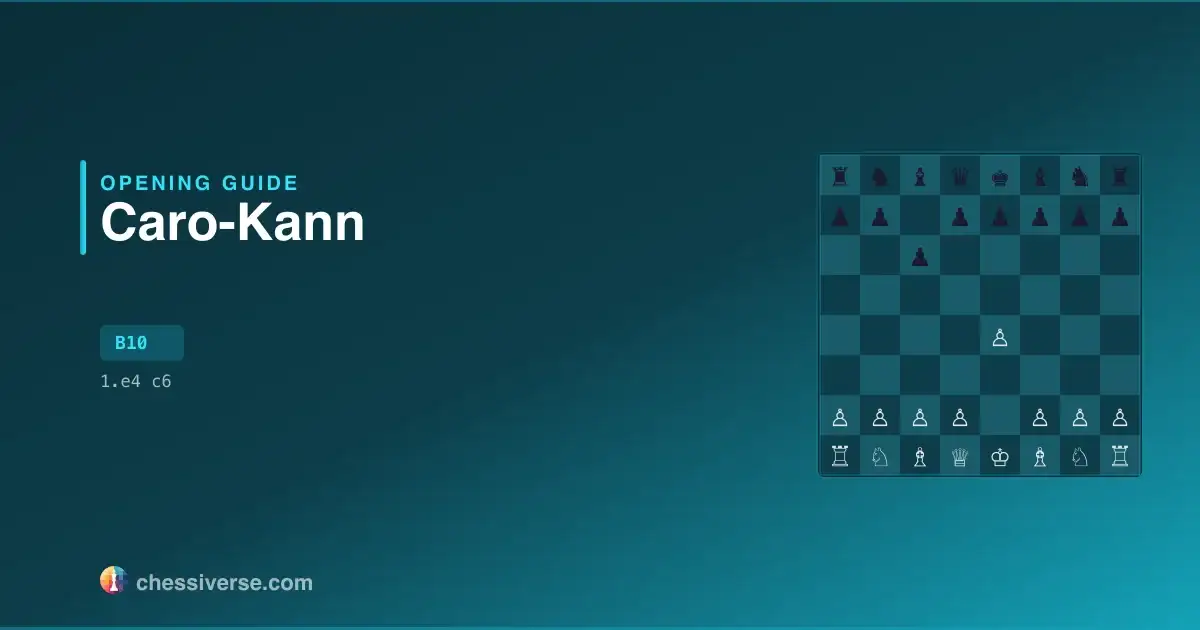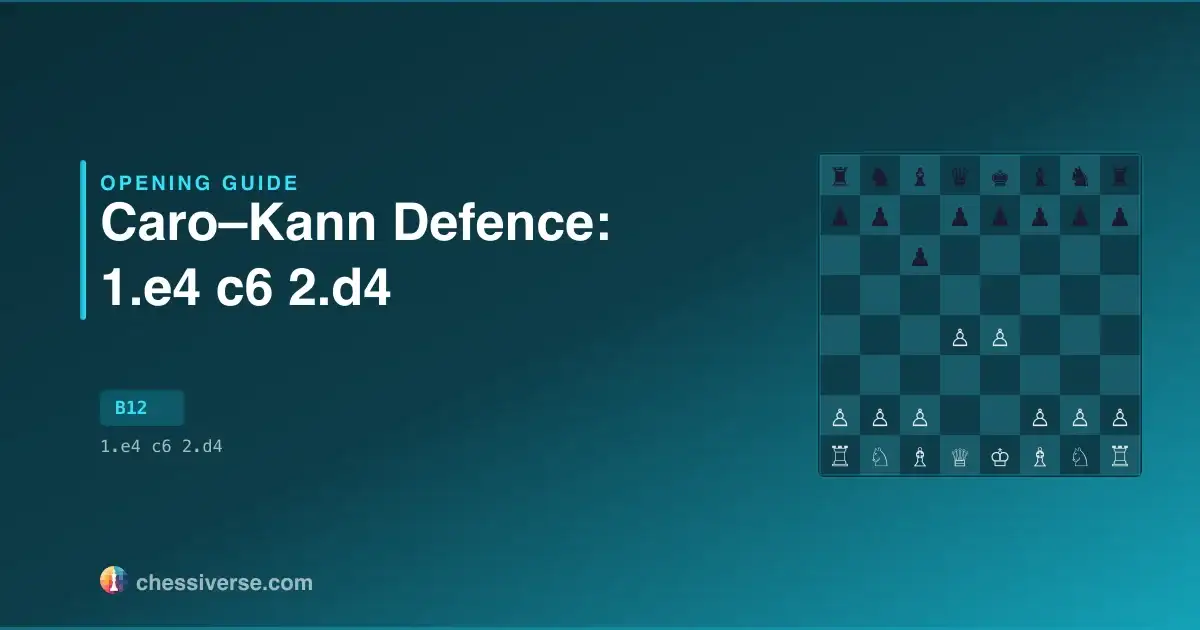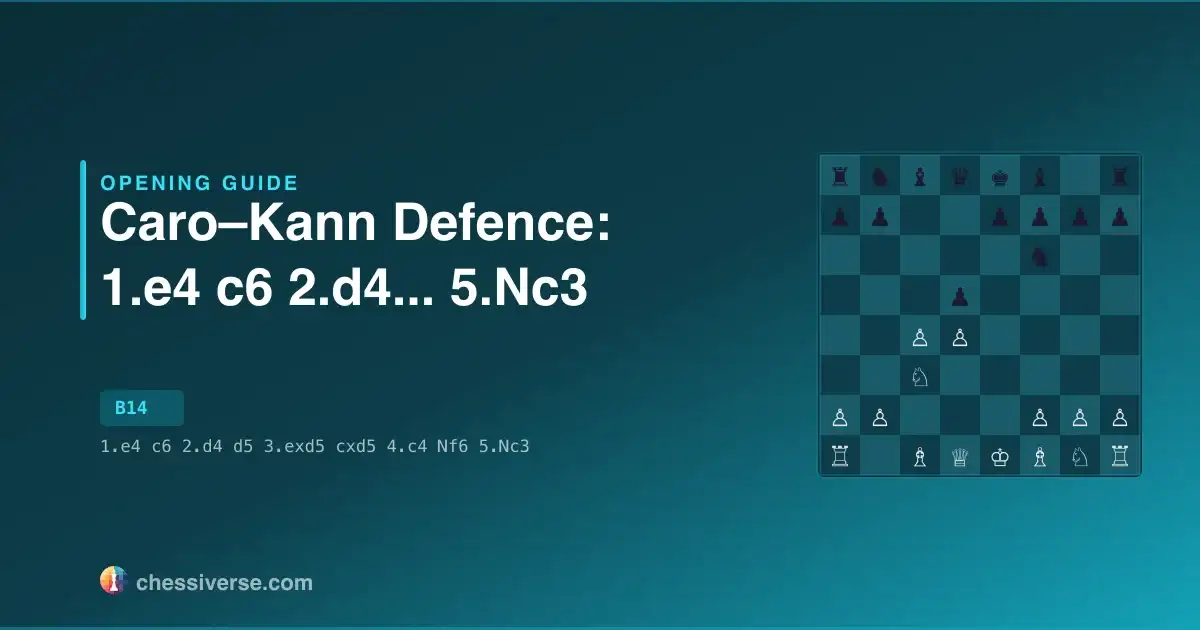




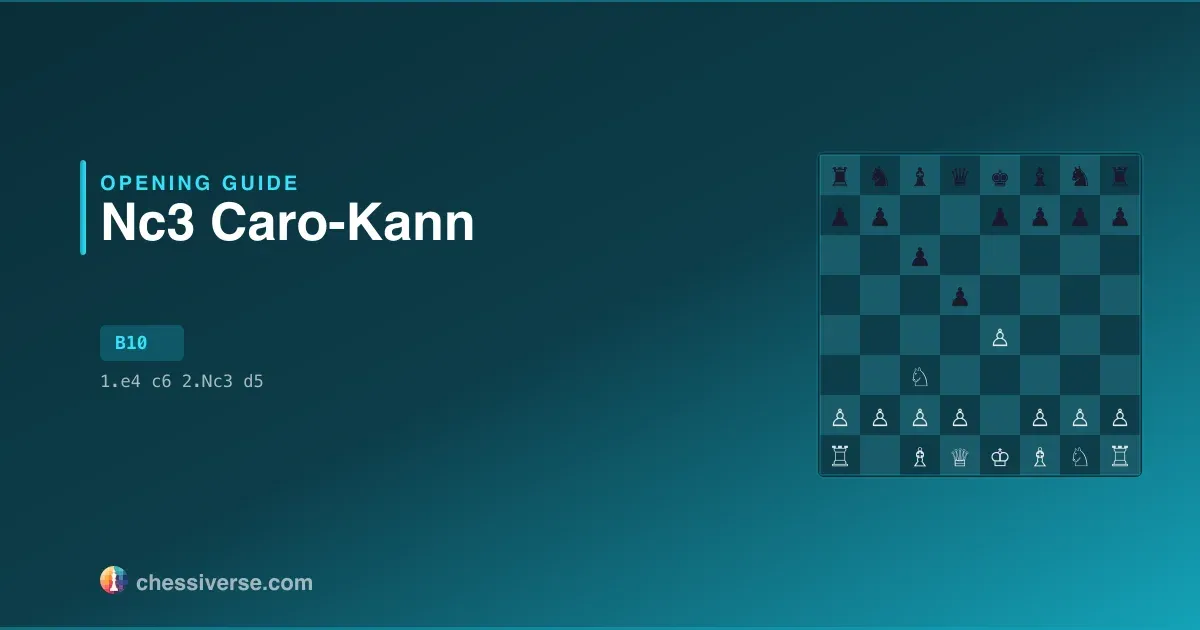
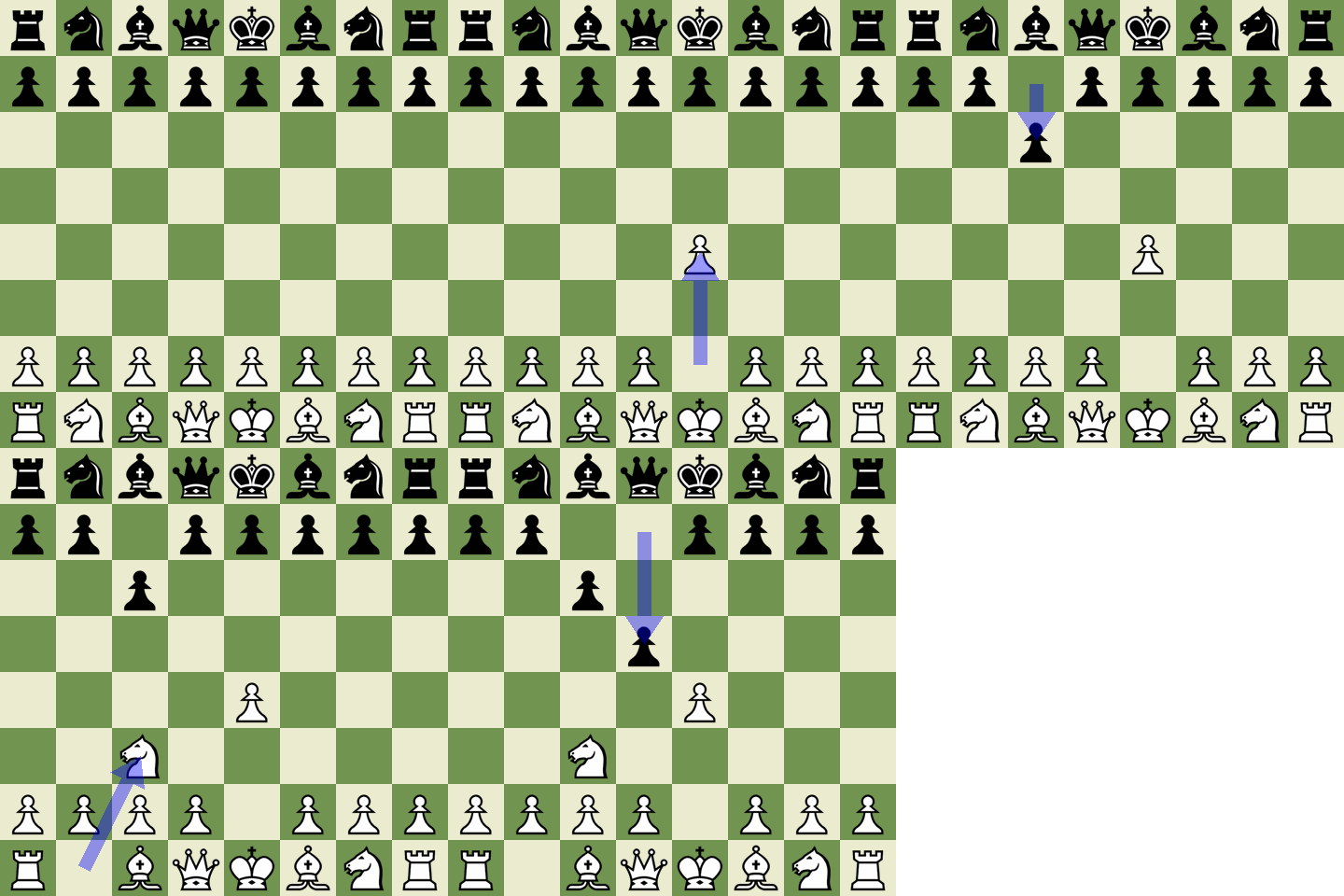
The Nc3 Caro-Kann begins with 1.e4 c6 2.Nc3 d5 (ECO B10). White guards e4 with a piece instead of grabbing space with 2.d4, keeping two different games in reserve. Whether Black faces the Two Knights Attack or a Classical main line gets decided one move later, by White.
- After 3...dxe4 4.Nxe4 Black picks a setup: the classical 4...Bf5 develops the queen's bishop early, while 4...Nd7 keeps the pawn structure intact.
- In the classical line White grabs kingside space with h4-h5 to harass the bishop, though that advanced h-pawn can turn into an endgame weakness.
- Black gets a solid, principled game - unlike the French, the queen's bishop is not shut in, at the cost of spending a tempo on ...c6.
Strategic Overview
2.Nc3 protects e4 with a piece and postpones the defining question of the Caro-Kann: whether White will build the big d4 centre at all. Black should play 2...d5 anyway, the strike the whole defence is built around, and now White chooses the character of the game. 3.Nf3 is the Two Knights Attack, the truly independent path, where White develops both knights before touching the centre pawns and meets the thematic ...Bg4 pin with h3, happy to recapture on f3 with the queen and bank the bishop pair. 3.d4 instead transposes directly into the Classical main lines, so nothing a Caro-Kann player has learned there goes to waste.
The move order hides one genuinely useful detail: the lazy exchange 3.exd5 cxd5 gives White almost nothing, because the knight on c3 blocks its own c-pawn, the pawn White normally needs to support d4 or to hit d5 in Exchange and Panov structures. For Black the plan never changes. Keep the c6-d5 wall, develop the light-squared bishop actively, castle, and let White prove the knight belongs on c3. The common club mistakes are psychological rather than concrete. White players treat 2.Nc3 like the start of an attack and lash out before finishing development, while Black players suspect a trap that is not there and abandon the setup that makes the Caro-Kann solid in the first place.
History and Notable Players
It arises from the Caro-Kann Defense.
Caro and Kann analyzed the defense in 1886, and Kann had already beaten Jacques Mieses with it at the 1885 German Chess Congress in Hamburg.
Named after: The parent Caro-Kann is named for Horatio Caro and Marcus Kann, who analyzed 1...c6 in 1886.
Notable players: David Bronstein, Bent Larsen, Viktor Korchnoi, Bukhuti Gurgenidze
This line hides a famous trap: 3...dxe4 4.Nxe4 Nd7 5.Qe2 Ngf6?? allows 6.Nd6 smothered mate - and the same 4...Nd7 variation was on the board when Kasparov blundered in the decisive final game against Deep Blue in 1997.
Performance Across Rating Levels
The picture changes a lot as you climb the rating ladder. At 1200 Elo, the opening shows up in 0.21% of games (1,441,063 samples). White scores 46.3%, Black 49.8%, draws 3.9%. Move up to 1800 Elo and the share shifts to 0.33%, with White winning 47% versus Black's 48%. At the top end (2500+ Elo), popularity is 0.61% with 10.8% draws — a clear sign of how much theory rules the line at master level. Positions also become less sharp as level rises (sharpness 0.96 → 0.89).
Time Control Patterns
The Nc3 Caro-Kann skews toward bullet chess. In bullet, it appears in 0.55% of games (14,490,801); White wins 48%. Blitz shows 0.30% adoption across 10,608,505 games, White scoring 46.9%. In rapid, the share rises to 0.25% — 2,799,205 games, White 45.9%. White's score swings 2.1pp across formats, so time control isn't just a stylistic choice here — it shifts the actual results.
Move Diversity and Theory Depth
Looking at move selection shows how forcing — or not — the position really is. At 1200 Elo (1,441,063 games), the top reply is exd5, played 51.5% of the time. Four other moves each take at least 5% of games, and the top three moves account for 77.5% of games. Entropy: 2.28. By 2500 (83,423 games), Nf3 takes over as the top reply at 62.6%; only three other moves still reach 5% and the top three moves account for 86% of games. Entropy drops to 1.87.
Historical Trends
Long-term, the trajectory of this opening is informative. Adoption peaked in 2025 at 0.34% (2,506,416 games). 2025 marks the high — the opening is rising, currently at 0.34%.
Common Mistakes
- Drifting away from main theory — At 400 Elo, the three most-played moves cover 68.4% of games, against 80.5% at 2000. The most popular deviation is d3 (played 11.3% of the time at 400, much less so up top). It looks fine but quietly hands the better-prepared side an edge.
- Neglecting development — It can feel productive to make extra pawn moves early, but falling behind in piece development is what loses most amateur games — especially in open positions where active pieces find squares fast.
- Drifting into passivity — These openings are solid, but solid is not synonymous with passive. Look for the right moment to break with a central pawn advance — without it, your pieces stay cramped.
Practice on Chessiverse
Ready to try the Nc3 Caro-Kann against a bot? Pick an opponent at your level and play a game.