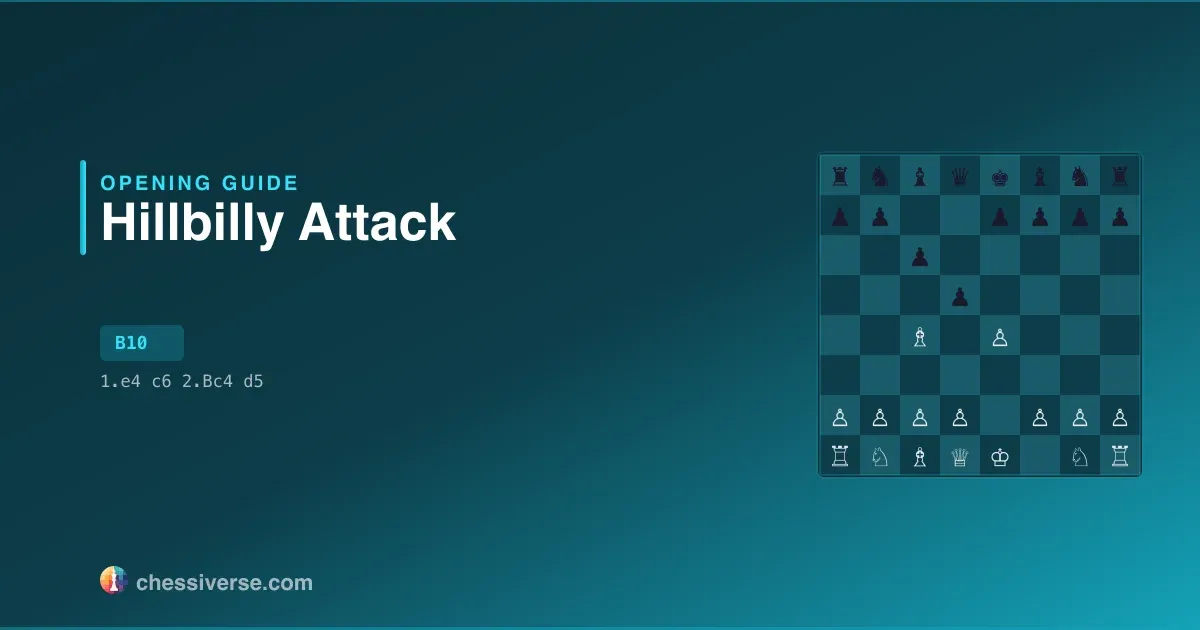
The Hillbilly Attack begins with 1.e4 c6 2.Bc4 d5 (ECO B10). The bishop takes aim at f7 on move two, bringing Scholar's Mate energy to the most solid defence in chess. One calm pawn move, 2...d5, asks the awkward question: what exactly is that bishop attacking now?
- The solid reply 2...d5 3.exd5 cxd5 kicks the bishop a second time, so White has to move it again and loses a tempo.
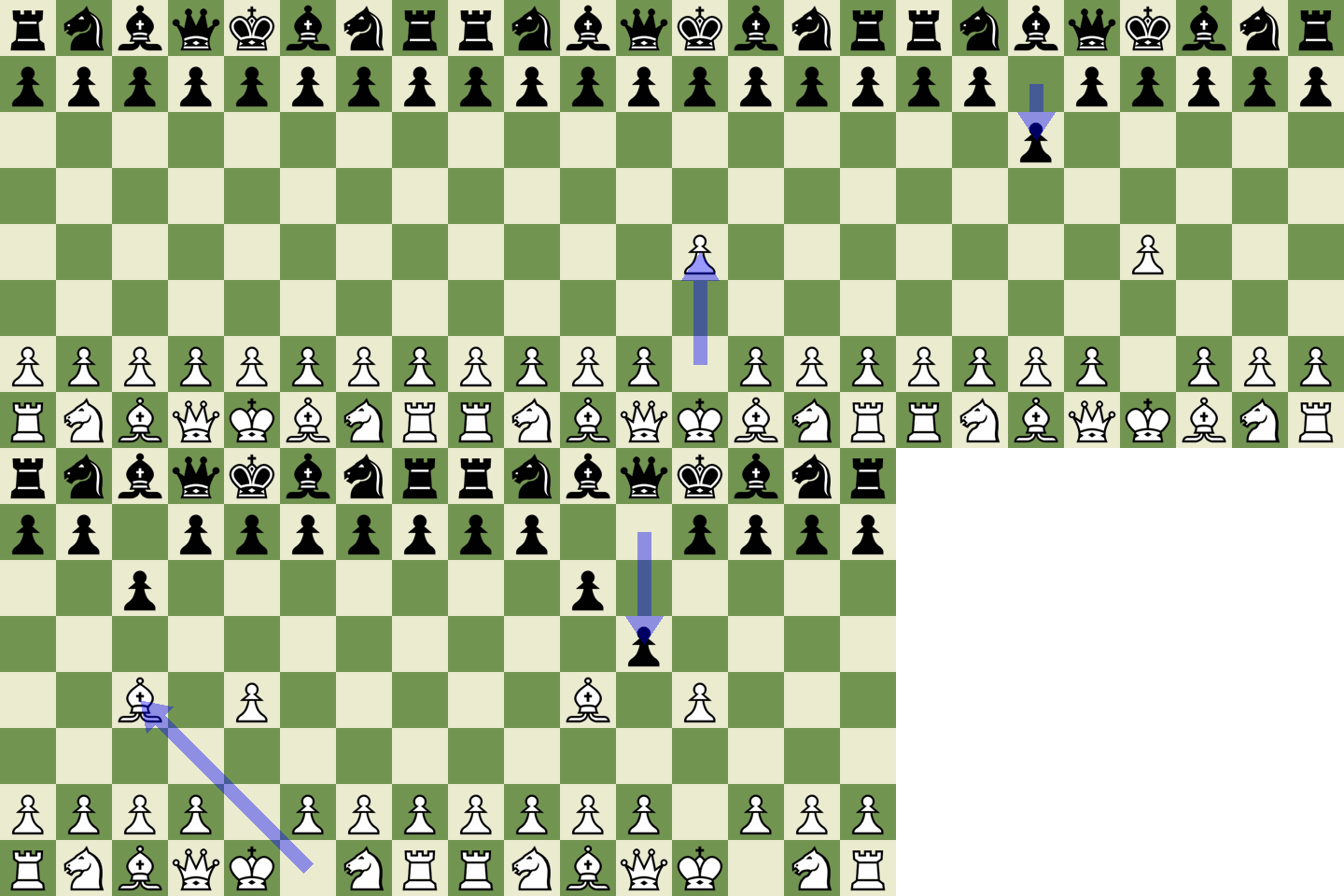
- The modern point is the 3.Bb3 gambit: if Black grabs the e4-pawn, 4.Qh5 piles on f7, defended only by the king, with sharp play.
- Black usually meets the queen sortie with ...g6 or ...e6 to blunt the threats against f7.
Strategic Overview
The Hillbilly Attack is a trap-first opening, and its problem is baked into Black's very first move: 1...c6 exists to support 2...d5, which attacks the e4-pawn and the c4-bishop at the same time. That leaves White only two consistent follow-ups. The popular 3.exd5 cxd5 trades a centre pawn for a flank pawn and attacks the bishop again, so after it retreats White has spent two tempi on a piece with little to show. The check 4.Bb5+ is comfortably met by 4...Bd7, when trading leaves Black at ease, while 4.Bb3 keeps staring at f7 without challenging anything. Every other third move either loses the bishop or admits 2.Bc4 was a waste of time.
The real Hillbilly spirit is 3.Bb3, gambiting the e4-pawn to keep the bishop aimed at f7 and follow with Qh5. It is tricky rather than sound. After 3...dxe4 4.Qh5 there is no Scholar's Mate on the board: even the careless 4...Nf6 runs into 5.Qxf7+ when the king simply steps to d7, though handing over f7 like that is nothing to volunteer for. Defend the pawn calmly, develop, and the attack burns out. The club mistakes write themselves. White keeps believing in mate long after Black has defended and falls behind in development, while Black panics at the sight of Qh5, weakens the kingside, or grabs material with the king still in the centre. Principled moves beat this opening; frightened ones lose to it.
History and Notable Players
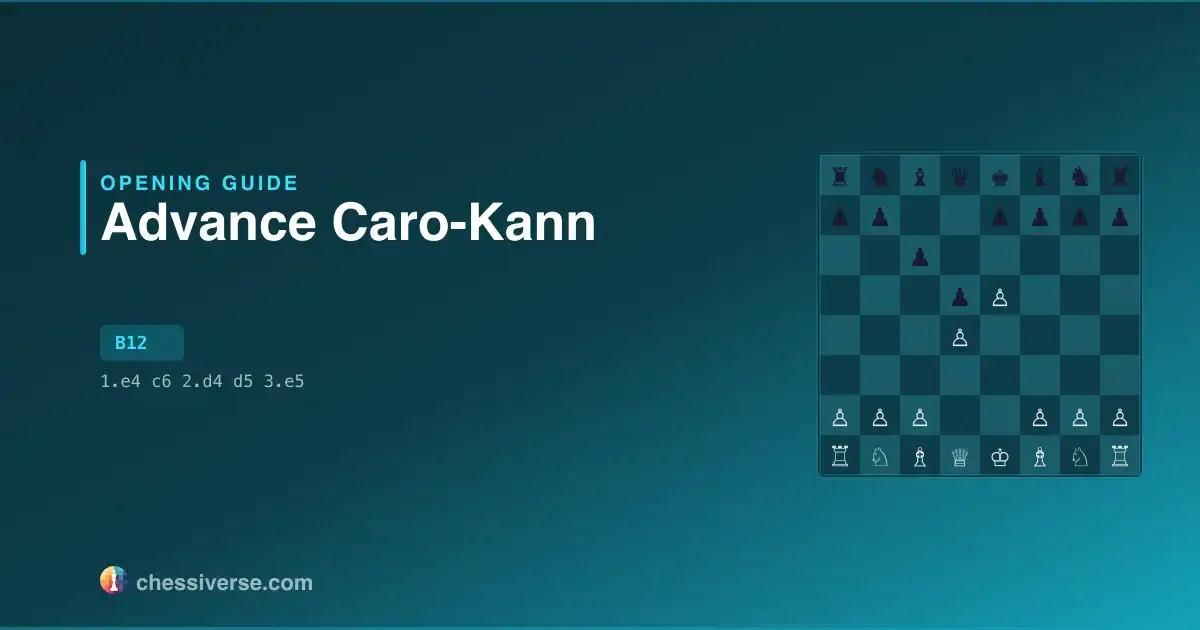
It arises from the Caro-Kann Defense.
2.Bc4 against the Caro-Kann long had a poor reputation because 2...d5 3.exd5 cxd5 forces the bishop to move again, costing White a tempo. It has resurfaced as a surprise weapon in online blitz thanks to the 3.Bb3 gambit line advocated by Simon Williams.
Notable players: Simon Williams
On paper 2.Bc4 simply loses time against the Caro-Kann, yet it thrives as an online-blitz surprise weapon: one greedy pawn grab and White's queen leaps to h5 with immediate threats against f7.
Performance Across Rating Levels
The picture changes a lot as you climb the rating ladder. The 1200 bracket has 2,408,933 games (0.36% of all games at that level); White wins 43.6%, Black 52.8%, 3.6% are drawn. At 1800 the opening surfaces in 0.22% of games; White wins 41.5%, Black 53.8%, draws 4.7%. Among 2500-rated players the line appears in 0.03% of games and draws spike to 6.8%, indicating tight preparation. White's score improves by 6.9pp from the 1200 bracket to the 2500 bracket — the line rewards preparation.
Time Control Patterns
The Hillbilly Attack skews toward rapid chess. In bullet, it appears in 0.24% of games (6,277,746); White wins 43.3%. Blitz shows 0.27% adoption across 9,597,042 games, White scoring 43.2%. In rapid, the share rises to 0.33% — 3,616,621 games, White 41.7%.
Move Diversity and Theory Depth
Looking at move selection shows how forcing — or not — the position really is. At 1200 Elo (2,408,933 games), the top reply is exd5, played 93.8% of the time. No other move reaches 5% of games, and the top three moves account for 97.8% of games. Entropy: 0.49. By 2500 (3,665 games), Bb3 takes over as the top reply at 94.1%; one other move reaches 5% and the top three moves account for 99.9% of games. Entropy drops to 0.34.
Historical Trends
Year-over-year data tells you whether this opening is a contemporary fixture or a fading one. Adoption peaked in 2025 at 0.33% (2,430,640 games). 2025 marks the high — the opening is rising, currently at 0.33%.
Common Mistakes
- Neglecting development — Extra pawn moves in the opening are tempting, especially when you "know the moves". Developing a piece each turn is the simple correction.
- Playing without a plan — Each Hillbilly Attack middlegame demands a specific approach. Decide whether the position calls for attack, manoeuvre, or simplification before reaching for a move.
Practice on Chessiverse
Ready to try the Hillbilly Attack against a bot? Pick an opponent at your level and play a game.