Dobrý den, fellow artisan! In Praha, where glass meets imagination, I temper each move as I would molten silica, slowly, carefully, with breath and patience. Shall we sit at the chequered board, share a few tempered trials, and see what colors our game might paint together? Na shledanou, for now!🎨
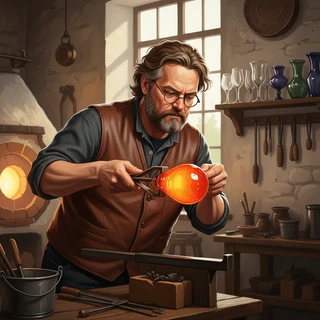
Czech Glasi is a 53-year-old glassblower from Czechia who plays at an estimated 1398 ELO, placing him squarely in the casual club bracket. Based in Praha, he spends most of his hours shaping intricate sculptures rather than studying chess theory, and his board play reflects that: he has picked up the basic principles of development and king safety through years of friendly games, but his middlegame plans wander and his endings tend to slip. As White he gravitates toward the Bishop's Opening, aiming an early bishop at f7 in the same way he aims a blowpipe at a glowing bulb of glass. Opponents can expect an opponent who enjoys lively positions, keeps pieces on the board, and treats each game as a small artisanal project rather than a calculated exercise.
How Czech plays
Czech plays in an aggressive, complicating style, preferring to keep tension on the board rather than trade pieces off. He leans toward solid, well-trodden setups instead of razor-sharp theoretical battles, and his repertoire stays close to mainstream ideas without diving deep into preparation. With White he favors the Bishop's Opening and the Queen's Gambit; against 1.d4 as Black he reaches for the Nimzo-Indian structure.
Who should play Czech
Players rated roughly 1200 to 1500 will find Czech a natural sparring partner. Because he keeps the position complicated and pushes for activity rather than trading down, opponents who want practice defending against initiative, untangling cluttered middlegames, and converting small endgame advantages against a shaky finisher will get the most from the matchup. Beginners stepping up from absolute basics can also test their opening principles here.
Frequently asked about Czech
What rating is Czech?
What opening does Czech play?
How can intermediate players use Czech to improve?