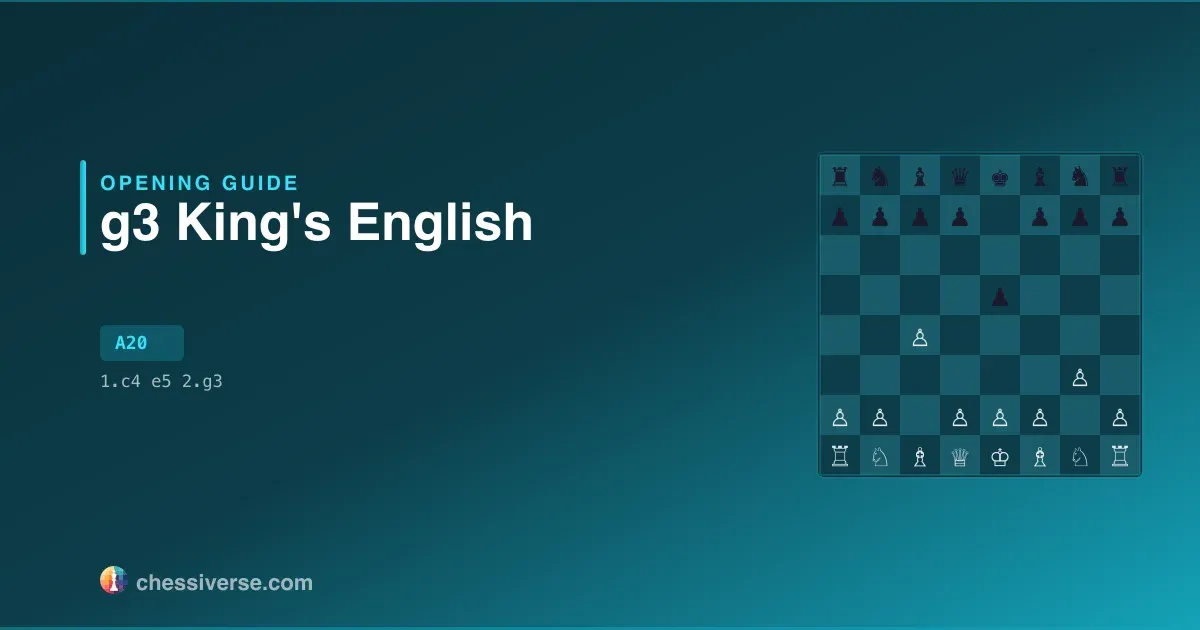
Starting from 1.c4 e5 2.g3, players enter the g3 King's English — ECO A20. After just two moves White's plan is already on the table: the bishop is heading to g2 to claim the longest diagonal on the board. The twist is that until it lands there, that same diagonal points straight at White's own rook on h1.
- After 1.c4 e5 White is effectively playing a Sicilian with colours reversed, enjoying the same setups a tempo up.
- The g3 bishop goes to g2, bearing down on the long diagonal and putting pressure on d5 to discourage Black's ...d5 break.
- White controls the centre from the flank in hypermodern style, keeping rich options to transpose into other openings.
Strategic Overview
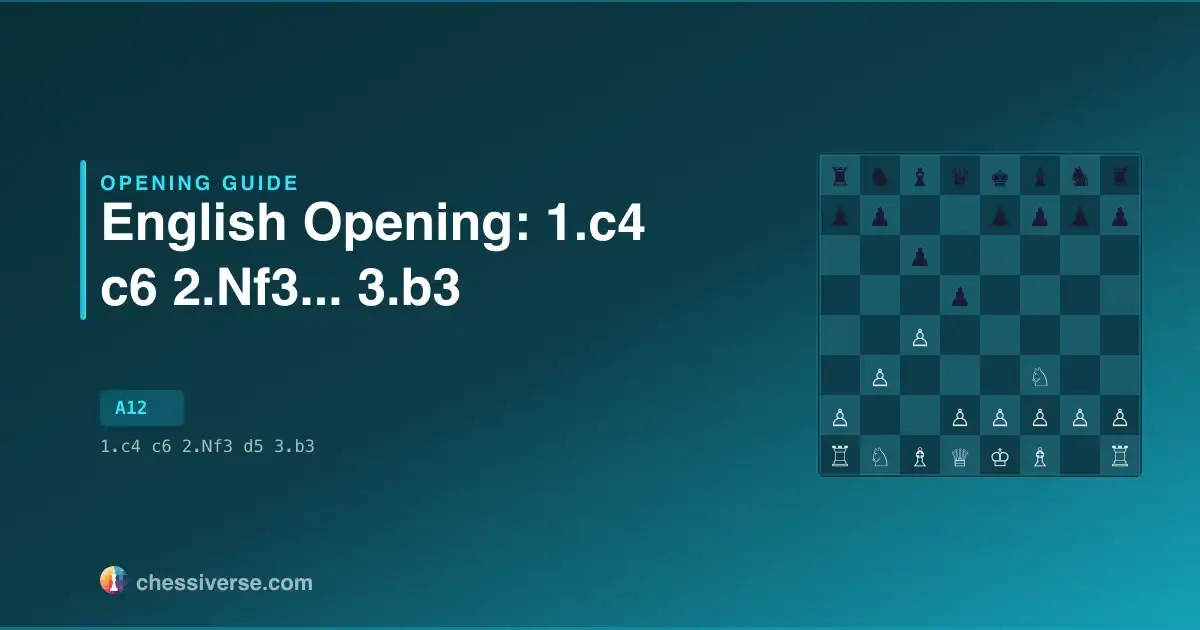
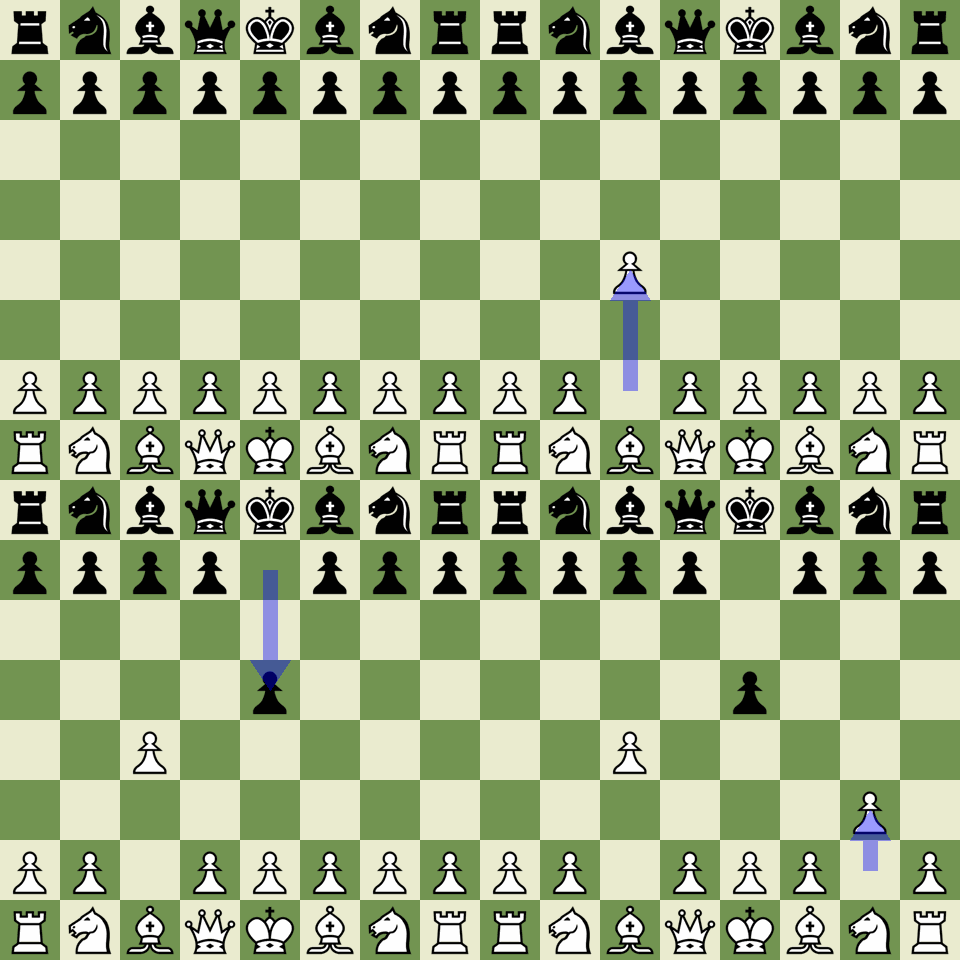
With 2.g3 White announces the plan at once: the bishop goes to g2, where it presses on d5 and stares at b7 for the rest of the game. This is the fianchetto version of the Reversed Sicilian, a full Sicilian setup played a tempo up, so familiar ideas arrive one move faster for White. The ideal game is calm: Bg2, Nf3, castle short, support the centre with d3 and Nc3, then gain space while d5 stays under permanent guard. Black has two honest ways to fight for that square anyway. The prepared 2...c6 readies ...d5 and can steer into the Reversed Alapin, where Black gains time chasing the f3-knight with ...e4. The direct 2...d5 is also sound, with a wrinkle both sides must know: after the exchange the black queen recaptures on d5 and hits the rook on h1, since the bishop has not reached g2 yet, so White must block with Nf3.
That position hides the trap this line is famous for. Pushing the e-pawn on to e4 looks active but backfires: the knight jumps to c3 with tempo on the queen, a check on a4 follows, and the e4-pawn falls. Retreating the queen to c6 keeps material level, but the pin Bb5 hangs over Black once White opens the diagonal with e3, and grabbing the f3-knight loses the queen for two minor pieces. The club lesson on both sides is the same: finish development before you go pawn hunting.
History and Notable Players
It arises from the Reversed Sicilian.
Staunton played 1.c4 in his 1843 match with Saint-Amant and at London 1851, but the opening only caught on in the twentieth century. Champions from Botvinnik to Carlsen have used it, and Bobby Fischer famously took it up in his 1972 World Championship match against Spassky.
Named after: The English Opening is named for Howard Staunton, the leading 19th-century English master who used 1.c4 in his 1843 match against Saint-Amant.
Notable players: Howard Staunton, Bobby Fischer, Garry Kasparov, Magnus Carlsen
Customarily a 1.e4 player, Bobby Fischer created a stir by switching to the English, wheeling it out against Boris Spassky in their 1972 World Championship match.
Performance Across Rating Levels
How well the g3 King's English works depends on what level you're playing at. The 1200 bracket has 917,034 games (0.14% of all games at that level); White wins 53.2%, Black 43.3%, 3.4% are drawn. Move up to 1800 Elo and the share shifts to 0.18%, with White winning 53% versus Black's 42.3%. At the top end (2500+ Elo), popularity is 0.43% with 9.5% draws — a clear sign of how much theory rules the line at master level. White's edge erodes by 6.7pp from 1200 to 2500 Elo, suggesting Black's counterplay is easier to find with experience.
Time Control Patterns
Look at the same opening across time controls and rapid stands out. In bullet, it appears in 0.11% of games (2,999,205); White wins 53.3%. Blitz shows 0.16% adoption across 5,882,882 games, White scoring 52.6%. In rapid, the share rises to 0.17% — 1,895,450 games, White 53.7%.
Move Diversity and Theory Depth
What players actually play after the opening moves depends heavily on rating. At 1200 Elo (917,034 games), the top reply is Nf6, played 29.5% of the time. Four other moves each take at least 5% of games, and the top three moves account for 64.8% of games. Entropy: 2.90. By 2500 (58,409 games), Nf6 is still the top reply, at 41.8%; only two other moves still reach 5% and the top three moves account for 83.5% of games. Entropy drops to 2.31. The narrowing is significant — strong players consolidate around a small set of best moves, while amateurs scatter across many plausible-looking options.
Historical Trends
Year-over-year data tells you whether this opening is a contemporary fixture or a fading one. Adoption peaked in 2020 at 0.19% (1,063,618 games). By 2025 it sits at 0.17%, 8% below the peak but still 204% above its 2013 level, so the line is up over the full period despite easing from the high.
Common Mistakes
- Drifting away from main theory — At 400 Elo, the three most-played moves cover 59.3% of games, against 68.7% at 2000. The most popular deviation is Bc5 (played 16.4% of the time at 400, much less so up top). It looks fine but quietly hands the better-prepared side an edge.
- Neglecting development — Extra pawn moves in the opening are tempting, especially when you "know the moves". Developing a piece each turn is the simple correction.
- Playing without a plan — Each g3 King's English middlegame demands a specific approach. Decide whether the position calls for attack, manoeuvre, or simplification before reaching for a move.
Practice on Chessiverse
Ready to try the g3 King's English against a bot? Pick an opponent at your level and play a game.