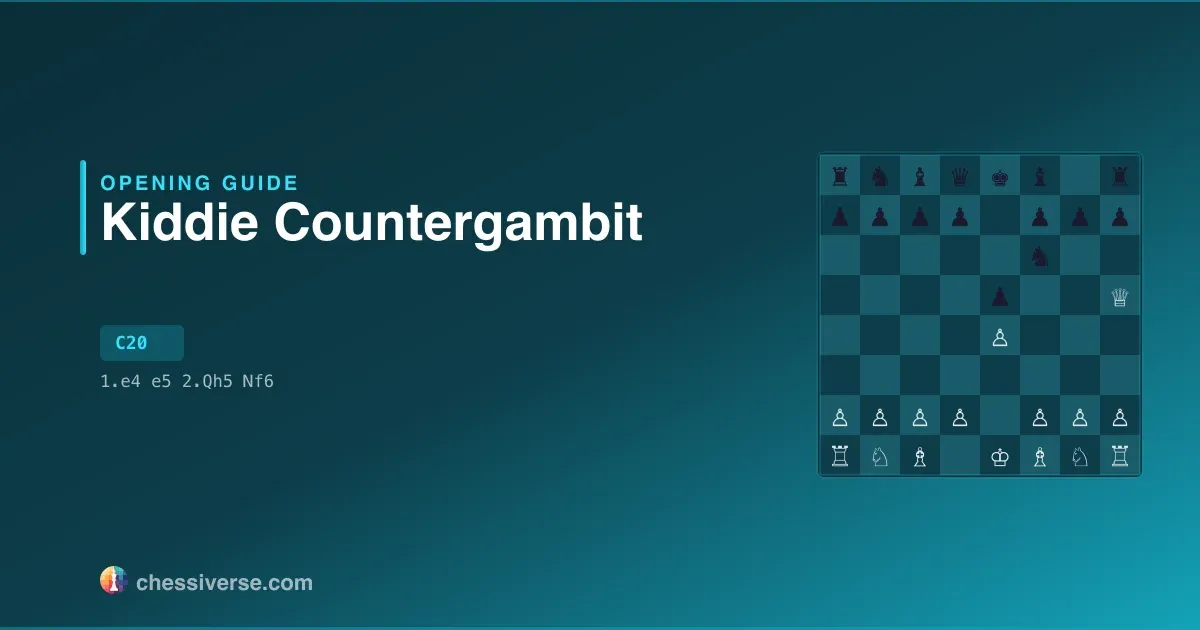
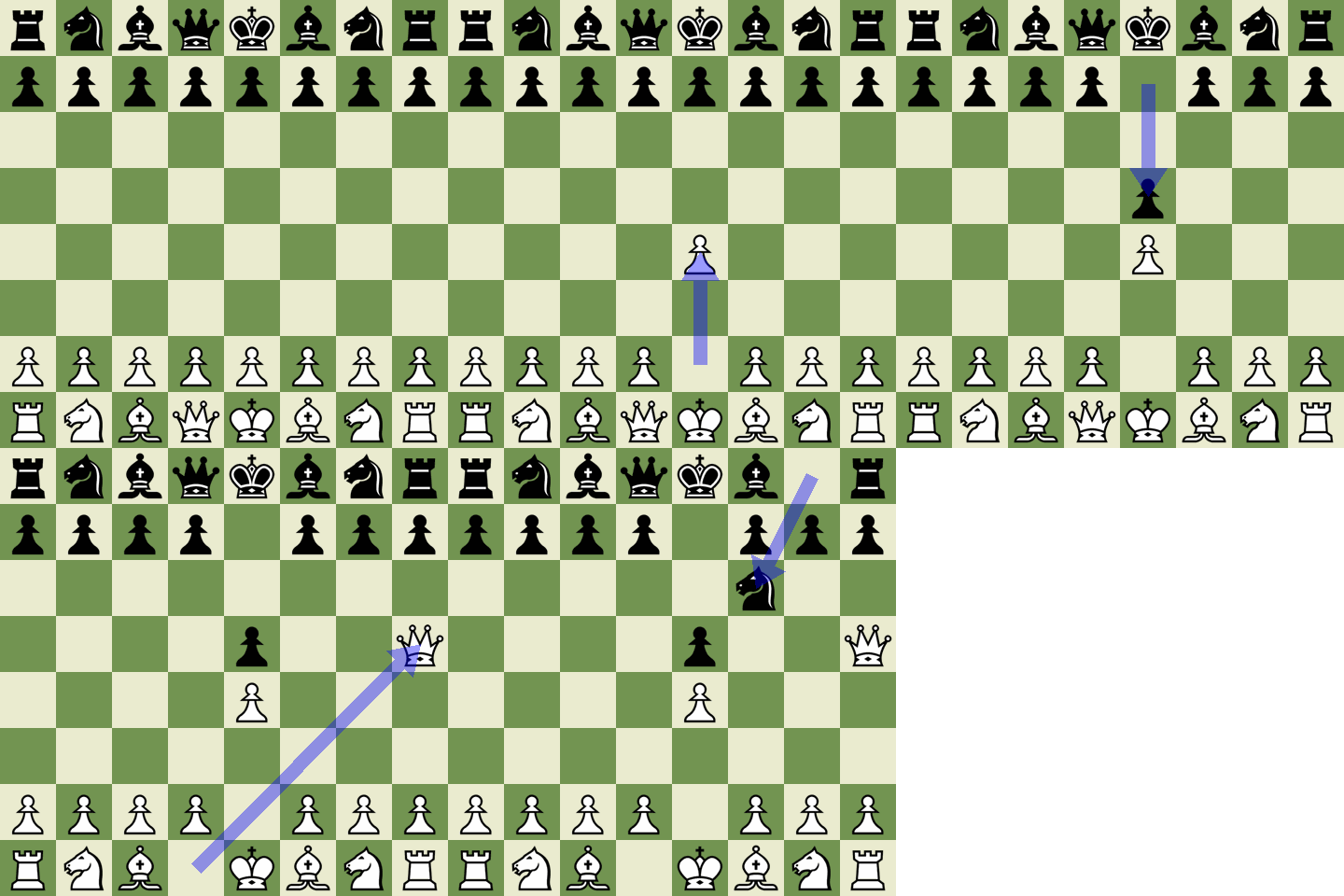
1.e4 e5 2.Qh5 Nf6 opens the Kiddie Countergambit, ECO C20. Instead of defending the e-pawn, Black attacks the queen and offers a snack: take on e5, and every Black piece comes out with tempo. It is the cheekiest answer to the Wayward Queen, for kids who have stopped fearing it.
- Black offers the e5 pawn and hits the h5 queen at once, banking on a lead in development after 3.Qxe5+ Be7
- The knight on f6 shuts down any Scholar's Mate ideas, so White's queen has no mating tricks left
- Even without the gambit White's queen must lose time anyway, so Black's pawn sacrifice is bold rather than strictly necessary
Strategic Overview
Where 2...Nc6 politely defends the e-pawn, 2...Nf6 ignores it and attacks the queen instead, chasing her off the diagonal and ending any thought of Scholar's Mate. White is invited to take: after 3.Qxe5+ Be7 blocks the check, and Black's plan is out in the open, rapid development while the white queen hunts for a safe home. A natural follow-up is ...Nc6, hitting the queen yet again, then quick castling, and suddenly every Black piece is active while White has spent three moves on the queen and developed nothing else. The name is affectionate rather than dismissive: this is the counter kids reach for once the queen raid stops scaring them, and it is genuinely playable, even though 2...Nc6 remains the more solid choice.
The tactical accounting favours Black on every point that matters. With the white bishop still on f1 there is no mating trick against f7, and if the queen goes to f3 the knight on f6 stands in the way, so there is no threat at all. Nor is there a repeat of the disaster after 2...g6, where Qxe5+ forks king and rook: here the knight and g-pawn block the long diagonal and h8 stays safe. Black's real task is urgency. A pawn down, you cannot drift, trade pieces aimlessly or make quiet pawn moves; every move should develop something or ask the queen a question. White's most common club mistake is stubborn greed, clinging to the extra pawn while the position fills up with active black pieces.
History and Notable Players
It arises from the Wayward Queen Attack.
The gambit answers the Parham Attack (also called the Danvers Opening), the early queen raid 2.Qh5 that Hikaru Nakamura defended as playable and tried in tournament games in 2005. FM Dennis Monokroussos has recommended 2...Nf6 as the psychologically right way to meet the queen sortie.
Wikipedia calls the pawn sacrifice unnecessary, since White's wandering queen loses a tempo in any case.
Performance Across Rating Levels
The picture changes a lot as you climb the rating ladder. The 1200 bracket has 1,535,027 games (0.23% of all games at that level); White wins 46.5%, Black 49.6%, 3.9% are drawn. Move up to 1800 Elo and the share shifts to 0.01%, with White winning 47.8% versus Black's 48.2%. Among 2500-rated players the line appears in 0.00% of games and draws spike to 4.1%, indicating tight preparation. White's score improves by 6.6pp from the 1200 bracket to the 2500 bracket — the line rewards preparation.
Time Control Patterns
The Kiddie Countergambit skews toward rapid chess. In bullet, it appears in 0.04% of games (1,175,491); White wins 47%. Blitz shows 0.12% adoption across 4,143,251 games, White scoring 46.3%. In rapid, the share rises to 0.28% — 3,146,667 games, White 45.8%.
Move Diversity and Theory Depth
Looking at move selection shows how forcing — or not — the position really is. At 1200 Elo (1,535,027 games), the top reply is Qxe5+, played 91.8% of the time. One other move takes at least 5% of games, and the top three moves account for 98.1% of games. Entropy: 0.56. By 2500 (147 games), Qxe5+ dominates at 93.2% of replies; no other move reaches 5% and the top three moves account for 97.3% of games. Entropy drops to 0.52.
Historical Trends
Long-term, the trajectory of this opening is informative. Adoption peaked in 2013 at 0.20% (5,805 games). By 2025 it sits at 0.12%, down 39% from that high, leaving the line in decline.
Common Mistakes
- Neglecting development — It can feel productive to make extra pawn moves early, but falling behind in piece development is what loses most amateur games — especially in open positions where active pieces find squares fast.
- Overextending the attack — Gambits look like permission to throw everything forward. They aren't — every attacking move should improve a piece. Random checks and threats burn the initiative once they fail to coordinate.
Practice on Chessiverse
Ready to try the Kiddie Countergambit against a bot? Pick an opponent at your level and play a game.