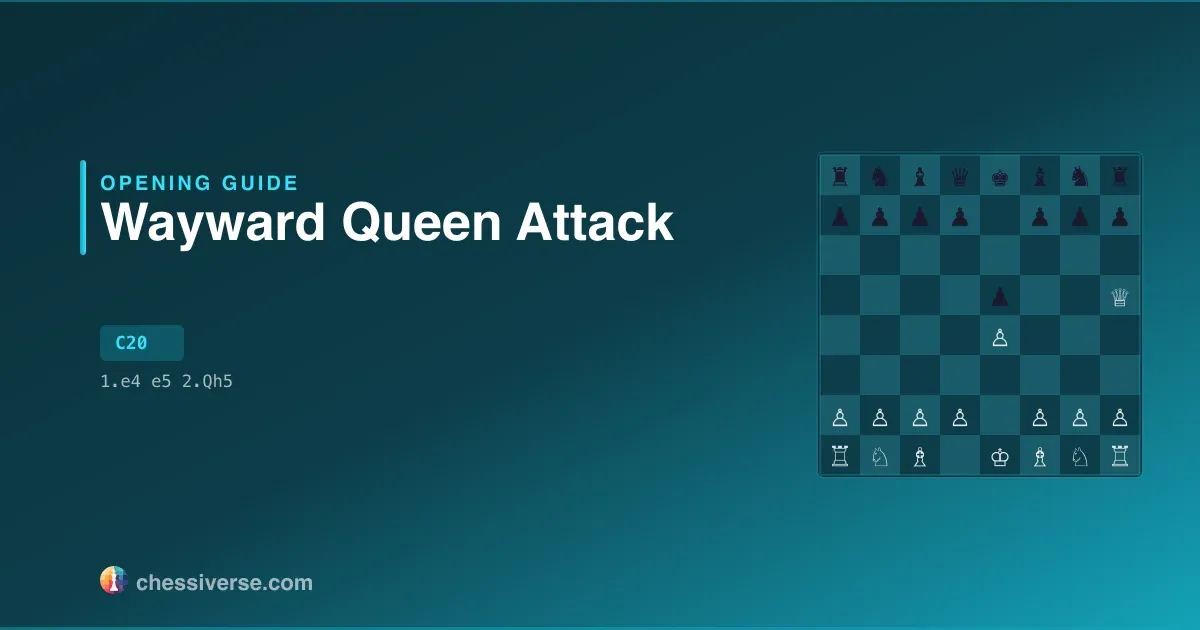
The Wayward Queen Attack begins with 1.e4 e5 2.Qh5 (ECO C20). The queen lunges out on move two, eyeing f7 and dreaming of the four-move checkmate. Every scholastic player meets it eventually, and one calm knight move starts taking the sting out.
- White aims the queen and bishop at f7, threatening a quick Scholar's Mate if Black is careless, and banks on the shock value of the early queen sortie.
- Black's most common reply is 2...Nc6, but after 3.Bc4 each defence has a drawback: 3...g6 commits the kingside, 3...Qe7 and 3...Qf6 clog Black's own pieces.
- If Black defends accurately White retreats the queen (for example Qf3 and Ne2) and settles for a roughly level game.
Strategic Overview
White's idea could not be more direct. The queen on h5 attacks the e5 pawn at once and glares at f7, the one square in Black's camp defended only by the king. The dream continuation is Bc4 next, when a careless developing move like 3...Nf6 allows Qxf7#, Scholar's Mate, the famous four-move checkmate. It pays to be precise about the real threats, though. Right after 2.Qh5 White does not yet threaten to take f7, which is attacked once and defended once, but Qxe5+ genuinely is a threat, so Black's reply must guard the e-pawn. The calm and best answer is 2...Nc6, defending e5 while developing a piece to its favourite square.
From there Black neutralises everything with natural moves that hit the queen. If White continues 3.Bc4, then ...g6 gains a tempo by blocking the h5 to f7 diagonal, and when the queen slides to f3 to renew the mate idea, ...Nf6 blocks the file while developing another piece. Two warnings for Black: never play 2...g6 immediately, because Qxe5+ forks king and rook, and keep an eye on f7 until you have castled. For White the honest accounting is that against a prepared opponent every queen move becomes a free developing move for Black, and the attack simply runs out of targets. If you have lost to this line, you are in good company, and even Magnus Carlsen has played 2.Qh5 as a surprise weapon. Learn the pattern once and it never works on you again.
History and Notable Players
It arises from the Open Games (1...e5).
The line first appeared in print in 1875, when the Dubuque Chess Journal called it the Kentucky Opening; the Danvers name came in 1905 from psychiatrist E. E. Southard, after the hospital where he worked. Bernard Parham of Indianapolis advocated it as part of his early-queen 'Matrix System', and Hikaru Nakamura played it in two tournament games in 2005, insisting the move is playable.
Named after: The 'wayward queen' is the queen itself, strolling out on move two; the line is also called the Danvers Opening and the Parham Attack, after Bernard Parham.
Notable players: Hikaru Nakamura, Bernard Parham
It has celebrity pedigree: Woody Harrelson used 2.Qh5 to draw Garry Kasparov in a 1999 Prague exhibition (with grandmaster coaching), while Boris Becker tried it against Kasparov in 2000 and was beaten in 17 moves.
Performance Across Rating Levels
How well the Wayward Queen Attack works depends on what level you're playing at. The 1200 bracket has 9,557,685 games (1.42% of all games at that level); White wins 49.7%, Black 46.2%, 4.1% are drawn. At 1800 the opening surfaces in 0.09% of games; White wins 51.2%, Black 43.9%, draws 4.8%. Among 2500-rated players the line appears in 0.02% of games and draws spike to 8.7%, indicating tight preparation.
Time Control Patterns
The Wayward Queen Attack skews toward rapid chess. In bullet, it appears in 0.25% of games (6,664,319); White wins 52.4%. Blitz shows 0.68% adoption across 24,403,391 games, White scoring 50.6%. In rapid, the share rises to 1.46% — 16,106,607 games, White 49.6%. White's score swings 2.8pp across formats, so time control isn't just a stylistic choice here — it shifts the actual results.
Move Diversity and Theory Depth
What players actually play after the opening moves depends heavily on rating. At 1200 Elo (9,557,685 games), the top reply is Nc6, played 48.9% of the time. Three other moves each take at least 5% of games, and the top three moves account for 77.5% of games. Entropy: 2.26. By 2500 (2,282 games), Nc6 dominates at 84.5% of replies; only one other move still reaches 5% and the top three moves account for 94.6% of games. Entropy drops to 1.00. That entropy collapse is the signature of a line where preparation pays off: at the top, players know the best move and play it.
Historical Trends
Year-over-year data tells you whether this opening is a contemporary fixture or a fading one. Adoption peaked in 2013 at 1.44% (41,546 games). By 2025 it sits at 0.71%, down 51% from that high, leaving the line in decline.
Main Lines and Variations
After 1.e4 e5 2.Qh5, the established follow-ups are:
Each branch leads to a different middlegame character — the resulting pawn structure decides what kind of game you get.
Common Mistakes
- Drifting away from main theory — At 400 Elo, the three most-played moves cover 68.8% of games, against 91.2% at 2000. The most popular deviation is Nf6 (played 24.6% of the time at 400, much less so up top). It looks fine but quietly hands the better-prepared side an edge.
- Neglecting development — It can feel productive to make extra pawn moves early, but falling behind in piece development is what loses most amateur games — especially in open positions where active pieces find squares fast.
- Playing without a plan — Each Wayward Queen Attack middlegame demands a specific approach. Decide whether the position calls for attack, manoeuvre, or simplification before reaching for a move.
Practice on Chessiverse
Ready to try the Wayward Queen Attack against a bot? Pick an opponent at your level and play a game.