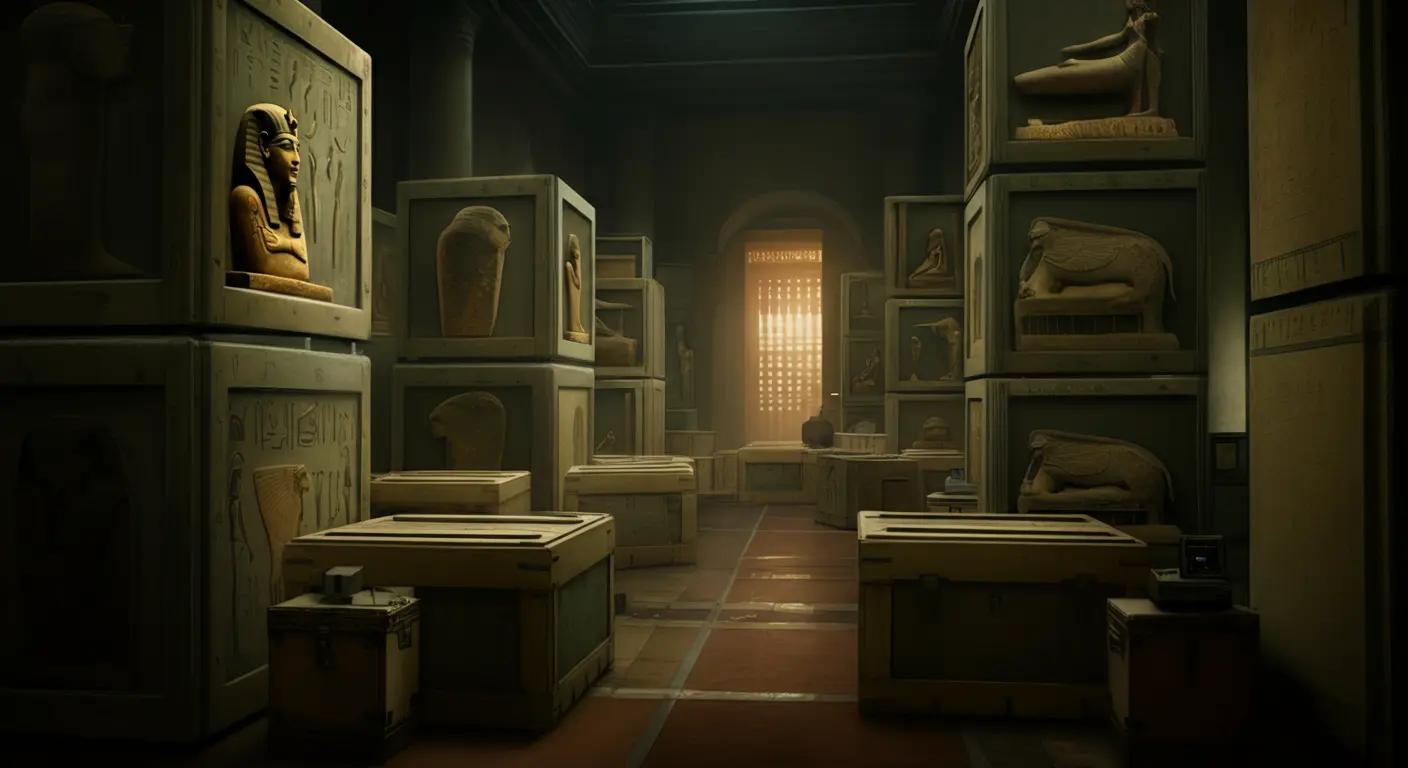
Welcome, traveler, to my hidden chamber, where every time traveler on the board whispers of Kemet's forgotten dawn, and the sands shift with each move. 🌀 Sit, sit, and let us dig, layer by layer, toward the final eclipse, for as Pharaoh Neferankhet the Unwritten said, patience outlasts the pyramids. 🔺👁 🌀
Art Tyfacts, known as Ty, is a 35-year-old museum curator from Egypt who plays his chess games from the halls of a Cairo museum. His estimated rating of 2324 places him at the candidate master to expert level, where calculation is accurate, opening preparation is deep, and most mistakes from club opponents are punished. Ty's backstory frames each game as a journey through ancient epochs, with pieces standing in for civilizations and every move marking a new age. At the board, that translates into a clear opening identity. With White he favors the Closed Sicilian, his most played opening at 645 games, along with the Vienna Game. With Black he turns to the Dragon and the King's Indian, both sharp, counterattacking systems. His lucky charm is an ancient scarab amulet, and his favorite quote treats the board as history itself. Opponents should expect a well-prepared, tactically alert player who keeps positions sharp and rarely hands over a free point.
How Ty plays
Ty plays sharp, tactical chess. His sharpness score of 0.58 shows a clear preference for double-edged lines, while slight leans toward aggression (0.12) and toward keeping tension (0.17) mean he avoids early simplification without forcing wild attacks. His opening choices sit near the middle between mainline theory and offbeat ideas. He builds pressure as White with the Closed Sicilian and counterattacks as Black with the Dragon.
Who should play Ty
Ty suits strong club players and tournament regulars rated roughly 2100 to 2450 who want a demanding test. His sharp, tension-keeping style rewards players who calculate concrete variations accurately and punishes loose moves. Players aiming for candidate master or expert status will learn the most, especially those who need practice handling Sicilian-type positions, surviving tactical complications, and converting small advantages against an opponent who rarely errs.