Pirc Defense

+33%
B001.e4 d6
Oct 6, 2027
Play this opening as...
TL;DR

One quiet pawn move sets up Black's whole counterattacking machine: ...Nf6, ...g6 and ...Bg7, without ever letting e5 kick the knight. Black trades space today for targets tomorrow. The front door to the entire Pirc family, ideal for patient players who love to punch back.

Reviewed by

IM John Bartholomew
IM John BartholomewCo-Founder & Chess Educator

International Master and chess educator. Co-founded Chessable and joined Chessiverse as co-founder. Best known for his "Climbing the Rating Ladder" YouTube series and structured opening courses.

Pirc Defense: A Complete Guide
Pirc Defense - Opening Moves
Summary

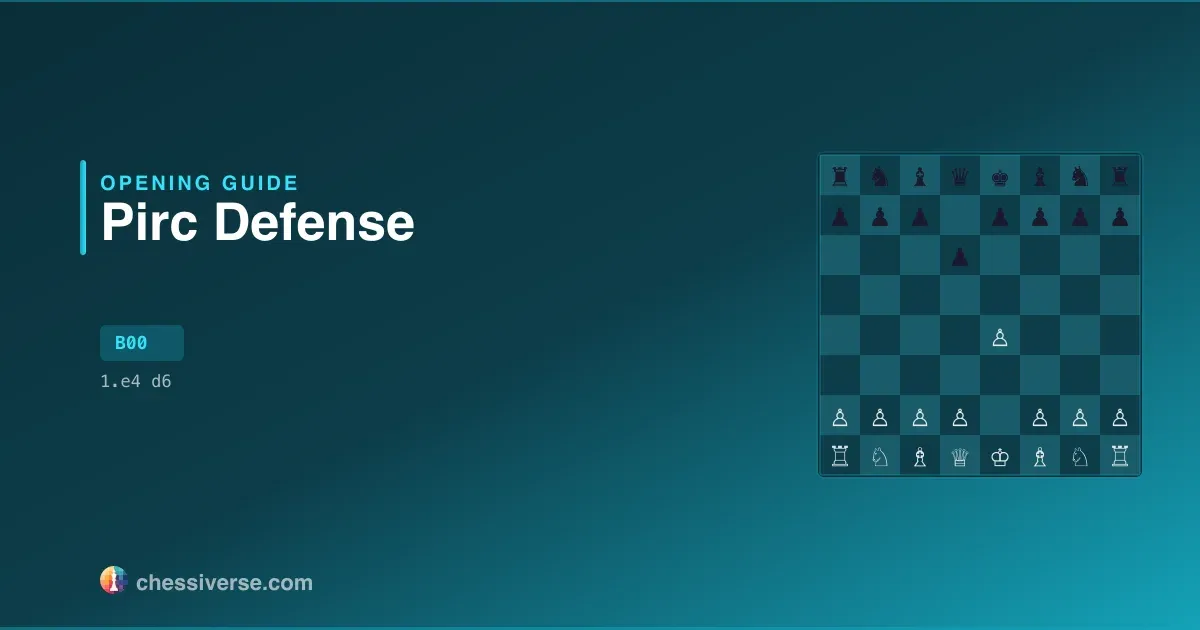
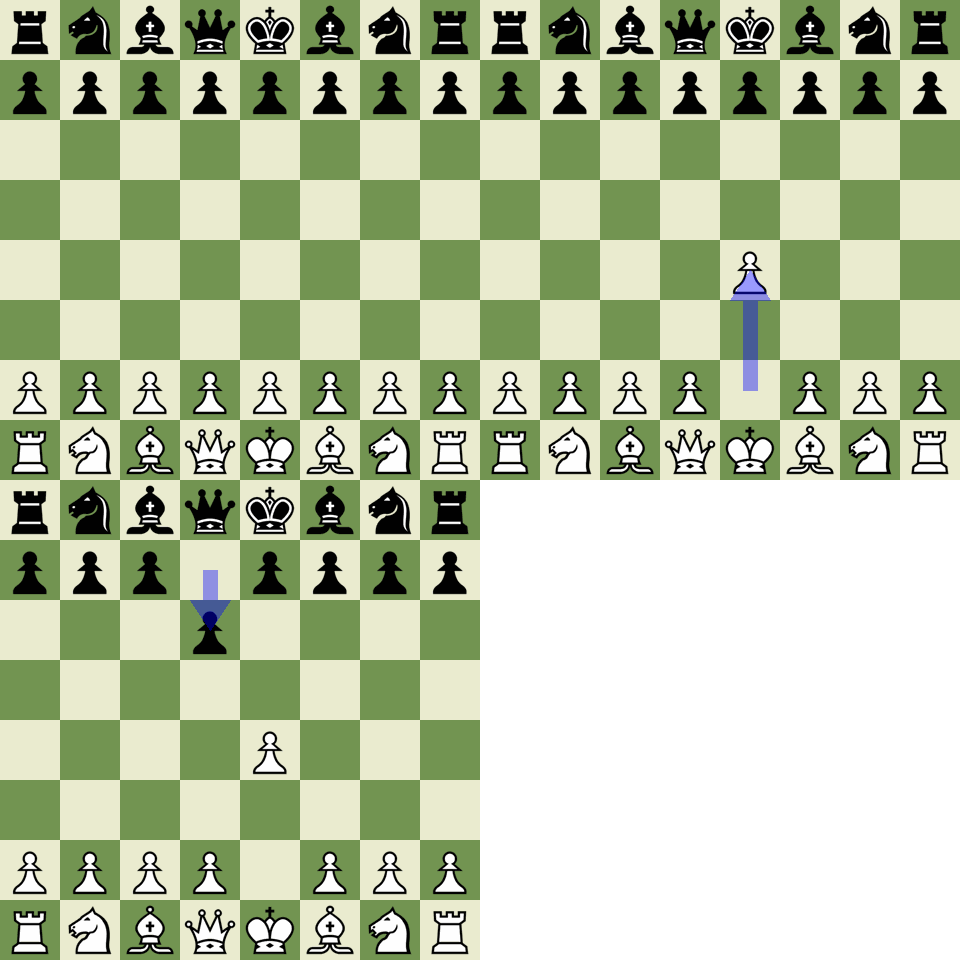
Starting from 1.e4 d6, players enter the Pirc Defense — ECO B00. 1...d6 looks like the humblest reply to 1.e4, but it is really an invitation with teeth: build your big centre, White, and Black will spend the whole game turning it into a target.

Strategic Overview

The Pirc Defense is built on a neat piece of move-order logic. Black wants a knight on f6 to pressure e4, but the immediate 1...Nf6 lets White chase it away with e5. So Black plays 1...d6 first, taking control of the e5-square, and only then develops the knight in peace. The setup continues with ...g6 and ...Bg7, castling short and aiming the bishop down the long diagonal at the very centre White is busy building. That is the hypermodern bargain: Black gives up space today, betting that the broad pawn centre becomes a target tomorrow, once the counterblows ...e5 or ...c5 arrive and the g7-bishop comes alive.

White's second move sets the tone for everything that follows. 2.d4 is played almost automatically, claiming the full centre, and ambitious players continue with Nc3 and f4, the Austrian Attack, trying to flatten Black before the counterplay begins. 2.Nf3 is the quieter road; it gives up the f4 plan, but it also hands Black a pleasant choice, since 2...c5 can steer the game into an Open Sicilian and 2...e5 into a Philidor. At club level the typical failures are mirror images of each other. White pushes pawns forward without finishing development and watches the centre collapse, while Black shuffles pieces behind the pawn chain and forgets that the counterattack is the entire point of the opening.

History and Notable Players

It arises from the King's Pawn Game.

Performance Across Rating Levels

Popularity and results vary sharply by rating level. Among 1200-rated players, it appears in 1.87% of games — 12,613,662 of them on record — with White winning 50% and Black 46%. At 1800 the opening surfaces in 2.47% of games; White wins 48.6%, Black 47%, draws 4.5%. At the top end (2500+ Elo), popularity is 2.15% with 8.9% draws — a clear sign of how much theory rules the line at master level.

Time Control Patterns

The Pirc Defense skews toward bullet chess. In bullet, it appears in 2.55% of games (67,747,871); White wins 49%. Blitz shows 2.22% adoption across 79,770,727 games, White scoring 49.1%. In rapid, the share rises to 1.99% — 22,025,620 games, White 49.7%.

Move Diversity and Theory Depth

What players actually play after the opening moves depends heavily on rating. At 1200 Elo, the top reply is d4, played 39.1% of the time. There are 4 other moves seeing meaningful share, and 83.9% of games stick to established theory. Entropy: 2.24. By 2500, d4 dominates at 84.1% of replies; only 3 viable alternatives remain and 96.4% of moves are theory. Entropy drops to 0.97. That entropy collapse is the signature of a line where preparation pays off: at the top, players know the best move and play it.

Tracking the Pirc Defense year over year shows a clear story. Adoption peaked in 2025 at 2.32% (17,198,958 games). 2025 marks the high — the opening is rising, currently at 2.32%.

Main Lines and Variations

After 1.e4 d6, the established follow-ups are:

Each branch leads to a different middlegame character — the resulting pawn structure decides what kind of game you get.

Common Mistakes

  • Drifting away from main theory — At 400 Elo, theory adherence sits at 71.7% — versus 89.4% at 2000. The most popular deviation is Nf3 (played 29.5% of the time at 400, much less so up top). It looks fine but quietly hands the better-prepared side an edge.
  • Neglecting development — It can feel productive to make extra pawn moves early, but falling behind in piece development is what loses most amateur games — especially in open positions where active pieces find squares fast.
  • Letting White own the centre — Hypermodern openings concede central space on purpose, but only if you strike back in time. Delay the counter-blow and you end up squeezed.

Practice on Chessiverse

Ready to try the Pirc Defense against a bot? Pick an opponent at your level and play a game.

Quick Facts

Main Line1.e4 d6
FENrnbqkbnr/ppp1pppp/3p4/8/4P3/8/PPPP1PPP/RNBQKBNR w KQkq - 0 2
DifficultyBeginner
Parent OpeningKing's Pawn Game
Style

Hypermodern openings let the opponent occupy the center with pawns, then attack it from the flanks with pieces and fianchettoed bishops. Control is exerted from a distance rather than by direct occupation.

101,796,347games on Lichess
49.2%
4.4%
46.4%
White wins Draws Black wins

Data from Lichess opening explorer (blitz & rapid)

Most Popular At2000
SharpnessVery Sharp

Popularity by Rating

Percentage of all games at each rating bracket that feature this opening.

Data from Lichess opening explorer (blitz & rapid games)

Theory Adherence by Rating

How often players choose the single most popular move at this position. Higher = more predictable play.

White to move after the opening line

Popularity Over Time

Share of all Lichess blitz + rapid games featuring this opening, by year.

Top Moves by Rating

White to move after the opening line

RatingMost Popular2nd3rd
400d429.6%Nf329.5%Bc412.6%
1000d436.1%Nf333.4%Bc410.9%
1200d439.1%Nf334.4%Bc410.5%
1400d442%Nf333%Bc49.6%
1600d446.9%Nf329.6%Bc47.8%
1800d455.5%Nf324.1%f46.2%
2000d466.6%Nf317.1%Nc35.6%
2200d476.9%Nf310.1%Nc37%
2500d484.1%Nc36.9%Nf35.4%

Popularity by Time Control

Bullet
2.5%67.7M
Blitz
2.2%79.8M
Rapid
2.0%22.0M
2% more decisive in bullet
Raw data tables (Lichess blitz + rapid)
Pirc Defense: popularity and win rates by player rating
Rating (Elo)Share %GamesWhite win %Black win %Draw %Sharpness
4001.914,407,17350.444.74.90.951
10001.907,956,25750.145.74.20.958
12001.8712,613,66250.046.04.00.960
14001.9217,419,20349.746.43.90.961
16002.1120,936,28349.146.84.10.959
18002.4720,771,62848.647.04.50.955
20002.8412,884,87148.446.55.10.949
22002.674,513,74148.745.06.30.937
25002.15293,52948.143.08.90.911
Pirc Defense: move-choice theory adherence by rating
Rating (Elo)Top moveTop move %Viable movesTheory %Entropy
400d429.6471.72.691
1000d436.1480.42.383
1200d439.1483.92.244
1400d442.0484.72.177
1600d446.9484.22.109
1800d455.5485.81.937
2000d466.6389.41.651
2200d476.9394.01.295
2500d484.1396.40.972
Pirc Defense: popularity over time
YearShare %GamesWhite win %Black win %Draw %
20131.7550,41452.644.03.4
20142.01181,50750.345.83.9
20151.96435,85649.546.63.9
20161.911,179,54149.146.74.1
20171.892,161,85849.046.84.2
20181.823,409,83449.146.74.2
20191.755,005,14749.246.64.2
20201.8110,385,18149.146.14.7
20211.9715,018,27149.446.14.6
20222.1115,630,91049.346.34.3
20232.1116,775,33849.246.44.4
20242.2616,856,22649.246.44.4
20252.3217,198,95849.246.44.4
Pirc Defense: popularity by time control
FormatShare %GamesWhite win %Black win %Draw %Sharpness
bullet2.5567,747,87149.048.12.90.971
blitz2.2279,770,72749.146.64.30.957
rapid1.9922,025,62049.745.64.70.953
Pirc Defense: top candidate moves by rating bracket
Rating (Elo)1st move1st %2nd move2nd %3rd move3rd %
400d429.6Nf329.5Bc412.6
1000d436.1Nf333.4Bc410.9
1200d439.1Nf334.4Bc410.5
1400d442.0Nf333.0Bc49.6
1600d446.9Nf329.6Bc47.8
1800d455.5Nf324.1f46.2
2000d466.6Nf317.1Nc35.6
2200d476.9Nf310.1Nc37.0
2500d484.1Nc36.9Nf35.4
Play this opening

Pick your side — then choose where to start.

Guided Play

Practice the Pirc Defense with a coach

John follows this exact line and grades every move — green for best, red for blunders — with hints on demand and a blunder guard watching your back.

Training Recommendations

Targeted drills using our bots' unique playstyles to sharpen your skills in this opening.

Getting Started in the Pirc Defense

beginner

Finn Laserson, a versatile Mediator, plays the position on its merits, while attacking Savage Vito Enfilade is most dangerous when positions get messy. Practice at the beginner level to learn the patterns by playing them.

Cementing the Basics in the Pirc Defense

novice

Terry Cotta plays sharply — an aggressive Savage who lives for complications, while gao Shan is an all-round Mediator comfortable across position types. Good fit if the basic ideas are clear but the middlegame still surprises you.

Stepping Up in the Pirc Defense

intermediate

Elo Must is an all-round Mediator comfortable across position types, while chen Noodle is an aggressive Savage who thrives in tactical chaos. A solid step up when the textbook lines stop being enough.

Pressure Test in the Pirc Defense

skilled

Attacking Hunter Ford Ward forces the position, then simplifies once the initiative bites, while sue Chef plays patiently — a defensive Guardian who cuts down the position. Practice at the skilled level to test your preparation under pressure.

♟️

No-Quarter Sparring in the Pirc Defense

advanced

Pawnelia March defends with depth — a defensive Observer who welcomes complications, while dee Feated, a versatile Mediator, plays the position on its merits. Drill here when you want responses that punish small inaccuracies.

Frequently Asked Questions

What is the Pirc Defense?

The Pirc Defense begins with 1.e4 d6 and is classified under ECO code B00. The Pirc defence is a hypermodern response to 1.

Is the Pirc Defense good for beginners?

The Pirc Defense can be played at any level. Beginners should focus on understanding the key strategic ideas rather than memorizing long theoretical lines. Our AI bots at various rating levels provide a great way to practice the opening concepts.

What are the main variations of the Pirc Defense?

The main continuations include: Pirc Defense. Each variation leads to distinct types of positions with their own strategic themes.

What are the win rates for the Pirc Defense?

In a database of 173,333,365 master games, White wins 49.1% of the time, Black wins 47.1%, and 3.8% are drawn.

Reviewed by

IM John Bartholomew
IM John BartholomewCo-Founder & Chess Educator

International Master and chess educator. Co-founded Chessable and joined Chessiverse as co-founder. Best known for his "Climbing the Rating Ladder" YouTube series and structured opening courses.

Practice This Opening on Chessiverse

Play against 1000+ AI bots with unique personalities and opening repertoires. From beginner-friendly to grandmaster-level opponents, find the perfect sparring partner for any opening.

Play Now

Not sure which opening fits you? Take the free chess personality test — your style determines which openings will work with you.

Back to Articles