
Vienna Game: Max Lange Defense

Popularity increased 191% since 2013

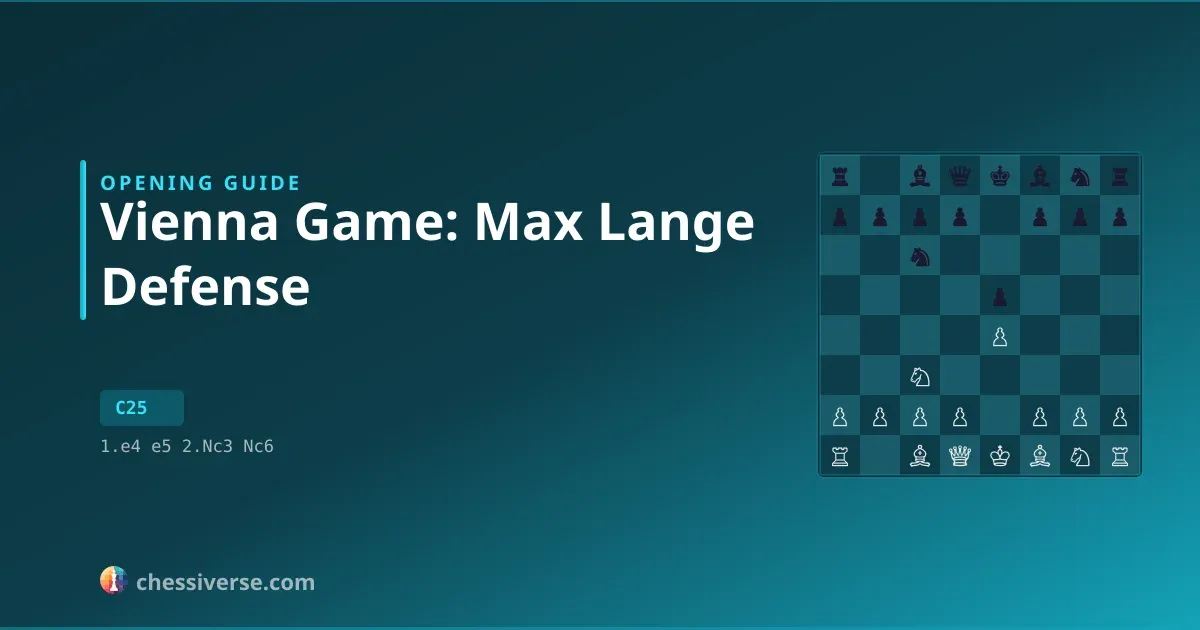
C251.e4 e5 2.Nc3 Nc6

Nov 24, 20265 min read

TL;DR Black answers 2.Nc3 with the mirror move 2...Nc6, so e5 is defended before White can strike at it. White picks between 3.Bc4, the Vienna Gambit 3.f4, the quiet Paulsen Variation 3.g3, or 3.Nf3, which transposes to the Three Knights Game. The line Black has to know is 3.Bc4 Bc5 4.Qg4, where the natural 4...Qf6? loses to 5.Nd5.

Vienna Game: Max Lange Defense: A Complete Guide
Vienna Game: Max Lange Defense - Opening Moves

Summary

The Vienna Game: Max Lange Defense arises after 1.e4 e5 2.Nc3 Nc6 and falls under ECO code C25. Black mirrors White's knight, so e5 is defended before White's f4 can attack it. It is Black's second most common answer to the Vienna Game, after the Falkbeer Variation (2...Nf6), and it leads to very different games depending on White's third move.

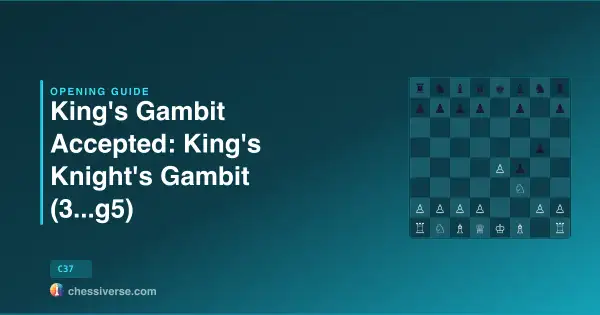
  • 3.f4 exf4 turns the game into a King's Gambit with the knights already on c3 and c6: 4.Nf3 g5 invites sacrifices on f3 and f7, and 4.d4 Qh4+ 5.Ke2 is the Steinitz Gambit.
  • 3.Bc4 is White's most common reply; 3...Nf6 is the solid answer, while 3...Bc5 runs into 4.Qg4, and the natural 4...Qf6?? loses to 5.Nd5.
  • 3.g3, the Paulsen Variation, fianchettoes the bishop for a slow positional game, and 3.Nf3 transposes to the Three Knights Game.

Strategic Overview

Against 2...Nc6, White has four main plans:

  • 3.Bc4 aims the bishop at f7 and keeps f4 in reserve.
  • 3.f4 is the Vienna Gambit: White gives a pawn for the centre and an open f-file, as in the King's Gambit, but with both queen's knights already developed.
  • 3.g3, the Paulsen Variation, is the slow, positional choice.
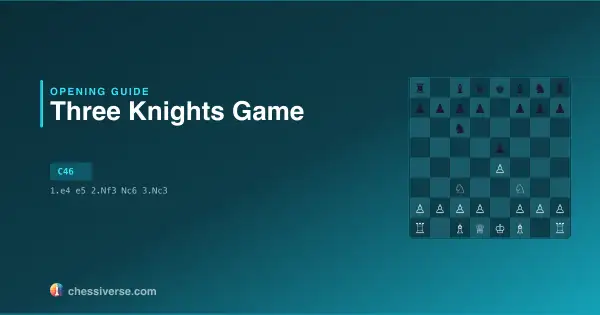
  • 3.Nf3 transposes to the Three Knights Game.

Black's knight on c6 defends e5 and supports ...Nd4 in some lines, but it does not fight for e4 or d5 the way 2...Nf6 does. In return, Black keeps the option of ...Bc5 and ...f5 set-ups, and in the Vienna Gambit Black can grab the pawn with 3...exf4 knowing the knight on c6 will help defend.

History and Notable Players

It arises from the Vienna Game. The traditional name "Vienna Gambit" belongs to this line, 2...Nc6 3.f4, although it is now also used for 2...Nf6 3.f4 in the Falkbeer Variation.

After 3.f4 exf4, Steinitz's 4.d4 Qh4+ 5.Ke2 put White's king in the open on purpose, while 4.Nf3 g5 leads to the Hamppe-Allgaier, Hamppe-Muzio and Pierce Gambits, where White often gives up a knight for the attack. Louis Paulsen won three games with 3.g3 at Vienna 1873, and that quieter line now carries his name.

Named after: Max Lange, the 19th-century German master and chess writer.

Notable players: Wilhelm Steinitz, Louis Paulsen, Carl Hamppe

Statistics

Based on 58.8 million Lichess games across all rating levels:

  • White wins: 50.8%
  • Black wins: 45.5%
  • Draws: 3.7%

The line is most popular at club level and becomes rarer as ratings rise: it appears in 0.90% of games at 400 and only 0.27% at 2500 and above. White's score climbs slightly with rating, from 49% at 400 to 51.3% at 2000, before falling back to 46.9% at 2500, where 9.7% of games are drawn. Bullet players use it most (1.01% of bullet games, White 51.3%), ahead of blitz (0.69%) and rapid (0.59%, White 49.6%). Its share of Lichess games has nearly tripled since 2013, from 0.24% to 0.70% in 2025.

Master games tell a different story. In 2,054 games from the Lichess masters database, White wins 32.5%, Black 27.7%, and 39.8% end in a draw.

Main Lines and Variations

After 1.e4 e5 2.Nc3 Nc6, the main continuations are:

  • 3.Nf3 is the most played move on Lichess (41.5%). It transposes to the Three Knights Game, and 3...Nf6 leads to the Four Knights.
  • 3.Bc4 (27.9%) is White's most common move in master games. Black's solid answer is 3...Nf6, which transposes to the Vienna Game: Stanley Variation, Three Knights Variation; 4.d3 then gives the Berlin-Vienna Hybrid. 3...Bc5, the Symmetrical Variation, invites 4.Qg4 (see below).
  • 3.f4 exf4, the Vienna Gambit, is played in 11.2% of Lichess games and 18.9% at 2500 and above. 4.d4 is the Steinitz Gambit (4...Qh4+ 5.Ke2). After 4.Nf3 g5, White has three sharp gambits: the Hamppe-Allgaier, 5.h4 g4 6.Ng5, where the knight is given up on f7; the Hamppe-Muzio, 5.Bc4 g4 6.O-O, giving up the knight on f3; and the Pierce Gambit, 5.d4. Black does not have to take: 3...d6, 3...Nf6 and 3...Bc5 decline the pawn.
  • 3.g3, the Paulsen Variation, fianchettoes the king's bishop. Black's most common answer among masters is 3...Bc5. It is rare at club level (1.4% at 1200) but 12% at 2500 and above.

Common Mistakes to Avoid

  • Meeting 4.Qg4 with 4...Qf6: After 3.Bc4 Bc5 4.Qg4 the queen attacks g7. 4...Qf6, the natural way to defend it, is Black's most common reply (42.1%), but 5.Nd5 attacks the queen and c7. 5...Qxf2+ 6.Kd1 leaves White's king safe enough and White threatening Qxg7, Nxc7+ and a queen trap. White scores 67.5% after 4...Qf6. Wikipedia names 4...Kf8 and 4...g6 as the best replies, and 4...Kf8 holds level on Lichess (Black 48.2%).
  • Walking into 4.Qg4 at all: 3...Bc5 is played in 26.6% of games after 3.Bc4, and 4.Qg4 is White's most common answer to it, scoring 62.4% for White. 3...Nf6 avoids it and is the most common reply (48%).
  • Grabbing the f4 pawn without a plan: After 3.f4 exf4 4.Nf3, the King's Gambit move 4...g5 holds the pawn but opens the door to the Hamppe-Allgaier and Hamppe-Muzio sacrifices. If you play it, know those lines; otherwise develop with 4...Nf6 or 4...d6.

Practice on Chessiverse

Ready to try the Vienna Game: Max Lange Defense against a bot? Pick an opponent at your level and play a game.

Play the Vienna Game: Max Lange Defense

Play As
Start From

After 1.e4 e5 2.Nc3 Nc6 Pick the position up and play on from there.

Opponent

No account needed — your game saves if you sign up after.

Want the full game experience — enter the game arena!

Quick Facts

Games on Lichess
31,342,469
Most Popular At
400
Sharpness
Sharp
Scored as part of the Vienna Game family
Main Line
1.e4 e5 2.Nc3 Nc6
FEN
r1bqkbnr/pppp1ppp/2n5/4p3/4P3/2N5/PPPP1PPP/R1BQKBNR w KQkq - 2 3
Parent Opening
Vienna Game
Named After
Max Lange
Style
Romantic

White wins 50.2%, draws 4.3%, Black wins 45.5%.

Data from Lichess opening explorer (blitz & rapid)

Romantic
Romantic openings prioritize piece activity, open lines, and direct attacks on the king over material considerations. They echo the swashbuckling style of 19th-century chess masters.

Popularity by Rating

Popularity view

It's played most at 400: about 1 in 110 games there, against 1 in 370 games at 2500. At 1200, White wins 50% and Black 46%; at 2500 it's 47% to 44%, with more draws (10%).

Percentage of all games at each rating bracket that feature this opening.

Data from Lichess opening explorer (blitz & rapid games)

Theory Adherence by Rating

Theory adherence view

At 1200, White's most common reply is 3.Nf3 (44% of games), with four other moves each played in at least 1 in 20 games. At 2500, 3.Bc4 takes over (40%).

How often players choose the single most popular move at this position. Higher = more predictable play.

White to move after the opening line

Popularity Over Time

It's nearly three times as popular as in 2013: about 1 in 140 games in 2025, up from 1 in 420 games.

Share of all Lichess blitz + rapid games featuring this opening, by year.

Top Moves by Rating

White to move after the opening line

Top moves by rating
RatingMost Popular2nd3rd
4003.Nf353%3.Bc420.2%3.d36.8%
10003.Nf348.8%3.Bc425.6%3.f46.2%
12003.Nf344.1%3.Bc430.4%3.f47.7%
14003.Nf340%3.Bc433.7%3.f48.8%
16003.Bc436.4%3.Nf335.4%3.f410.9%
18003.Bc437.4%3.Nf330.5%3.f414.9%
20003.Bc436.7%3.Nf324.6%3.f421.1%
22003.Bc437.5%3.f422.7%3.Nf319.5%
25003.Bc439.9%3.g322.8%3.Nf319.3%

Popularity by Time Control

The faster the game, the more it's played: about 1 in 99 bullet games, against 1 in 170 rapid games.

  • Bullet1.0%26.8M
  • Blitz0.69%24.8M
  • Rapid0.59%6.6M

2% more decisive in bullet

Raw Data Tables (Lichess Blitz + Rapid)
Vienna Game: Max Lange Defense: popularity and win rates by player rating
Rating (Elo)Share %GamesWhite win %Black win %Draw %Sharpness
4000.902,069,38549.046.24.80.952
10000.843,531,80749.146.64.30.957
12000.795,342,69449.746.34.00.960
14000.736,677,44150.146.04.00.960
16000.646,335,98050.745.14.20.958
18000.554,599,54551.144.44.50.955
20000.472,108,28051.343.75.00.950
22000.38640,20251.142.56.40.936
25000.2737,13546.943.59.70.903
Vienna Game: Max Lange Defense: move-choice theory adherence by rating
Rating (Elo)Top moveTop move %Viable movesTheory %Entropy
4003.Nf353.0480.02.257
10003.Nf348.8580.52.233
12003.Nf344.1582.22.217
14003.Nf340.0582.52.235
16003.Bc436.4482.72.275
18003.Bc437.4482.82.326
20003.Bc436.7482.42.319
22003.Bc437.5479.72.204
25003.Bc439.9482.02.071
Vienna Game: Max Lange Defense: popularity over time
YearShare %GamesWhite win %Black win %Draw %
20130.246,91651.145.63.3
20140.2219,88751.045.33.7
20150.2963,68950.545.63.9
20160.29179,38149.946.14.0
20170.30340,79749.946.04.2
20180.34645,02749.746.04.3
20190.391,105,95749.746.04.3
20200.452,565,12149.745.74.6
20210.594,506,68750.245.44.4
20220.634,655,61550.445.44.2
20230.715,636,33750.245.54.3
20240.685,079,37550.345.44.3
20250.705,178,48850.345.44.3
Vienna Game: Max Lange Defense: popularity by time control
FormatShare %GamesWhite win %Black win %Draw %Sharpness
bullet1.0126,806,34751.345.63.00.970
blitz0.6924,772,89250.445.44.30.957
rapid0.596,569,57749.645.94.50.955
Vienna Game: Max Lange Defense: top candidate moves by rating bracket
Rating (Elo)1st move1st %2nd move2nd %3rd move3rd %
4003.Nf353.03.Bc420.23.d36.8
10003.Nf348.83.Bc425.63.f46.2
12003.Nf344.13.Bc430.43.f47.7
14003.Nf340.03.Bc433.73.f48.8
16003.Bc436.43.Nf335.43.f410.9
18003.Bc437.43.Nf330.53.f414.9
20003.Bc436.73.Nf324.63.f421.1
22003.Bc437.53.f422.73.Nf319.5
25003.Bc439.93.g322.83.Nf319.3

Frequently Asked Questions

Vienna Game: Max Lange Defense

What is this opening?

This opening begins with 1.e4 e5 2.Nc3 Nc6 and is classified under ECO code C25. Black develops the queen's knight to defend e5, and White chooses between 3.Bc4, the Vienna Gambit 3.f4, the Paulsen Variation 3.g3 and 3.Nf3, the Three Knights Game.

Is this opening good for beginners?

Yes, as long as you know one trap. After 3.Bc4 Bc5 4.Qg4, the natural 4...Qf6 loses to 5.Nd5, and Black scores only 30.5% after it on Lichess. 3...Nf6 against 3.Bc4 avoids the problem altogether. Practice against our bots to get used to both sides of the Vienna Gambit.

What are the main variations of this opening?

The main continuations are 3.Bc4 (3...Nf6 transposes to the Vienna Game: Stanley Variation, Three Knights Variation), the Vienna Gambit 3.f4 exf4 with the Steinitz Gambit 4.d4 and the Hamppe-Allgaier, Hamppe-Muzio and Pierce Gambits after 4.Nf3 g5, the Paulsen Variation 3.g3, and 3.Nf3, which transposes to the Three Knights Game.

What are the win rates for this opening?

Across 58.8 million Lichess games, White wins 50.8% of the time, Black wins 45.5%, and 3.7% are drawn. In 2,054 master games the result is far more balanced: White wins 32.5%, Black 27.7%, and 39.8% are drawn.

Sources

Brought to you by

IM John BartholomewCo-Founder & Chess Educator

International Master and chess educator. Co-founded Chessable and joined Chessiverse as co-founder. Best known for his "Climbing the Rating Ladder" YouTube series and structured opening courses.

Practice This Opening on Chessiverse

Play against 1000+ AI bots with unique personalities and opening repertoires. From beginner-friendly to grandmaster-level opponents, find the perfect sparring partner for any opening.

Not sure which opening fits you? Take the free chess personality test — your style determines which openings will work with you.

Back to Articles